



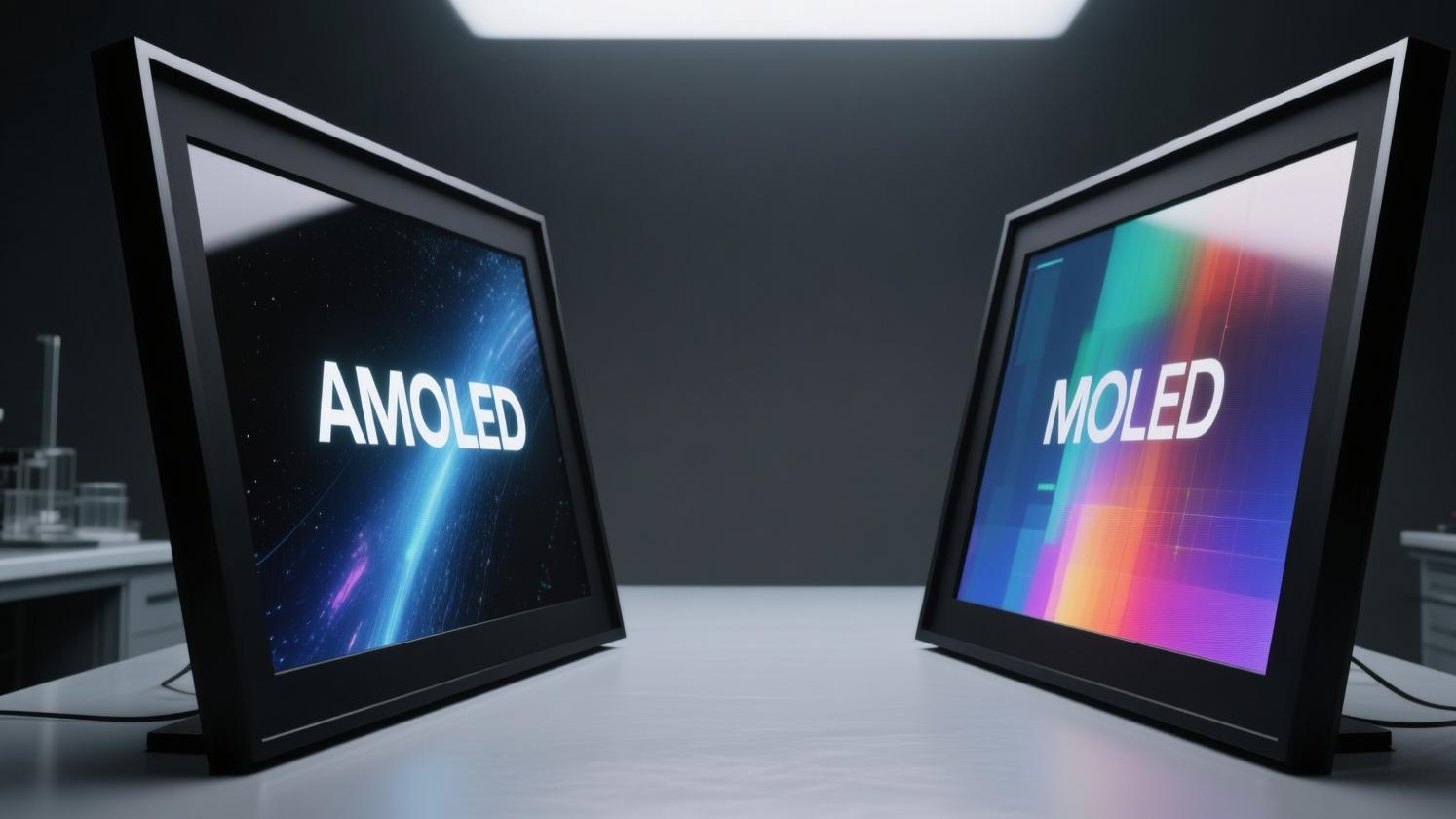
AMOLED vs PMOLED | Key Differences, Price & Use
AMOLED relies on a TFT active matrix to achieve an ultra-fast response time of less than 1ms, making it the preferred choice for high-definition large screens;
PMOLED features a simple structure and low cost, but is limited to miniature displays under 3 inches.
Key Differences
AMOLED uses TFT circuits, where each pixel is equipped with a capacitor and a transistor, allowing it to maintain a continuous light-emitting state.
PMOLED relies on row and column intersection pulse power supply; pixels only emit light at the instant the current is conducted.
Because the lighting time of PMOLED pixels scales down as the number of rows increases, instantaneous high voltages of 15V to 20V must be applied to large screens to ensure brightness.
This results in PMOLED sizes usually being restricted to under 3 inches.
In contrast, AMOLED can support screens of over 6 inches or even up to 100 inches, easily reaching resolutions above 500 PPI with refresh rates maintained between 60Hz and 144Hz.
Current Control Mode
In this mode, the display is composed of horizontal row electrodes and vertical column electrodes crossing each other, with organic light-emitting material sandwiched in between.
To light up a specific pixel, the control circuit needs to apply a high potential to the corresponding row line and a low potential to the corresponding column line.
Under this method, pixels have no memory function; they only emit light at the moment current flows through them.
To make the entire screen appear constantly lit, the controller must continuously scan every row from top to bottom at high speed.
If a PMOLED screen has 128 rows, the lighting time allocated to each row of pixels during one frame display cycle is only 1/128th of the total time—a ratio typically referred to as the duty cycle.
To compensate for the extremely short lighting time, the control circuit must inject extremely high current into the pixels instantaneously to generate a peak brightness high enough to ensure that the average brightness perceived by the human eye reaches a usable level.
- The instantaneous voltage of PMOLED is usually maintained between 15V and 20V.
- Peak brightness often needs to reach 100 to 200 times the average brightness or more.
- Increasing the number of rows further reduces the duty cycle, forcing instantaneous current to surge in a non-linear fashion.
- Joule heat generated by high voltage accumulates in the organic material layer, leading to a significant decay in luminous efficiency after 3,000 to 5,000 hours of continuous operation.
Due to the lack of an independent current regulation mechanism, the display effect of PMOLED is limited by the resistance of the physical wiring.
When the screen size increases, the length of the wires increases, making the voltage drop due to resistance very obvious.
This causes non-uniform brightness between the top and bottom of the screen or visible horizontal stripes.
To alleviate this current pressure, the resolution of PMOLED is usually limited to very low levels, such as 128 x 64 or 96 x 16.
If one attempts to use this passive drive on a screen with 240 rows, to achieve an average brightness of 100 nits, the peak brightness of a single pixel might need to hit 24,000 nits.
This extreme current load would instantly puncture the organic film or cause the driver chip to burn out due to excessive heat.
Therefore, the physical ceiling for passive driving is generally under 3 inches.
The control mode of AMOLED is completely different. It places a complex Thin Film Transistor (TFT) circuit under every single pixel.
The most basic AMOLED pixel circuit contains two transistors and one storage capacitor. The first transistor acts as a switch, responsible for the entry of control signals.
The second transistor acts as a constant current source, responsible for directly driving the OLED to emit light. The storage capacitor serves to maintain the electrical signal.
When the row line signal opens the switching transistor, the voltage signal on the column line enters the interior of the pixel and is stored in the capacitor.
Even when the scanning for that row ends and the switching transistor closes, the charge in the capacitor can still maintain the "on" state of the driving transistor.
This allows every pixel to emit light continuously throughout the duration of a frame.
Because it no longer requires instantaneous high voltage to compensate for the passage of time, the driving voltage of AMOLED can be reduced to around 3.3V to 5V.
- 2T1C Structure: Composed of two Transistors and one Capacitor, this is the minimum threshold for achieving active control.
- Continuous Luminous Characteristic: Pixels work 100% of the frame time, eliminating the need for high-voltage pulses and significantly reducing organic material wear.
- Low Voltage Operation: Typically uses 3V to 4.6V DC power supply, which perfectly aligns with the lithium battery voltage of modern smart devices.
- Material Lifespan: Due to steady working conditions, the decay speed of blue light materials and red/green materials is several times slower than that of PMOLED.
To solve the non-uniformity problem in large-area production, modern AMOLED screens often use more complex compensation circuits, such as 5T1C or even 7T1C structures.
This is because different TFT transistors produce slight threshold voltage differences during the manufacturing process. If driven directly, the screen would show graininess or brightness patches.
Compensation circuits automatically measure and cancel out voltage deviations before light emission, ensuring that brightness errors across millions of pixels are controlled within 2%, even when displaying a solid gray background.
This high-precision current control mode allows AMOLED to support high pixel densities of over 500 PPI and ultra-high refresh rates of 60Hz, 120Hz, or even 240Hz.
In terms of power management, AMOLED's advantage lies in its ability to precisely control the current size of every pixel.
When the screen displays a pure black image, the TFT transistors completely cut off the current path, resulting in nearly zero power consumption.
When displaying color images, the system dynamically adjusts the current flowing to each sub-pixel based on the image's brightness requirements.
This control method avoids the extra power consumption generated by PMOLED just to maintain scanning.
Particularly after adopting LTPO (Low-Temperature Polycrystalline Oxide) backplane technology, AMOLED can achieve dynamic switching between 1Hz and 120Hz.
In the 1Hz low-frequency state, by optimizing leakage current control, the screen can maintain an image for a long time without refreshing, greatly extending the standby time of wearable devices.
Screen Size & Precision
Since ordinary transparent conductive films have limited conductivity, the longer the wire, the greater the resistance.
On screens larger than 2 inches, this resistance leads to a severe voltage drop phenomenon—that is, before the current reaches the middle of the screen, more than half of the voltage has already been lost.
This causes inconsistent brightness between the screen edges and the center, resulting in obvious color deviations.
To overcome wire resistance, PMOLED must use extremely high driving voltages, which in turn generates a large amount of heat, accelerating the aging of the organic light-emitting layer.
Under current production levels, the diagonal size of PMOLED is usually maintained between 0.5 inches and 2.8 inches.
Once it exceeds 3 inches, the screen's power consumption and heat generation will increase exponentially, losing commercial value.
| Size Parameters | PMOLED Specifications | AMOLED Specifications |
|---|---|---|
| Mainstream Diagonal Range | 0.49" to 2.4" | 1.4" to 100"+ |
| Thickness (incl. Driver Circuit) | 1 mm to 1.5 mm | 0.5 mm to 1 mm (flexible is thinner) |
| Bezel Width | 2 mm to 5 mm | 0.5 mm to 1.5 mm |
| Substrate Material | Mainly Glass | Glass or Flexible Polyimide (PI) |
Regarding pixel precision (PPI), PMOLED is limited by the Fine Metal Mask (FMM) process.
During manufacturing, organic materials must be deposited onto the substrate through a steel plate with micro-holes.
Since PMOLED lacks backplane driving transistors, the spacing between pixels cannot be shrunk too much; otherwise, current interference will occur between adjacent pixels, leading to image blurring.
Typical PMOLED resolutions are very limited, such as the common 128 x 64 pixels, with PPI usually between 80 and 130. This precision results in visible graininess when viewed up close.
If one tries to increase pixel density, the lighting time allocated to each row will be further shortened.
In a scanning structure with more than 100 rows, to reach a visual brightness of 100 nits, the instantaneous peak brightness might need to reach over 10,000 nits, which exceeds the physical load limit of organic materials.
| Precision & Display Indicators | PMOLED Performance | AMOLED Performance |
|---|---|---|
| Pixel Density (PPI) | 80 to 150 PPI | 300 to 800 PPI |
| Resolution Upper Limit | Around 256 x 128 | 3840 x 2160 and above |
| Sub-pixel Arrangement | Standard RGB or Monochrome | Diamond, Pentile, etc. |
| Grayscale Capability | 4-bit to 6-bit (16 to 64 levels) | 8-bit to 12-bit (256 to 4096 levels) |
On small devices like mobile phones, AMOLED uses LTPS backplanes, which have extremely high electron mobility, allowing driving transistors to be made very small, thereby packing more pixels into a tiny space.
Currently, the PPI of mainstream smartphone AMOLED screens generally exceeds 450, with some high-end models even reaching 500+, a level where the human eye cannot distinguish individual pixels at a distance of 20 cm.
In the large-size field, such as 55-inch or 77-inch TVs, AMOLED shifts to using Oxide semiconductor backplanes.
This type of backplane offers high consistency during large-area production and can support ultra-high resolutions of 4K or even 8K without encountering the physical barriers of resistance voltage drop and current overload seen in PMOLED.
| Device Type | Screen Size (Typical) | Resolution Specification | Precision (PPI) |
|---|---|---|---|
| Smart Band (PMOLED) | 0.95" | 120 x 240 | Approx. 280 PPI (Limit) |
| Industrial Meter (PMOLED) | 2.4" | 128 x 64 | Approx. 60 PPI |
| High-end Phone (AMOLED) | 6.7" | 3200 x 1440 | Approx. 520 PPI |
| Gaming Monitor (AMOLED) | 27" | 2560 x 1440 | Approx. 108 PPI |
From a manufacturing process perspective, AMOLED can achieve ultra-narrow or even bezel-less designs because it adopts integrated array circuit technology.
This technology allows the logic circuits required by driver chips to be directly integrated into the substrate at the screen's edge.
In contrast, PMOLED must leave a large number of pin positions on one or both sides of the screen to connect external driver integrated circuits, making it difficult for PMOLED to achieve high screen-to-body ratios.
Furthermore, because AMOLED does not need to withstand instantaneous high voltage like PMOLED, the physical size of its pixels can be scaled non-uniformly according to display needs.
For example, to extend screen life, AMOLED often uses an arrangement where the blue sub-pixel area is larger than the red and green sub-pixels—a flexible pixel design that is impossible under PMOLED's passive drive structure.
In precision control, AMOLED utilizes charge compensation technology to solve brightness non-uniformity problems.
Even on large screens, the internal circuit of every pixel can automatically sense voltage changes and perform self-correction.
This fine current control at the micron level enables AMOLED to display extremely delicate color transitions, especially in deep gray and shadow areas, where AMOLED's 10-bit color depth can present over 1.07 billion colors.
PMOLED, restricted by the simple logic of row-column scanning, is prone to banding when handling complex images and is typically only used for displaying simple numbers, icons, or monochrome text.
Power Consumption
The power consumption of PMOLED is non-linearly related to its number of scanning rows because this type of screen uses a line-by-line pulse power supply method.
Assume a PMOLED display with 128 rows; in each frame cycle, the lighting time for a specific row only accounts for 1/128th of the cycle.
For the human eye to perceive an average brightness of 100 nits, this row of pixels must burst with a peak brightness close to 12,800 nits at the moment it is scanned.
This extremely high instantaneous brightness requirement forces the control circuit to output a massive current density, and the luminous efficiency of organic materials drops sharply under ultra-high current densities—a physical phenomenon usually called "efficiency roll-off."
In the case of a 100-nit average brightness requirement, the PMOLED driving current density often needs to reach over 50 mA/cm². At this point, excitons inside the organic material undergo massive quenching, causing a large amount of electrical energy to be converted into heat rather than visible light. For a 1.5-inch 128 x 128 pixel PMOLED, when displaying a 50% area white image, its power consumption often exceeds 150 mW.
Because every pixel is equipped with a dedicated LTPS driving transistor and storage capacitor, pixels remain in a continuous light-emitting state for the entire frame time, unlike PMOLED which requires high-voltage pulses to compensate for lighting time.
This continuous power supply method allows AMOLED to work at extremely low current densities, thereby avoiding the high-current regions where organic materials are inefficient.
The driving voltage of AMOLED is usually maintained between 3.3V and 4.6V, whereas PMOLED often requires 15V or higher boost circuits to drive instantaneous high currents over long wires.
The energy conversion loss during the boosting process itself is also a major reason for the high overall power consumption of PMOLED.
When displaying the same 100-nit average brightness, the instantaneous brightness of AMOLED pixels is 100 nits, and its current density is only about 1% of PMOLED's. For an AMOLED screen of the same size, displaying a 50% area white light, the power consumption can be controlled under 80 mW, which saves nearly half the electricity compared to PMOLED.
Another difference in power consumption is reflected in the ratio of static to dynamic display consumption.
The structure of PMOLED is very simple; when no pixels are lit, the base static current of its driver chip is tiny, usually only a few microamps.
This makes PMOLED perform excellently when displaying minimalist content, such as a few small lines of monochrome text on a pure black background.
However, once the complexity of the displayed content increases, such as showing a color-rich photo, PMOLED's power consumption spirals out of control due to the surge in row-column scanning current.
When PMOLED needs to display a full-screen white image, its power consumption grows squarely with the number of rows. In applications with screens over 2 inches, full-screen power consumption might be as high as 300 mW to 500 mW, which is enough to drain the battery of a small wearable device within a few hours.
Although AMOLED screens have excellent luminous efficiency, the millions of transistors on their backplane generate basic leakage current power consumption.
Even when the screen is completely black, the driving circuit still needs to maintain a basic working voltage to prepare for a response at any time.
To optimize this part of the power loss, high-end modern AMOLED screens have introduced LTPO (Low-Temperature Polycrystalline Oxide) technology.
This technology combines the extremely low leakage current characteristics of oxide semiconductors, allowing the screen refresh rate to drop to 1Hz.
In 1Hz mode, the screen refreshes the image only once per second, and the driving circuit is in a semi-sleep state the rest of the time, which greatly offsets the static power consumption of the active backplane.
AMOLED screens using LTPO technology can drop power consumption to under 10 mW in Always-On Display (AOD) mode when showing a clock and basic notifications. This method of saving electricity by adjusting refresh frequency is impossible in a PMOLED structure that relies on hardware logic for timed scanning.
When analyzing specific device application scenarios, power consumption is also affected by the wire resistance of the screen.
In PMOLED, current must travel a long distance through the transparent conductive film to light up pixels; this part of the power consumption due to resistance does not emit light.
As screen size increases from 1 inch to 2.5 inches, this line loss increases more than three times.
AMOLED's current transmission path is shorter and mainly conducts through metal layers on the backplane, and the resistance of metal layers is much lower than that of transparent conductive films.
This dictates that AMOLED has an absolute energy efficiency advantage in medium and large display applications.
A 27-inch AMOLED gaming monitor consumes about 30 to 50 watts at normal brightness. If one attempted to manufacture a monitor of the same size and brightness using PMOLED technology, its line heat loss and efficiency roll-off would cause power consumption to exceed 500 watts, damaging the physical structure within minutes due to overheating.
Regarding the precision of power management, AMOLED supports pixel-level current adjustment, converting image data into precise microamp-level current through Digital-to-Analog Converters (DAC).
This control method can fine-tune the brightness of each sub-pixel according to ambient light.
PMOLED brightness control is usually coarser, often employing Pulse Width Modulation (PWM).
This method can produce visible flickering at low brightness levels and often necessitates maintaining a high minimum power baseline to ensure display consistency at low duty cycles.
Therefore, in products like smartwatches that have extremely high battery life requirements, AMOLED provides better battery utilization through more advanced backplane driving logic and dynamic frequency adjustment technology.
Price
PMOLED, relying on a simple electrode cross-architecture, typically costs less than $3 per unit for small screens under 1.5 inches.
In contrast, because AMOLED integrates LTPS or LTPO transistor backplanes, the starting price for a 6-inch module is approximately $45.
This more than 15-fold price difference stems from the equipment investment in production lines: an AMOLED production line easily costs between $5 billion and $10 billion, while a PMOLED line requires only tens of millions of dollars.
When screen size exceeds 3 inches, the driving power consumption of PMOLED causes the cost of supporting circuitry to skyrocket, making it lose price competitiveness.
Backplane Manufacturing Differences
The production process of PMOLED is closer to basic semiconductor etching. Its backplane structure consists of a series of perpendicular Indium Tin Oxide (ITO) electrodes.
This design does not involve any active devices and requires only 3 to 5 layers of photomasks during the process.
Workers first deposit a transparent electrode layer on a glass substrate and etch it into parallel strips using photolithography.
When manufacturing the cathode layer, Physical Vapor Deposition (PVD) is usually performed through a metal mask.
Since there is no complex transistor array, the cleanliness requirement for this backplane production line is usually around ISO 5 (Class 10,000).
PMOLED manufacturing mainly faces precision issues with cathode separators; if the separator height is not up to standard, it leads to current leakage or short circuits.
This process is mature and stable, with yields long maintained above 95%, and production costs after equipment depreciation are extremely low, making it suitable for mass-producing low-end display modules with fixed specifications.
The focus of AMOLED manufacturing is on the Thin Film Transistor (TFT) driving array. It requires building millions of tiny switches and capacitors on glass or plastic substrates, much like producing a computer CPU.
Current mainstream backplane technologies are divided into Low-Temperature Polycrystalline Silicon (LTPS) and Oxide.
Manufacturing LTPS backplanes requires Excimer Laser Annealing (ELA) equipment. This process instantaneously heats amorphous silicon to 400–600°C, causing it to recrystallize.
This process significantly improves electron mobility, typically reaching 50 to 100 cm²/Vs.
In comparison, ordinary PMOLED electrodes lack this switching capability.
The AMOLED photomask process involves 9 to 14 layers, and each layer requires extremely precise alignment, with errors controlled at the nanometer level.
- Pixel Driving Method: PMOLED backplanes are controlled through simple scanning. Each row electrode carries a massive instantaneous current when selected, leading to rapid material wear at high brightness. AMOLED TFT backplanes equip each pixel with an independent capacitor.
- Physical Material Limits: In backplane manufacturing, the row and column electrode resistance of PMOLED increases geometrically as screen size grows. If the screen exceeds 3 inches, the voltage drop at the wire ends causes uneven brightness. AMOLED utilizes the high mobility of LTPS to ensure electrical signals reach every pixel quickly and accurately, even on tablets over 10 inches or 65-inch TVs.
- Equipment Asset Investment: A high-vacuum evaporation machine used for AMOLED production (such as models produced by Canon Tokki) can be 100 meters long and cost over $100 million per unit. This equipment must operate in a vacuum of 10⁻⁷ Pa to prevent oxygen or moisture from entering the backplane. The spin-coating or low-cost evaporation equipment used for PMOLED is two orders of magnitude lower in precision and vacuum requirements, explaining the chasm in fixed costs.
- Substrate Material Differences: PMOLED mostly uses 0.5mm or 0.7mm soda-lime glass as a carrier. High-performance AMOLED, to achieve curved effects, uses Polyimide (PI) flexible substrates. Before backplane manufacturing, liquid PI is coated on a glass tray and cured before TFT array layout. After production, Laser Lift-Off (LLO) technology is used to cleanly remove the ultra-thin backplane from the glass. This complex flow increases manufacturing risk, with each additional step bringing a 1% to 3% yield loss.
Due to the tedious and complex manufacturing process of AMOLED backplanes, initial yields often fluctuate between 60% and 70%.
This creates an obvious production waste issue: if a short or open circuit occurs in just a few pixels of the TFT array, the entire backplane may be scrapped or require extremely expensive laser repair systems for salvage.
The simple structure of PMOLED results in almost zero repair costs; if a defect appears, direct disposal does not result in serious financial impact.
In a 2K resolution mobile screen, there are over 10 million micro-electronic components distributed on the backplane.
These components must maintain high electrical consistency under various temperatures and voltages. Even a 0.1V offset in turn-on voltage will show up on the screen as color non-uniformity (Mura effect).
To solve this, AMOLED production lines need complex external compensation circuits or additional compensation transistors (like 7T1C structures) in the backplane, further driving up design costs.
| Technical Indicator | PMOLED Manufacturing Detail | AMOLED Manufacturing Detail |
|---|---|---|
| Photomask Layers | 3 - 5 layers | 9 - 14 layers |
| Electron Mobility | Not involved | 50 - 100 cm²/Vs (LTPS) |
| Environment Cleanliness | ISO 5 (Class 10000) | ISO 1 - 2 (Class 10 - 100) |
| Typical Process Temp | Room Temp - 150°C | 300 - 600°C |
| Driving Current Mode | High-frequency pulse | Constant DC |
Current LTPO technology involves hybrid manufacturing of LTPS and Oxide transistors on the same backplane.
This type of backplane can adjust the refresh rate in real-time based on display content, switching flexibly from 1Hz to 120Hz, while the passive structure of PMOLED is entirely incapable of such dynamic adjustment.
The power and chemical consumption required to manufacture one LTPO backplane is more than 10 times that of PMOLED, and these hidden costs are ultimately reflected in the retail price.
Size-Cost Trends
In the small display field under 1.5 inches, PMOLED demonstrates strong cost control. The cost composition of this type of screen is very simple, consisting mainly of substrate glass, organic light-emitting materials, and driver chips.
Since complex transistor circuits are not needed, the PMOLED manufacturing process skips expensive semiconductor lithography, keeping the unit price of 0.96-inch monochrome modules between $1.2 and $2 during mass shipments.
In contrast, AMOLED screens of the same size, needing to integrate LTPS backplanes, involve several times more manufacturing steps, causing unit costs to jump to over $10.
This huge price gap makes PMOLED almost the only economic solution for basic smart bands, industrial thermostats, and small audio displays.
When the display size increases to between 2 and 3 inches, the cost advantage of PMOLED begins to collapse rapidly.
This is primarily limited by its passive driving method—lighting pixels through the intersection of row and column electrodes.
On a 3-inch screen, to reach sufficient visual brightness, PMOLED must apply extremely high voltages during extremely short pulses.
The overhead of these extra components causes the total cost of a 3-inch PMOLED to climb, while AMOLED of the same size can maintain lower voltage requirements through active matrix driving, and its power performance and total system cost actually begin to outperform PMOLED.
| Screen Size (Diagonal) | Tech Type | Driver IC Cost (USD) | Total Module Cost (USD) | Typical Resolution |
|---|---|---|---|---|
| 0.91 inch | PMOLED | 0.3 - 0.5 | 1.1 - 1.8 | 128 x 32 |
| 1.3 inch | PMOLED | 0.6 - 0.9 | 2.5 - 4.0 | 128 x 128 |
| 1.4 inch | AMOLED | 3.5 - 5.5 | 15.0 - 22.0 | 454 x 454 |
| 2.4 inch | PMOLED | 1.8 - 2.5 | 8.0 - 12.0 | 240 x 320 |
| 6.1 inch | AMOLED | 6.0 - 9.0 | 45.0 - 65.0 | 1170 x 2532 |
Currently, mainstream Gen 6 glass substrates are approximately 1500mm x 1850mm. On such a large sheet of glass, if cutting 6.1-inch phone screens, theoretically over 200 pieces can be cut.
As production yields improve from 50% in the early stages to over 80%, the fixed asset depreciation allocated to each screen significantly decreases.
At present, the factory price of flexible AMOLED panels around 6 inches has dropped from $100 a few years ago to the $40–$60 range.
PMOLED, due to physical limitations, is almost impossible to mass-produce at sizes over 5 inches, because its driving voltage drop (IR Drop) would cause obvious brightness non-uniformity between the top and bottom of the screen, and without storage capacitors, instantaneous current overload would directly burn the circuits.
Since the utilization rate of Gen 6 lines for cutting large panels is extremely low, manufacturers must invest billions of dollars to build Gen 8.5 or higher lines.
On a Gen 8.5 line, when cutting 55-inch panels, the utilization rate can reach over 90%.
Currently, large-size AMOLED TV panels mainly use White OLED (WOLED) or Quantum Dot OLED (QD-OLED) technologies, and these backplanes typically use Oxide processes.
Although the electron mobility of Oxide backplanes is lower than the LTPS used for phones, it offers better consistency over large areas and lower manufacturing costs.
A 55-inch AMOLED panel currently has a market price of about $400 to $600, reflecting the extreme technical challenges of backplane processing in high-vacuum, large-area coating environments.
- Driver Ancillary Expenses: PMOLED driver chips typically only need to handle simple serial interface signals with minimal storage capacity, with prices usually under $1. AMOLED driver chips need to integrate large-scale SRAM buffers and complex image processing algorithms for pixel-level brightness compensation. At 4K resolution, AMOLED chip costs can account for 10% to 15% of the total module price.
- Material Utilization Differences: In PMOLED production, organic material evaporation usually uses lower-precision metal masks (FMM), resulting in higher material loss but lower equipment costs. AMOLED, to achieve high pixel density (PPI), needs high-precision FMM, which are expensive consumables with short life cycles, making the hourly operation cost of an AMOLED line several times higher than that of PMOLED.
- Circuit Design Load: AMOLED backplanes contain 2T1C or more complex driving structures. As screen resolution and size increase simultaneously, the difficulty of circuit wiring grows exponentially. PMOLED costs grow basically linearly with area, but its cost curve breaks completely after reaching a 4-inch physical limit due to unsolvable reliability issues.
- Customization Investment: If a product requires a special cut shape, the mold cost for PMOLED is usually only $5,000 to $10,000, with a development cycle of 4 to 6 weeks. AMOLED customization involves complex backplane circuit redesign and photomask redesign, with Non-Recurring Engineering (NRE) fees starting in the millions of dollars, making AMOLED difficult to apply in small-batch professional equipment.
Replacing an AMOLED screen module for a high-end flagship phone, including parts and labor, typically costs between $200 and $350, which is almost equivalent to the price of an entry-level smartphone.
In contrast, cheap fitness bands with PMOLED screens retail for $20 to $30; even if the screen is damaged, users tend to replace the whole device rather than repair it.
Maintenance & Update Costs
In a smartphone, the display panel, touch layer, and reinforced glass cover are usually fully laminated together using Optical Clear Adhesive (OCA).
While this process improves display effects, it also means that when physical damage occurs, users cannot just replace the outer glass or the light-emitting layer; they must pay for the entire display module.
In the North American market, replacing a 6.7-inch high-refresh-rate AMOLED screen through official channels usually costs between $270 and $380.
This high single maintenance expense increases the overall ownership cost for consumers, many of whom opt for additional commercial insurance.
For PMOLED devices, the maintenance logic follows a completely different path. Due to its simple structure, PMOLED usually exists as an independent display module without complex lamination processes. In industrial instruments, if a 1.3-inch PMOLED screen is damaged, the material price for a single module is typically only $4 to $8. Even with technician labor, the total expenditure rarely exceeds $20.
AMOLED uses an active matrix control method, and its organic materials—especially the blue light sub-pixels—experience brightness decay over time, leading to "burn-in" or image retention.
When a screen runs for over 20,000 hours, the brightness of areas with persistent status bars or icons will be 10% to 15% lower than other regions.
To mitigate this decay, manufacturers must integrate complex software algorithms at the control level to uniformly distribute material load using pixel shifting technology.
This long-term software maintenance and firmware updates require dedicated engineering teams, accounting for a significant portion of annual R&D budgets in large tech companies.
While PMOLED also faces material aging, it is typically used to display simple characters or icons, and the content is frequently refreshed or timed to turn off, so its effective life often covers the entire lifespan of the product.
PMOLED backplanes lack transistor arrays, so they do not experience color non-uniformity caused by transistor voltage offsets like AMOLED.
PMOLED screens used for over 10 years in industrial environments usually maintain better display consistency than AMOLED products under the same intensity.
Because complex internal compensation circuits are not needed, PMOLED system firmware is very lean, requiring no frequent color management software updates, which lowers the technical barrier for backend maintenance.
Regarding supply chain inventory management, AMOLED spare parts maintenance faces greater financial pressure. AMOLED panels produced in different batches have subtle differences in color temperature and brightness gain. To ensure display consistency after replacement, repair centers often need to stock large quantities of control chips and corresponding calibration configuration files for specific production batches.
For small-scale professional equipment, the cost of changing PMOLED masks is low.
If a product needs to tweak its display layout during iteration, manufacturers only need to invest $3,000 to $6,000 to remake a set of conductive layer molds.
Any minor change in AMOLED involves redesigning several layers of semiconductor lithography masks, with a single revision's engineering fee usually exceeding $1 million.
This makes AMOLED less economical for maintenance and updates in fast-changing niche markets.
For medical instruments with annual shipments under 50,000 units, maintaining a global AMOLED spare parts bank and technical support system adds costs that are amortized over each unit, driving up the price.
From a technical support standpoint, AMOLED requires professional external compensation solutions.
After replacing a screen, repair equipment must have the ability to write calibration data for the new screen model.
The procurement and maintenance of such repair equipment are also costs service providers must consider.
PMOLED control is usually through standardized interfaces, and the replacement process does not require re-burning underlying optical parameters.
The recycling and disposal costs of old panels are also gaining attention. AMOLED screens contain a large number of TFTs and metal wiring, making their chemical composition much more complex than PMOLED. In the disposal stage, dismantling AMOLED modules and recycling control chips, flexible PCBs, and rare metals requires specialized automated lines.
In extreme temperature environments, the electrical characteristics of AMOLED backplanes can fluctuate, leading to screen flickering.
To maintain stable display, additional temperature sensors and compensation circuits are needed, components that carry a failure risk over years of operation.
PMOLED's passive structure is more tolerant of temperature; in industrial-grade wide-temperature applications, its failure rate is significantly lower than AMOLED with complex backplanes.
As display standards evolve toward HDR10+, maintaining older AMOLED devices is not just about replacing hardware but also involves maintaining compatibility with video decoding protocols.
This deep hardware-software binding gives AMOLED product life cycle maintenance a high-tech, high-investment character.
PMOLED remains at basic text-level display, its protocols unchanged for decades, making maintenance logic exceptionally clear.
Use
In the display technology field, AMOLED covers large-size scenarios from 6 inches to over 85 inches, supporting over 400 PPI and 120Hz refresh rates with response times under 1ms, making it standard for high-end phones and TVs.
PMOLED is limited by circuit heating, with sizes typically under 3 inches and resolutions mostly at 128 x 64 pixels.
Due to its simple structure, the PMOLED manufacturing cycle is about 40% shorter than AMOLED, and cost expenditures are only 30% to 50% of the latter, mainly handling low-information-density text and icon displays.
High-end Digital Selection
Mainstream flagship smartphones universally adopt LTPO (Low-Temperature Polycrystalline Oxide) backplanes.
This technology integrates oxide semiconductors into the pixel circuits to achieve adaptive refresh rate switching between 1Hz and 120Hz.
When displaying static images (such as e-books or standby clocks), the refresh rate drops to 1Hz, saving 15% to 20% of the panel's power compared to fixed 60Hz LTPS panels.
These panels typically have pixel densities between 450 and 550 PPI.
To balance luminous efficiency with lifespan, panel manufacturers often use sub-pixel sharing arrangements.
In this arrangement, there are twice as many green sub-pixels as red and blue ones, because the human eye is more sensitive to green and blue organic materials decay faster.
By enlarging the physical area of blue sub-pixels, the screen can maintain better color consistency after 25,000 to 30,000 hours of continuous use.
Current flagship AMOLED panels have local peak brightness levels exceeding 2,600 nits in HDR mode, and in strong light, the full-screen excitation brightness can maintain 1,200 to 1,600 nits, ensuring sunlight readability.
| Parameter Category | High-end Mobile AMOLED Indicator | Actual Performance Data |
|---|---|---|
| Refresh Rate Range | 1Hz to 120Hz (LTPO) | Static image power ~5mW; game scenes support 120fps |
| Pixel Density | 460 PPI (6.7" 2K Resolution) | Individual pixels indistinguishable beyond 20cm |
| Color Depth | 10-bit (1.07 Billion colors) | Covers 100% DCI-P3; Delta E typically < 1 |
| Contrast Ratio | Infinite (1,000,000:1+) | Black pixels fully closed; 0 nit light leakage |
| Response Time | Below 0.1 ms | Dynamic ghosting far less than IPS LCD panels |
Large display devices like TVs and professional monitors take a different path when applying AMOLED technology.
Since large-size panels are difficult to evaporate using FMM (Fine Metal Mask), manufacturers developed WOLED (White OLED) and QD-OLED (Quantum Dot OLED) solutions.
WOLED structure overlays multiple white organic light-emitting layers on the backplane and uses red, green, blue, and white filters to produce color.
These TVs range from 42 to 97 inches, and since each pixel is self-luminous, they provide excellent dark detail in HDR video without the "halo" effect common in Mini-LED TVs.
QD-OLED uses blue OLED as a light source to excite a quantum dot conversion layer for red and green, eliminating filters and improving light efficiency.
Test data shows QD-OLED peak brightness can reach 1,500 to 2,000 nits at a 3% window, and color shift at a 60-degree viewing angle is far lower than traditional VA or IPS LCD panels.
| Screen Type | Technical Implementation | Typical Performance Parameters |
|---|---|---|
| WOLED TV | White layer + RGBW Filters | 10% window brightness ~800 nits; ideal for dark rooms |
| QD-OLED TV | Blue OLED + Quantum Dot Layer | BT.2020 coverage 90%+; higher color vividness |
| Gaming Monitor | 240Hz or 360Hz High Refresh | 0.03ms GtG response; eliminates motion blur |
| Pro Monitor | Pure RGB Evaporation or Printing | Maintains 1,000,000:1 contrast; supports Dolby Vision |
In Virtual Reality (VR) and Augmented Reality (AR), AMOLED is currently the solution that can be mass-produced to solve dizziness issues.
VR screens are close to the eye and have mandatory requirements for Low Persistence.
AMOLED pixel switching speeds are measured in microseconds, allowing the screen to light up for only a very short time in each frame, staying off the rest of the time.
Current VR-dedicated AMOLED screens, through special driving circuits, can achieve constant 90Hz to 120Hz refreshes, which, combined with resolutions above 2K x 2K per eye, reduces the screen-door effect to a low level.
Because VR space is tight, AMOLED's lack of a backlight module allows display units to be less than 2mm thick, leaving more room for lens arrangement and reducing overall weight.
Flexible and foldable devices represent another direction for AMOLED application.
These devices discard traditional rigid glass substrates for Polyimide (PI) flexible films.
TFT driving circuits and organic light-emitting layers are built on the PI film, then covered with UTG (Ultra Thin Glass) only 30 to 50 microns thick.
This multi-layer composite structure allows the screen to bend with a radius as small as 1.5mm and withstand over 200,000 folds.
When folded, the physical thickness advantage of the panel keeps the device under 10mm.
To handle the battery pressure of large screens, foldable screens are usually forced to use LTPO energy-saving technology.
Data shows that a 7.6-inch internal foldable screen at 120Hz would consume 40% more power than an LCD without dynamic frequency adjustment; with it, consumption is pulled back to levels comparable to normal smartphone screens.
Wearable Device Differences
In wearables, the divide between AMOLED and PMOLED typically uses 1.5 inches as a physical boundary.
For full-color smartwatches, AMOLED provides pixel densities of 300 to 450 PPI, making pixels invisible at a normal 20cm viewing distance.
These screens generally integrate LTPO technology, allowing the frequency to adjust automatically between 1Hz and 60Hz.
In AOD (Always-On Display) mode, refreshing at 1Hz keeps panel power between 5mW and 10mW, whereas traditional LTPS panels in the same state consume over 3 times more.
To reach peak brightness over 1,000 nits for outdoor use, AMOLED pixels are driven by dedicated TFTs that provide constant current, ensuring brightness errors for sub-pixels stay within 3% during complex UI animations.
Specific performance parameters of AMOLED in wearables include:
- High-end smartwatches typically use 1.2" to 1.9" circular or rectangular AMOLEDs, resolutions around 390 x 450, supporting 24-bit true color.
- Surfaces are covered by 0.5mm sapphire glass or Gorilla Glass; with self-luminous properties, the module thickness is 0.6mm to 0.9mm, leaving room for 300mAh to 500mAh batteries.
- Response times are at the 0.1ms level, ensuring no motion blur when sliding through menus.
- Color coverage typically reaches 100% DCI-P3, allowing watches to accurately reproduce high-saturation digital dials with a print-like appearance.
In contrast, PMOLED dominates basic fitness bands and low-power trackers, with sizes strictly under 1 inch—common specs are 0.91" or 0.96".
These screens forgo expensive TFT backplanes for simple cross-electrode line scanning.
Limited by the scanning duty cycle, as rows increase, the lighting time per row shortens proportionally.
To maintain visible brightness, instantaneous current must pass through at several times the normal value, causing organic materials to age rapidly at high current densities and causing significant voltage drops.
Experimental data proves that when PMOLED size is expanded beyond 3 inches, driving voltage surges from 12V to over 20V, causing exponential heat growth and shortening panel life from 15,000 hours to less than 5,000 hours.
In basic wearables, PMOLED features include:
- Content is mostly monochrome (White, Blue, or Green) or fixed multi-color layouts, with resolutions like 128 x 64 or 128 x 32.
- Without silicon circuits, total thickness is 0.3mm to 0.5mm, keeping total band weight under 20g.
- When displaying minimalist info (like time), standby current is in the microamp range, allowing 70mAh batteries to last over 10 days.
- Manufacturing costs are one-third of AMOLED, with yields stable at 95%+, ideal for low-cost mass production.
Physical durability also varies in high-intensity outdoor or extreme environments. AMOLED screens, with integrated TFTs, are sensitive to bending and pressure; although flexible AMOLED can achieve curves, encapsulation requirements are strict.
A 1-micron crack in encapsulation leads to rapid pixel death from moisture.
PMOLED is structurally simple and robust; between -20°C and 70°C, pixel efficiency fluctuations are under 15%.
This keeps it relevant in professional dive watches or climbing altimeters where readability is more important than visuals.
From an interaction density standpoint, AMOLED carries complex OSs and apps; its driver ICs have independent VRAM to handle multi-layer compositing.
A typical smartwatch interface might have 5–10 transparent layers, which AMOLED can composite at 60fps.
PMOLED drivers use I2C or SPI interfaces with bandwidth limited to hundreds of megabits, capable only of simple bitmap updates or character scrolling without smooth animations.
This performance gap leads to product tiers: devices needing notifications, maps, and calls use AMOLED; passive trackers for steps and heart rate use PMOLED for longer maintenance cycles.
Industrial Instrument Solutions
In industrial instrumentation and automation, PMOLED is the standard for miniaturized monitoring due to its simple structure and extremely high contrast.
These devices focus on clear presentation of text, values, and status icons rather than dynamic video.
In the 1" to 2.5" range, PMOLED doesn't involve complex TFT lithography, keeping procurement costs between $1.5 and $3—about 40% of AMOLED costs.
For mass-deployed sensor terminals or portable gas detectors, this cost structure significantly reduces total BOM expenditure.
Electrically, PMOLED contrast exceeds 10,000:1, far surpassing monochrome LCD's ~50:1, ensuring engineers can read pressure or flow data from 160-degree angles in dim rooms or bright factories.
In typical 128 x 64 pixel PMOLED modules, the lack of a backlight keeps thickness to 1.1mm–1.4mm, reserving more battery space for medical monitors.
Industrial environments demand strict tolerance; PMOLED shows wider operating temperature ranges than LCD.
At -40°C, LCD molecules become viscous, causing ghosting or frozen images, but as a solid-state device, PMOLED's charge migration is minimally affected by temperature, maintaining microsecond responses and smooth updates at -40°C.
For high-temp environments, industrial-grade PMOLED can work continuously at 85°C. While heat accelerates aging, reducing life from 15,000 hours (room temp) to 6,000 hours, in non-continuous industrial readout scenarios, auto-sleep or 50% brightness can cover service cycles of 5 to 8 years.
Lab tests show single-color yellow PMOLED is ~30% more efficient than blue, so yellow or green is the mainstream choice for long-life frequency converters or PLC modules.
Circuit integration-wise, PMOLED driving is highly compatible with common industrial MCUs. It uses I2C or SPI protocols, unlike high-end AMOLED's MIPI DSI.
SPI needs only 4–5 signal lines and minimal storage; a 128 x 64 screen needs only ~1KB of SRAM for VRAM mapping.
This low bandwidth requirement allows developers to use 8-bit or 16-bit microprocessors under $0.5, rather than high-end application processors with GPUs and megabytes of RAM.
In EMC testing, since PMOLED driving voltage is under 12V and signal rates are low, EMI noise is far lower than high-frequency AMOLED panels, aiding high-sensitivity devices like oscilloscopes or ECG machines.
For static text displays, developers use pixel-shifting—moving content by 1 pixel every 10 minutes—to prevent uneven material wear, reducing burn-in risk by over 80%.
In high-end medical devices like infusion pumps or oximeters, AMOLED is penetrating for complex graphical UIs. For anatomy or color blood flow diagrams, AMOLED's 16-million color capability is essential.
Current 5" to 7" industrial AMOLED panels support 1080p Full HD at over 400 PPI, providing high clarity for surgical navigation or waveform analysis.
While the panel might cost $20–$40, this is less than 1% of the price of high-end medical equipment. AMOLED also has better blue light control, reducing high-energy short-wave blue light (415–455nm) by over 50%, easing eye strain for staff.
Modern lab monitors using AMOLED typically consume 200mW–400mW, but in black-background text mode, this can drop under 100mW, extending battery life in emergencies.
Thermostats, smart sockets, and security panels often choose 1.3" circular/square PMOLEDs because they are in standby 95% of the time, needing only intermittent displays of numbers or status.
In low-frequency interaction, PMOLED's higher manufacturing tolerance and simple glass encapsulation perform well in high-humidity bathrooms or oily kitchens.
For high-end smart hubs controlling media, light colors, or door cameras, manufacturers prefer 4" to 10" AMOLEDs.
The sub-1ms response provides smoother touch feedback for frequent gestures without the tearing seen in low-end LCDs.
In North American smart home surveys, over 70% of thermostats chose PMOLED to maintain a deep black aesthetic while keeping standby current under 20μA, meeting Energy Star standards.
In special environments like explosive-proof meters for petrochemicals or mining, power consumption directly affects safety ratings. PMOLED's self-luminous mechanism skips high-voltage backlight inverters, reducing stored energy.
If physical damage occurs, the lack of liquid leakage risk and low internal voltages make PMOLED's spark risk smaller. This safety, along with non-crystallization at low temperatures, makes it a top choice for extreme outdoor gear.
To handle high brightness outdoors, industrial PMOLED uses high-contrast filters; while losing ~10% initial brightness, it reduces reflection and boosts contrast to over 20,000:1, keeping white characters legible in direct sunlight.
En lire plus

SPI supports high-refresh OLED displays at rates above 10Mbps. Although it requires 4-5 pins, its performance is far superior to the I2C protocol, which only needs 2 wires for driving but has a ban...

IPS panels excel with 178° wide viewing angles and high color accuracy, but have slightly higher power consumption; TN panels have narrow viewing angles and are prone to color shifting, but their p...
Laisser un commentaire
Ce site est protégé par hCaptcha, et la Politique de confidentialité et les Conditions de service de hCaptcha s’appliquent.