


PMOLED vs AMOLED: Key Differences, Applications and Advantages
PMOLED and AMOLED both build pixels from organic emitters, so both switch off to a deep black and both respond faster than a backlit LCD. The dividing decision is how current reaches each pixel. A passive matrix scans the panel row by row and drives each pixel briefly at high current; an active matrix stores charge at every pixel so it can emit for the whole frame. Size ceiling, sustainable brightness and unit cost all follow from that choice.
Two architectures, two cost curves
Passive matrix saves the backplane. There is no transistor array under the organic stack, the driver IC runs a straightforward scan, and the mask count is lower. For a panel that shows two lines of characters or a row of icons, that is a genuinely cheaper structure to build.
Active matrix pays for the backplane and for the compensation that keeps neighbouring transistors matched. What it buys is independence from the row count: brightness no longer depends on how many lines must share the frame time.
That is the trade in two sentences, and every other difference in this comparison is a consequence of it.
Contrast and the off state
Both families are emissive, so on-axis contrast is high for both and neither needs a backlight to be dimmed. The divergence appears in how a black pixel is held.
On an active matrix panel a black pixel is a pixel whose charge has been removed; it emits nothing for the whole frame. On a passive matrix panel the pixel is addressed only during its row's slot and spends the rest of the frame in a multiplexed off state, so holding the black level down becomes harder as the row count rises and drive voltages climb.
In practice this matters most in a dark room, or on a black background with light text at close viewing distance. On a machine panel lit by factory lighting, where the display shows white characters on black, most users cannot separate the two.
Brightness and life are one specification
OLED lifetime is quoted as hours to a stated fraction of initial luminance, usually L50, at a stated brightness and temperature. Quoted without those conditions the figure means nothing.
Passive matrix pixels are driven at high instantaneous current for a short slice of each frame. Peak current is what ages the organic stack, so usable life falls quickly as the average brightness the product runs at goes up. Active matrix pixels run at low continuous current, which is gentler per unit of emitted light.
The design consequence is concrete: a passive matrix panel held at moderate brightness and refreshed occasionally can outlive the product, while the same panel pushed to high brightness continuously is where field returns come from. Ask for the lifetime curve at your operating brightness, not the headline hours figure.
Size and format limits
Passive matrix panels cluster in small diagonals at modest resolutions. That is not a marketing convention; it is the point where the drive scheme stops being able to reach the required brightness within an acceptable life. Character and small graphic formats sit comfortably inside that envelope.
Active matrix scales from watch size to television because each pixel holds its own state between writes. If the product needs a larger diagonal, or needs graphical content with gradients and motion, the choice is effectively made before cost enters the discussion.
What the module adds
At module level the two families diverge in ways that affect a project schedule more than the panel physics does.
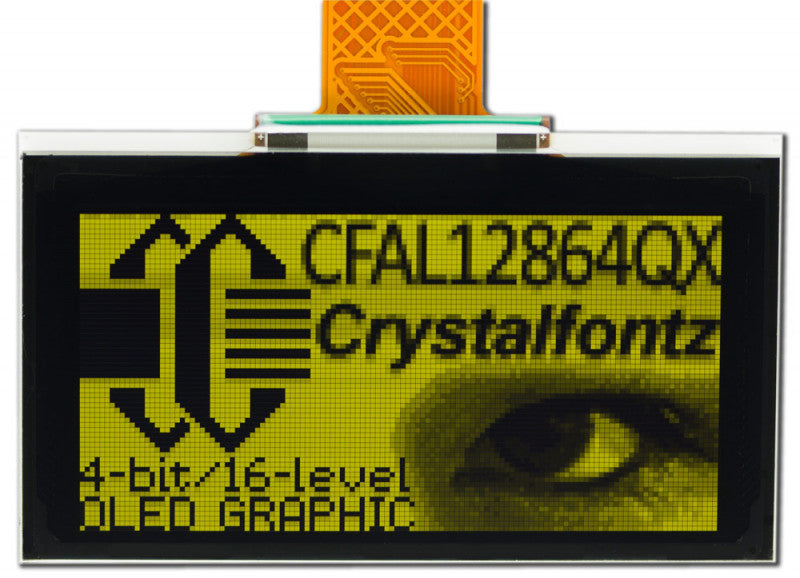
- Driver and interface. Passive matrix character and small graphic OLEDs typically ship with a controller that accepts parallel, I2C or SPI, and the module behaves like a text device with a built-in font. Active matrix modules usually need a source driver with frame memory and a faster bus.
- Tooling and availability. Small passive panels exist as standard parts that can be sampled immediately. Active matrix panels are more often custom or semi-custom, with tooling cost and a longer qualification cycle.
- Mechanical stack. An active matrix module carries a backplane, compensation circuitry and often a circular polariser, so it is thicker and its flex routing is more complex. A passive matrix module is close to glass plus driver.
Cost at the system level
Comparing panel prices in isolation misleads. The passive matrix saving sits in the panel and its simple driver, and it grows when the host does not need a graphics-capable microcontroller: a text-oriented interface can be driven by a small MCU with modest flash.
An active matrix module can cost more per unit and still win on total system cost when the product needs graphics, because the alternative is a larger MCU, more memory and a heavier software stack.
The break-even sits where content complexity exceeds what a text interface can express. Below that line passive matrix is the rational default; above it, active matrix repays its premium.
Which product belongs to which family
| Product requirement | Favours PMOLED | Favours AMOLED |
|---|---|---|
| Two to four lines of text or a set of icons | Yes — standard part, text controller | Over-specified |
| Meter, controller or instrument face | Yes — small format, moderate brightness | Only if graphics are needed |
| Charts, gradients, animation | Limited by off-state control | Yes |
| Continuous high brightness | Shortens life quickly | Yes |
| Lowest unit cost at low volume | Yes | Tooling dominates |
| Wearable with a face that stays on | Acceptable at low brightness | Preferred when space allows |
The row worth studying is brightness. A product that runs its display bright all day gains little from the cheaper panel, because the lifetime cost arrives later as warranty returns. A product that shows short readings at moderate brightness most of the time sits exactly where passive matrix makes sense.
A short selection order
- Write down the content: how many characters, whether any graphics, whether anything moves.
- Fix the brightness the product actually runs at, and the ambient light the panel must survive.
- Turn that into a lifetime requirement with its conditions, then read the panel's curve at that brightness rather than the datasheet headline.
- Compare quotes only after both state luminance and lifetime with conditions attached.
Luminance, contrast and uniformity are measured under defined conditions in ISO 9241-307[1], and the wider trade between emissive and backlit technologies is surveyed in the display literature[2]. Passive matrix parts are listed in the PMOLED display collection, active matrix parts in the AMOLED display collection, and small text formats in both families under character OLED displays.

Passive matrix wins where the content is simple, the panel small and unit cost dominant. Active matrix wins where resolution, brightness or graphics push past what a scan can deliver. Specify luminance and lifetime with their conditions and the choice becomes arithmetic rather than opinion.
References
- ISO 9241-307:2008 — Ergonomics of human-system interaction — Part 307: Analysis and compliance test methods for electronic visual displays. International Organization for Standardization. https://www.iso.org/standard/40102.html
- Hilsum, C. (2010). Flat-panel electronic displays: a triumph of physics, chemistry and engineering. Philosophical Transactions of the Royal Society A, 368(1914), 1027–1082. https://doi.org/10.1098/rsta.2009.0247
Weiterlesen
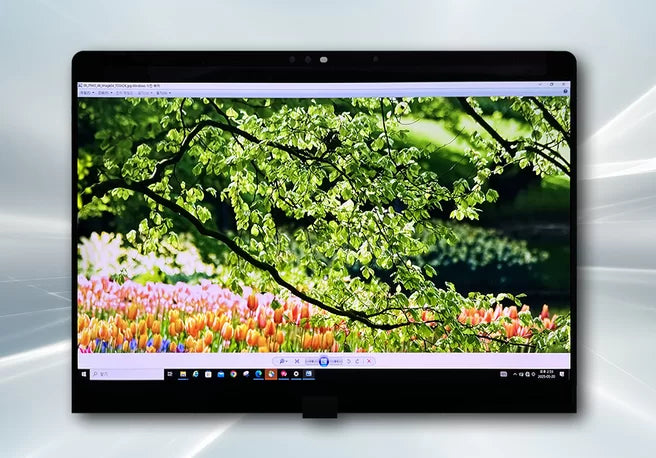
PMOLED, short for Passive Matrix OLED, is a display tech using simple row-column electrode grids to light pixels sequentially, perfect for small screens.
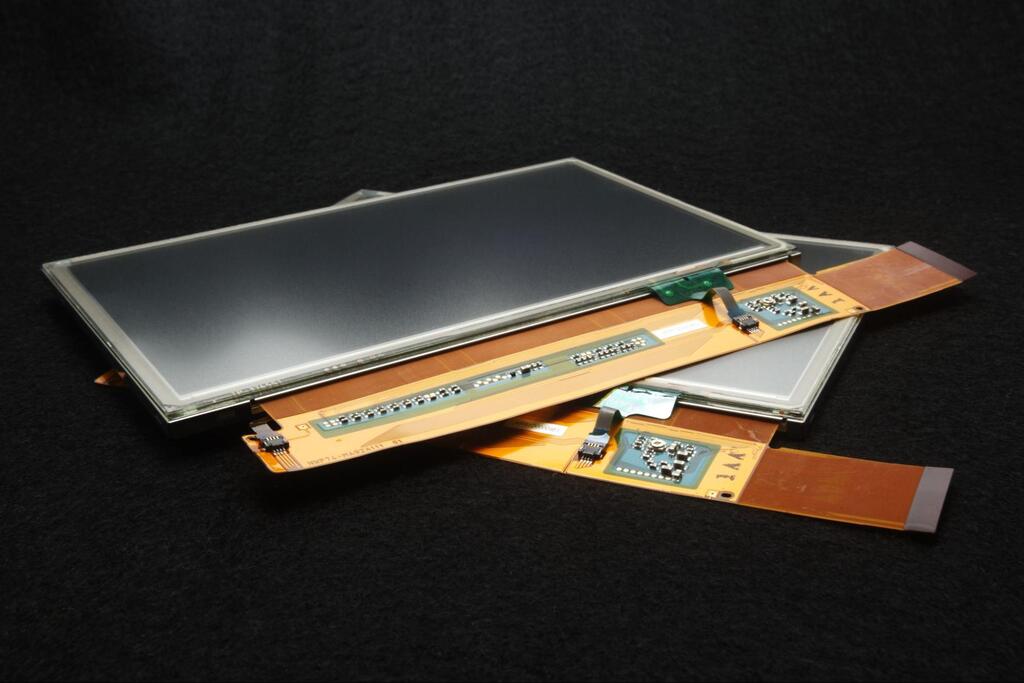
This IPS Display Guide covers types (standard, Nano IPS), pros like 178-degree viewing angles and ΔE<2 color accuracy , and use cases: favored by.
Hinterlasse einen Kommentar
Diese Website ist durch hCaptcha geschützt und es gelten die allgemeinen Geschäftsbedingungen und Datenschutzbestimmungen von hCaptcha.