



Touch Screen on Graphic LCDs | Resistive Touch (RTP), Calibration & Durability
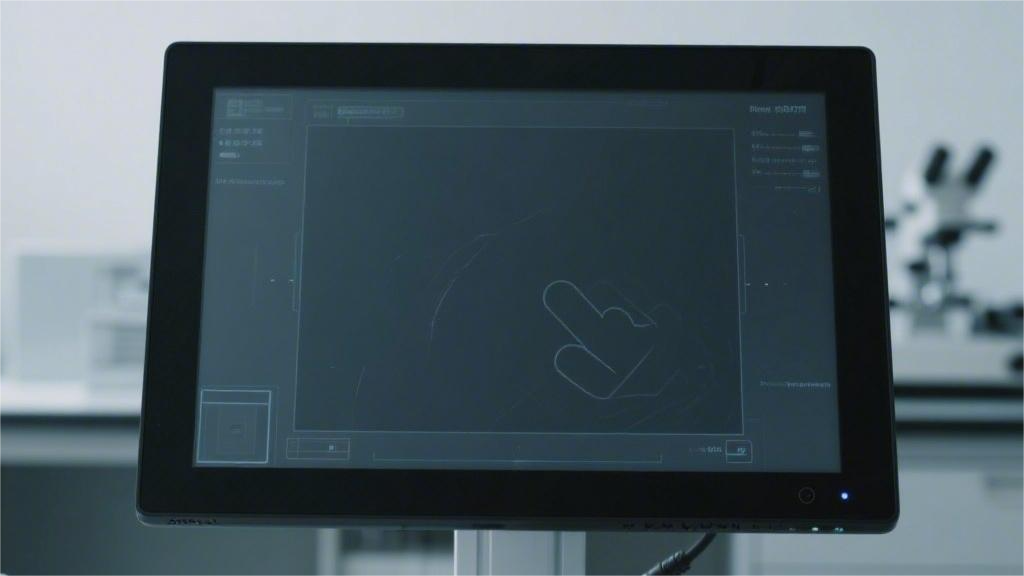
Resistive Touch Panels (RTP) generate signals through physical contact between two conductive layers driven by pressure, featuring IP54-rated dust and water resistance.
During use, coordinates must be calibrated via four-point or nine-point methods to ensure clicking accuracy remains within a ±1.5% error margin.
The surface hardness is typically 3H. While durability reaches 1 million clicks, the use of sharp metal objects should be avoided to prevent scratching.
Resistive Touch, RTP
Users apply a pressing force of 20 to 100 grams, causing the 0.18 mm thick surface PET film to deform and contact the 1.1 to 1.8 mm thick bottom glass substrate.
The controller applies 3.3V or 5V across the X and Y axes, measuring the voltage drop via a 10-bit or 12-bit Analog-to-Digital Converter (ADC) to output coordinates at resolutions of 1024×1024 or 4096×4096.
The response time is below 10 milliseconds. It resists surface water droplets and dust, and supports operation via fingers wearing 5 mm thick polyurethane gloves or hard plastic stylus tips.
Structure & Triggering
When a finger presses against the screen surface, the top 0.18 mm thick polyester (PET) film undergoes physical deformation, crossing an air gap of approximately 0.05 mm to 0.15 mm to make the inner ITO conductive layer contact the ITO layer on the bottom glass substrate. This contact process is equivalent to closing a precision voltage divider circuit, where the controller monitors pin voltage via a 12-bit ADC converter.
- PET Top Layer Thickness: Standard type is 188 microns with 3H hardness, determining the trigger tactile feel.
- Spacer Dot Diameter: Typically 50 to 80 microns, ensuring the circuit remains open in a no-pressure state.
- ITO Film Resistance: Sheet resistance per unit area is usually controlled between 150 to 500 ohms/square.
- Glass Substrate: Thicknesses are mostly 1.1 mm, 1.8 mm, or 2.0 mm, serving as a stable support.
- Trigger Pressure: Standard setting is between 20g to 100g; pressure below 15g may result in insensitive contact.
In a 5V supply system, if the contact point is at the center of the screen, the measured voltage at the X pin is approximately 2.5V. The controller completes logic judgment within 10 milliseconds, converting the analog signal into a 4096×4096 coordinate matrix. Since it does not rely on human body charge, RTP offers 100% tolerance for input media.
- Plastic Stylus: Recommended to use POM tips with a diameter > 0.8 mm to avoid damaging the PET.
- Leather Gloves: Supports precise operation even with heavy industrial protective gloves exceeding 2.0 mm in thickness.
- Fingernail Touch: Suitable for small UI interface operations requiring extremely high coordinate positioning accuracy.
- Insulating Objects: Tools made of wood, rubber, or Teflon can trigger the screen without needing human grounding.
Even if the surface is covered with a 0.5 mm thick water film or conductive metal dust, the RTP will not produce false touch signals like capacitive screens; linear error remains consistently below 1.5%.
- Voltage Divider Circuit: Constant bias voltages are applied sequentially to the X and Y axes by switching driver transistors.
- ADC Conversion: The controller utilizes 10-bit or 12-bit sampling rates to ensure coordinate jitter is less than 2 pixels.
- Response Speed: Typical report rates can reach 100 to 200 coordinate points per second.
- Insulation Gap: The interlaminar air layer provides fundamental buffering to prevent accidental touches caused by thermal expansion/contraction.
- Bezel Silver Paste: Low-resistance silver paste traces surround the screen edges, with widths usually controlled at 2 mm.
- Anti-interference Capability: Features 10V/m radiated immunity, adapting to environments near motors or radio stations.
The 4-wire or 5-wire Flexible Printed Circuit (FPC) from the connector uses gold-plated contacts with 0.5 mm or 1.0 mm pitch. The resistance of each trace is precisely calculated to match the internal gain parameters of the controller. In environments at -40°C, although the PET deformation recovery slows down, the device can still complete its first startup response within 200 ms due to the unchanged physical contact mechanism.
The ITO layer on the inner surface of the PET film is attached via a vacuum sputtering process. In high-frequency click tests, single-point fatigue performance can support 1 million cycles.
4-Wire vs. 5-Wire Screens
In the selection of graphic LCD interactions, the electrical architecture of 4-wire and 5-wire resistive screens determines the equipment's service life in industrial environments. 4-wire RTP relies on the top PET layer for X-axis voltage and the bottom glass for Y-axis voltage, alternating drive logic through four lead wires. This design is highly accurate when the 0.18 mm thick PET film is intact, with linear error typically controlled within 1.0%.
- Pin Definition: Includes X+, X-, Y+, Y- signals, using a 0.5 mm pitch FPC connector.
- Coordinate Calculation: When 5V is loaded on the X-axis, the controller reads the contact voltage through the Y-axis pins with 12-bit ADC precision.
- Cost Structure: Due to the simpler ITO coating process, the single-unit cost is about 30% to 40% lower than the 5-wire version.
- Applicable Temperature: Performance is stable in standard commercial environments from -10°C to +60°C.
As the number of clicks increases, the PET top layer of a 4-wire screen develops micron-level cracks in the internal ITO due to mechanical bending. When local resistance surges from a nominal 350 ohms to over 1000 ohms, the voltage division ratio becomes unbalanced, leading to significant coordinate drift. Even re-executing three-point or five-point calibration cannot fully compensate for the linear distortion caused by physical material wear.
To solve failure caused by material aging, the 5-wire RTP changes the electrode distribution. It integrates both X and Y axis drive electrodes onto the 1.1 mm or 1.8 mm thick bottom glass substrate, generating a uniform electric field through electrodes at the four corners. The top PET film no longer serves as a drive axis; it acts solely as a high-impedance voltage probe to send the contact voltage back to the controller.
| Performance Indicator | 4-Wire Resistive (4-Wire) | 5-Wire Resistive (5-Wire) |
|---|---|---|
| Drive Location | Top (X) and Bottom (Y) driven separately | Both driven by bottom glass substrate |
| Single-point Life | 1,000,000 clicks | 35,000,000 clicks |
| Linear Accuracy | High initial accuracy; drops fast with wear | Maintained within ±1.5% error long-term |
| Controller Pins | 4 Pins (X+, X-, Y+, Y-) | 5 Pins (LL, LR, UL, UR, Sense) |
| Damage Resistance | Top layer scratch cuts signal on that axis | Local top scratch doesn't affect positioning |
This architectural innovation makes 5-wire screens excel in heavy industrial control panels. Even if the PET surface is pierced by a sharp object, the system can still capture accurate voltage drop signals as long as the 150 ohms/square ITO coating on the bottom glass remains undamaged. Its "Sense" pin is dedicated to detecting contact voltage, unaffected by fluctuations in drive electrode contact resistance.
- Drive Electrodes: Distributed at the four corners of the glass substrate, distributing the electric field via a linearized resistor network.
- Sampling Frequency: Supports continuous sliding sampling above 180Hz, with latency below 8 ms.
- Insulation Performance: Interlaminar spacer dot height is precisely controlled at 70 microns to prevent thermal expansion false touches.
- Protection Level: Can reach NEMA 4X standards with sealing gaskets, resisting chemical solvent wipes.
In continuously operating gas station terminals or CNC machine tools, operators may click the screen over 2,000 times daily. With its bottom-drive characteristics, the 5-wire screen can withstand up to 10 years of high-intensity use without physical offset. Since the Sense line operates independently, the controller can compensate for parasitic capacitance interference caused by changes in environmental humidity in real-time.
When environmental temperatures rise to +85°C, the resistance of the PET film undergoes non-linear drift. Because 5-wire technology locks the measurement reference to the more thermally stable glass substrate, its temperature drift coefficient is only one-fifth that of 4-wire technology. This stability ensures that in outdoor power monitoring equipment, coordinate output remains locked within a 1024x1024 resolution grid without frequent manual intervention.
Optics & Environment
A standard RTP consists of a PET film layer, two ITO conductive layers, and a bottom glass substrate. As light passes through these media interfaces with different refractive indices, a 4% interface reflection loss occurs.
Standard 4-wire or 5-wire resistive screens, without special treatment, have a Total Light Transmission of only 76% to 82%. In contrast, graphic LCDs without touch layers usually exceed 90%. The backlight module must consume approximately 20% additional power to achieve the intended display brightness.
In outdoor high-light environments, the internal air gap of the RTP (approx. 0.05 mm to 0.1 mm) creates secondary reflections. This phenomenon leads to a significant drop in image contrast, and the reflectivity of a white background may rise to over 15%, making screen content difficult to discern.
To improve this visual degradation, engineers typically apply an AG (Anti-Glare) coating to the PET surface. This coating scatters direct light through micron-level surface roughening. Treated screens maintain a Gloss value of 60±15 units, effectively eliminating specular reflections.
- Haze Value: Industrial-grade RTP haze is typically controlled between 3% and 8%, balancing clarity with anti-glare effects.
- Surface Hardness: After hard coating the PET top layer, the Mohs hardness can reach 3H, enough to resist repeated wipes with steel wool under 500g pressure.
- UV Protection: For outdoor gas stations or charging piles, PET materials must include UV absorbers to prevent yellowing or embrittlement under long-term 340nm wavelength UV exposure.
- Anti-Reflection Film (AR): High-end models feature multi-layer dielectric films vacuum-sputtered on internal and external surfaces, reducing reflectivity to below 1.5% and increasing light transmission to about 90%.
This multi-layered physical structure determines not only visual effects but also constitutes the device's first line of defense against extreme climates. RTP operating temperature spans are broad; standard models support -20°C to +70°C, while specialized wide-temperature versions can maintain resistance fluctuations under 5% during -40°C to +85°C cycling tests.
Humidity is a key environmental factor affecting RTP lifespan. In environments with 40°C and 90% relative humidity, if the packaging process is substandard, water vapor can penetrate the air gap and oxidize the ITO layer. Qualified RTPs must pass a 240-hour constant humidity and heat test.
Regarding protection levels, by using 0.1 mm thick closed-cell acrylic tape for sealing around the screen edges, the RTP can help the entire machine reach IP65 or NEMA 4X specifications. This sealing structure blocks pressurized water jets at 12.5 liters per minute and effectively prevents dust particles with a diameter of 75 microns from entering the LCD module.
- Thermal Shock Resistance: Supports rapid temperature transitions from -40°C to +85°C within 30 minutes without interlaminar delamination.
- Chemical Resistance: PET surface coatings can withstand 24-hour contact with 70% isopropyl alcohol, kerosene, and common industrial cleaners without swelling.
- Altitude Adaptability: In low-pressure environments above 3000 meters, the internal/external pressure difference may cause the screen to bulge; micro-venting filter holes can maintain a constant 100g trigger force.
As environmental temperatures drop to extremes, the Young's modulus of the PET film changes, causing trigger pressure to increase from 50g at room temperature to 150g. The advantage of 5-wire technology is that its coordinate calculation logic does not rely on the PET's deformation linearity, thus maintaining ±2mm positioning accuracy in engineering vehicle instruments in polar regions.
Screens exposed long-term to salt spray environments (such as port hoisting equipment consoles) must have the FPC outlet reinforced with specialized UV glue. This prevents salt from corroding internal silver paste traces via capillary action. After a 48-hour neutral salt spray test, insulation resistance between pins should remain above 20 megohms.
Calibration
Resistive screen calibration involves collecting 12-bit ADC raw values (0-4095) from 3 to 5 sample points to calculate 6 floating-point coefficients (A-F) to compensate for physical displacement.
The goal is to control the linear voltage deviation of the touch layer within a 1.5% error margin, ensuring pixel alignment at 320x240 or 800x480 resolutions.
Voltage ≠ Coordinates
The physical layer of an RTP consists of two parallel Indium Tin Oxide (ITO) conductive layers separated by spacer dots with a diameter of 5μm to 15μm. When external pressure is applied, the two ITO layers contact, creating a voltage drop measured by the controller across X+ and X-. However, ideal linear voltage distribution rarely exists in mass production; the ITO sheet resistance typically fluctuates between 200Ω/sq and 500Ω/sq, with resistance deviations of about ±10% in the same batch.
This non-uniformity means raw ADC counts cannot be directly mapped to physical pixels. In a 12-bit ADC system, voltage is quantized from 0 to 4095, but due to an approx. 0.2 mm assembly gap between the LCD and touch screen—and because the touch sensing area is typically 1.5% to 3% larger than the LCD Active Area—the 0V or 3.3V at the edge does not correspond to pixel 0.
- Electrical Non-linear Offset: The theoretical midpoint of 2048 often deviates from the physical center by 5 to 15 pixels.
- ITO Edge Effect: Current gathers at the edges of the conductive layer, causing the voltage gradient within 2 mm of the bezel to change exponentially rather than linearly.
- Trace Resistance Interference: Silver busbars have an impedance of 10Ω to 50Ω, which lowers the effective range and prevents sampling from reaching full scale.
- Mechanical Assembly Stress: If the bezel downforce exceeds 50g, it may pre-alter the initial voltage distribution of the ITO layer.
Within the -20°C to +70°C range, the temperature coefficient of the ITO layer causes a voltage reading drift of about 0.5%. For a 1024x768 resolution screen, a 5.1 pixel logical shift occurs due to temperature alone, even if the finger remains stationary.
- Quantization Error: A 10-bit ADC resolution is approx. 3.22mV; in a 5V system, this corresponds to an uncertainty of about 0.8 pixels.
- Noise Suppression: Fluctuations in contact resistance during the press generate electrical noise for about 50ms; the first 20% of samples must be discarded via software.
- Coordinate Transformation Matrix: Six floating-point coefficients are used in matrix multiplication to map Raw_X to Pixel_X, canceling rotation and scaling errors.
- Pixel Pitch Difference: Resistive screens are continuous analog devices, while LCDs consist of discrete pixels (approx. 0.2 mm); the physical scales are inconsistent.
From a hardware perspective, the touch controller outputs ratiometric values. If the VDD supply voltage fluctuates by 100mV, raw coordinates would jump by 3% without a reference voltage source. Therefore, calibration logic must anchor these unstable readings to known physical coordinates using a mathematical model. Typically, diagonal reference points like (32, 32) and (992, 736) are sampled to capture the scaling factor of the active area.
- Scaling Factor: Compressing or stretching the 4096-step ADC range to the 800 or 1024 pixel width of the LCD.
- Rotation Compensation: Correcting micro-tilts between 0.5° and 2° during installation to prevent horizontal swipes from becoming diagonal lines.
- Translation Bias: Eliminating overall X or Y axis shifts caused by casing obstruction or tape thickness.
Parameters calculated via calibration are usually stored in float or double format. During system initialization, the driver loads these parameters to perform multiplication and addition on every interrupt-triggered voltage value. In high-frequency interaction scenarios like handwriting or menu sliding, the processor must complete over 120 matrix operations per second to ensure visual feedback latency is under 16ms.
Calibration Algorithm Comparison
In RTP implementation, 3-point and 5-point calibration are the two mainstream mathematical solutions. 3-point calibration is based on affine transformation, solving for 6 linear coefficients (A-F) using three non-collinear points. It assumes uniform ITO resistance; however, in screens larger than 7 inches, non-linear distortion at the edges usually exceeds 2%, making it hard to maintain edge accuracy within 5 pixels.
In contrast, 5-point calibration adds a center reference point and four corner points (typically at 10% margins), using the Least Squares Method for optimal solution calculation. This algorithm handles complex cross-term distortions, reducing average error to below 1.5%. On 800x480 WVGA screens, it effectively compensates for 0.5° to 1.5° local deformations caused by uneven bracket pressure.
| Technical Metric | 3-Point Calibration | 5-Point Calibration |
|---|---|---|
| Sample Point Distribution | L-shaped or triangular | Center + 4 corners |
| Degrees of Freedom | 6 parameters (Linear mapping) | 8+ parameters (2nd-order compensation) |
| Typical Positioning Error | Approx. 3.0% to 5.0% | Approx. 1.0% to 1.5% |
| CPU Cycles Consumed | ~50-100 instructions per touch | ~150-300 instructions per touch |
| Storage Footprint | 24 bytes (6 floats) | 40 bytes (10 floats) |
For devices requiring frequent handwriting (e.g., logistics terminals), 3-point calibration often results in an 8 to 12 pixel drift at corners. This is because it generates a global uniform matrix. 5-point calibration uses the center feedback to divide the screen into four quadrants for non-linear fitting, making the 4096-step signal better match the pixel distribution. Even at -30°C, where resistance changes by 3%, 5-point calibration maintains coordinate stability.
- Sampling Area Coverage: 5-point covers 80% of active area; 3-point covers only 50% to 60%.
- Noise Redundancy: 5-point reduces the impact of ±2LSB random ADC noise on coefficients through averaging.
- Axis Orthogonality: 5-point decouples the 0.2° non-orthogonal angle between X and Y axes better than 3-point.
- Production Consistency: 5-point calibration can improve batch yield rates by 5% to 8%.
In firmware development, one must weigh MCU floating-point capability. On Cortex-M0 (no FPU), 3-point fixed-point math is efficient (under 5μs). For Cortex-M4/M7 with an FPU, 5-point 2nd-order polynomial math takes only 2μs and offsets assembly deviations over 0.5mm.
For larger 7-inch or 10.1-inch screens, ITO non-linearity becomes obvious. 5-point calibration uses the Least Squares Method on 5 sets of ADC values to fit the data, reducing edge accidental touches by 40%.
- Sample Coverage: 3-point covers 65%; 5-point covers over 92%.
- Complexity: 3-point involves 3x3 matrix inversion (~5μs); 5-point involves overdetermined equation systems.
- Robustness: 5-point is more stable when 12-bit ADC jitters by 3-5 LSBs.
| Metric | 3-Point | 5-Point | 9-Point |
|---|---|---|---|
| Typical Error | < 3.0 pixels | < 1.2 pixels | < 0.5 pixels |
| Rotation Compensation | Good (0-360°) | Excellent (+non-linear) | Superior (+local deformation) |
| User Interaction Time | ~5-8 sec | ~10-15 sec | 20+ sec |
| Suitable Resolution | 320x240 / 480x272 | 800x480 / 1024x600 | 1280x800+ |
For precise sliders, 3-point's 5 to 10 pixel edge offset causes failure. 5-point math ensures the tip-to-pixel error remains within a 0.15mm physical span on 800x480 LCDs.
- Data Redundancy: 5-point uses 10 variables for 6 coefficients, improving robustness via MSE minimization.
- Geometric Distortion: Compensates for ~1.5° more geometric skew (trapezoidal distortion) than 3-point.
- Long-term Reliability: Dilutes local aging effects.
- CPU Load: On a 72MHz Cortex-M3, it takes <1% clock cycles.
In 10.1-inch screen tests, 3-point drift reached 12 pixels after 50,000 presses, while 5-point remained at 4 pixels.
- Sample Position: Set points at 15%-20% inward from the edge to avoid extreme non-linear zones.
- Pressure: Maintain 100g to 150g during calibration.
- Validation: Check A-F coefficients; if A or E deviates >20% from theory, reject calibration.
- Filtering: Use a median filter to reject random ±2 LSB ADC noise.
Three-Point Calibration
Controllers like the ADS7846 read 12-bit voltages. To map 0-4095 ADC counts to specific pixels on a 320x240 QVGA screen, affine transformation is used to correct scaling, rotation, and X/Y translation. Calibration points are typically at 10%-15% margins (e.g., (32, 32), (288, 32), (288, 208)).
To filter mechanical bounce, the driver samples 16 times, sorts them, discards the top/bottom 4, and averages the remaining 8 values. Then, Cramer's Rule is used to solve for A, B, C, D, E, F.
- A & E: Scale factors.
- B & D: Rotation (0.1° to 2°).
- C & F: Absolute translation (2-5mm).
Stored as 24 bytes of floats, the calculation Px = A*Rx + B*Ry + C takes less than 3μs on a 48MHz Cortex-M0. This supports over 100 report-per-second drag operations with <16ms latency. However, on screens 7 inches+, 3-point accuracy drops to 8-12 pixels at the fourth corner because it forces a linear grid over a non-linear field.
Durability
Single-point click life for 4-wire RTP is 1-5 million clicks with a 2H/3H PET hardness. Sliding life (signatures) is ~100k cycles. Its wide temperature range (-20°C to +70°C) and resistance to 90% humidity/industrial solvents make it more reliable than capacitive screens in extreme conditions.
Wear & Lifespan
Mechanical stress causes PET metal fatigue. In industrial RTPs, contact resistance rises from 50Ω to 200Ω+ after 1.5 million clicks. Standard hardness is 3H (ASTM D3363). Scratches >5μm can cut the conductive grid.
- Spacer Dots: ~0.05mm diameter, 2-4mm spacing.
- Transmission: Drops from 82% to <75% over time.
- Insulation: Must be >10MΩ at DC 25V.
- Temp Impact: At -20°C, trigger pressure increases by 30%.
UV radiation (300-400nm) degrades PET. Outdoor equipment uses 1.1mm-1.8mm soda-lime glass with UV-blocking films to extend service from 2 to 5+ years. POM stylus tips (COF <0.15) are recommended.
In thermal shock (-40°C to +85°C), high-end RTPs use Venting Slots to balance pressure and prevent the "pillow effect" or internal icing in sub-zero temps.
Environmental Resistance
RTP signal triggering is purely mechanical, making it stable against EMI/RFI > 10V/m. Coordinate jitter remains <1.0% near heavy motors. It works under 2mm of oil or water because liquids cannot penetrate the 0.188mm PET layer, unlike capacitive screens which lock up with 5pF capacitance shifts.
Industrial RTPs resist 5% HCl, IPA, and kerosene. After 24-hour immersion, clarity loss is <2%.
| Challenge | RTP Performance | Industrial Standard |
|---|---|---|
| Operating Temp | -20°C to +70°C | PET brittleness/softening limits. |
| Storage Temp | -40°C to +85°C | Coating must not crack under expansion. |
| Humidity | 90% RH @ 40°C | 240h test; insulation >10MΩ. |
| Salt Spray | 5% Salt / 48h | Silver bus bars must not corrode. |
ESD protection: ±8kV contact / ±15kV air (IEC 61000-4-2). It withstands 50G/11ms shocks and IP65 dust/water. It works with any insulator—5mm nitrile gloves or wooden sticks—with 100% success.
GFG (Glass-Film-Glass)
GFG uses a 0.1mm-0.2mm ultra-thin glass layer instead of PET. This blocks 98% of UV, preventing yellowing over 5 years. It features 7H hardness, resisting 1.5J steel ball impacts. Sliding life is 500,000 cycles (5x standard RTP).
- Thermal Stability: No softening at +85°C.
- Chemicals: 100% resistant to sulfuric acid and degreasers (NEMA 4X).
- Sealing: Supports IP67 with epoxy encapsulation.
GFG seals the ITO between two glass layers, passing 500-hour humidity tests where standard RTPs fail at 240h. It can be etched with AR or AG treatments that don't wear off, reducing reflection from 8% to <1.5% for 10,000-nit readability. Its rigidity filters out <15g vibrations, preventing "ghost touches" in bumpy 2G-acceleration environments.
En lire plus

IPS screens offer a superior performance! They feature 178° ultra-wide viewing angles and more accurate color reproduction. Verification method: You can observe the screen from a 45° side angle; if...
The light transmittance of transparent PMOLED displays typically reaches 40% to 60%. Its core lies in the elimination of the backlight layer, utilizing the self-emissive characteristics of organic ...
Laisser un commentaire
Ce site est protégé par hCaptcha, et la Politique de confidentialité et les Conditions de service de hCaptcha s’appliquent.