



16x2 Character LCD FSTN Transflective Large - MCU
- 💹 Enjoy a 20% discount for orders over 500
- 📉 A 15% discount is available for orders ranging from 200 to 499
- 🎁 A 10% discount is available for orders ranging from 50 to 199
- 🎁 A 5% discount is available when ordering 10-49
Interested in customizing this product? Get in touch with us.
Order samples, immediate delivery.
Factory bulk lead time: 3 weeks.
16x2 Character LCD FSTN Transflective Large - MCU
- 💹 Enjoy a 20% discount for orders over 500
- 📉 A 15% discount is available for orders ranging from 200 to 499
- 🎁 A 10% discount is available for orders ranging from 50 to 199
- 🎁 A 5% discount is available when ordering 10-49
Resources & Downloads
16×2 Character LCD FSTN Transflective Large – MCU
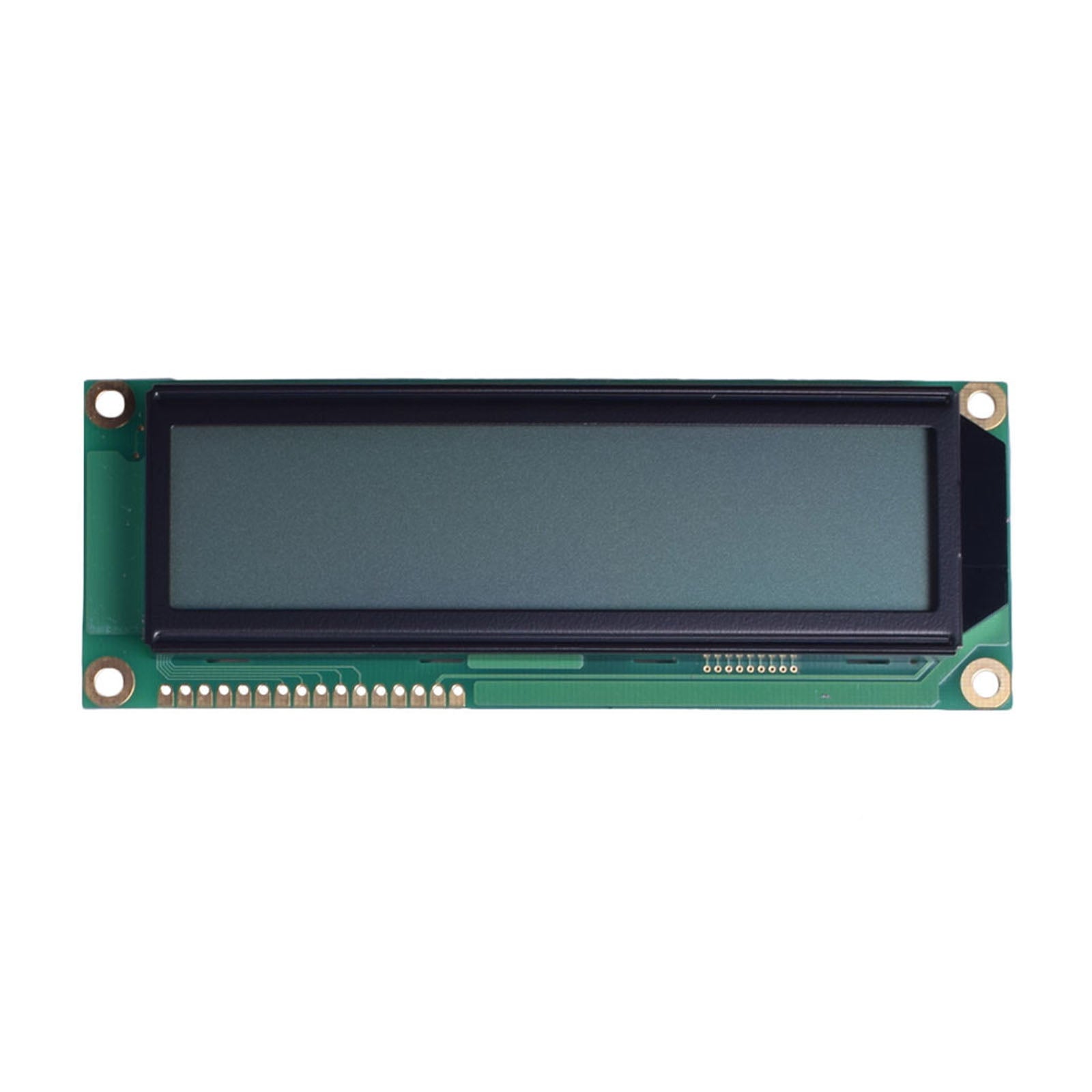
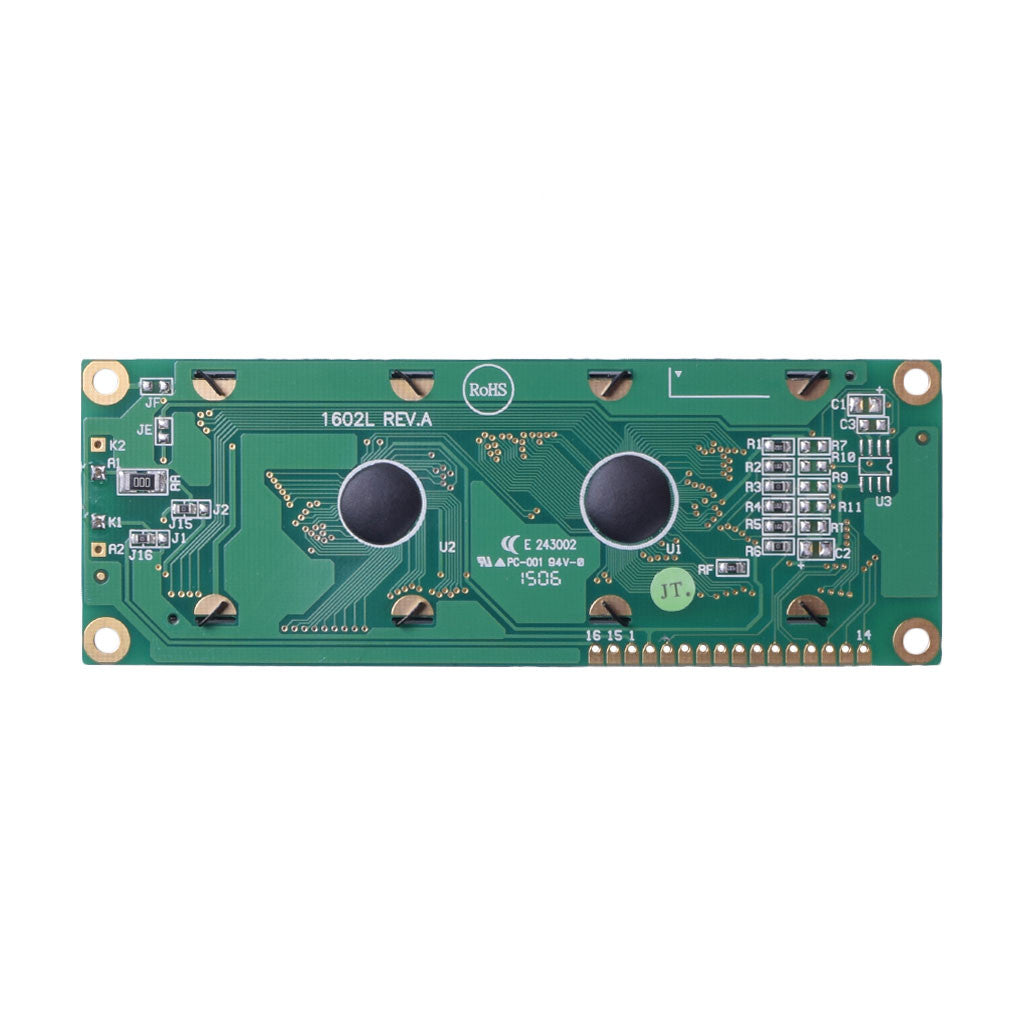
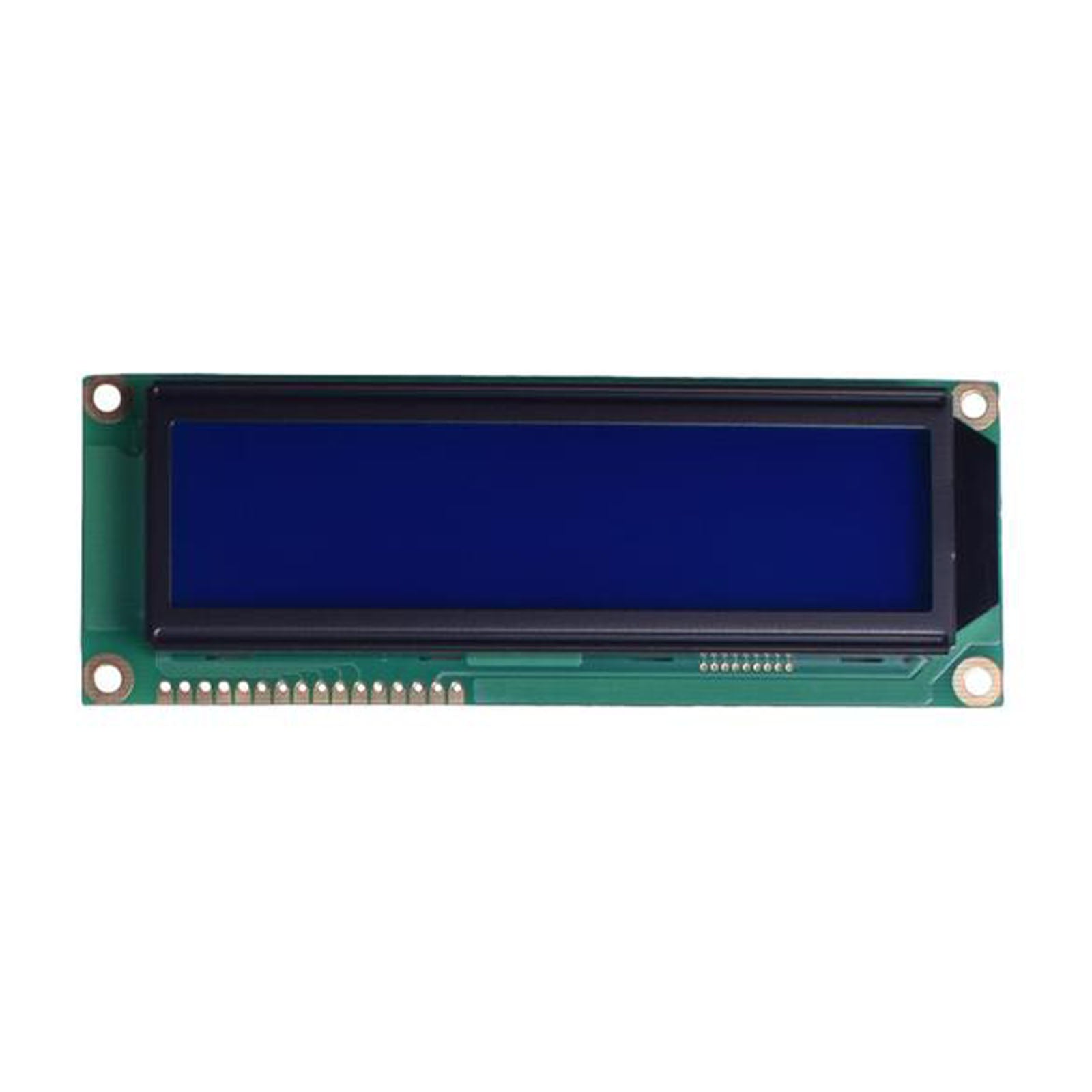
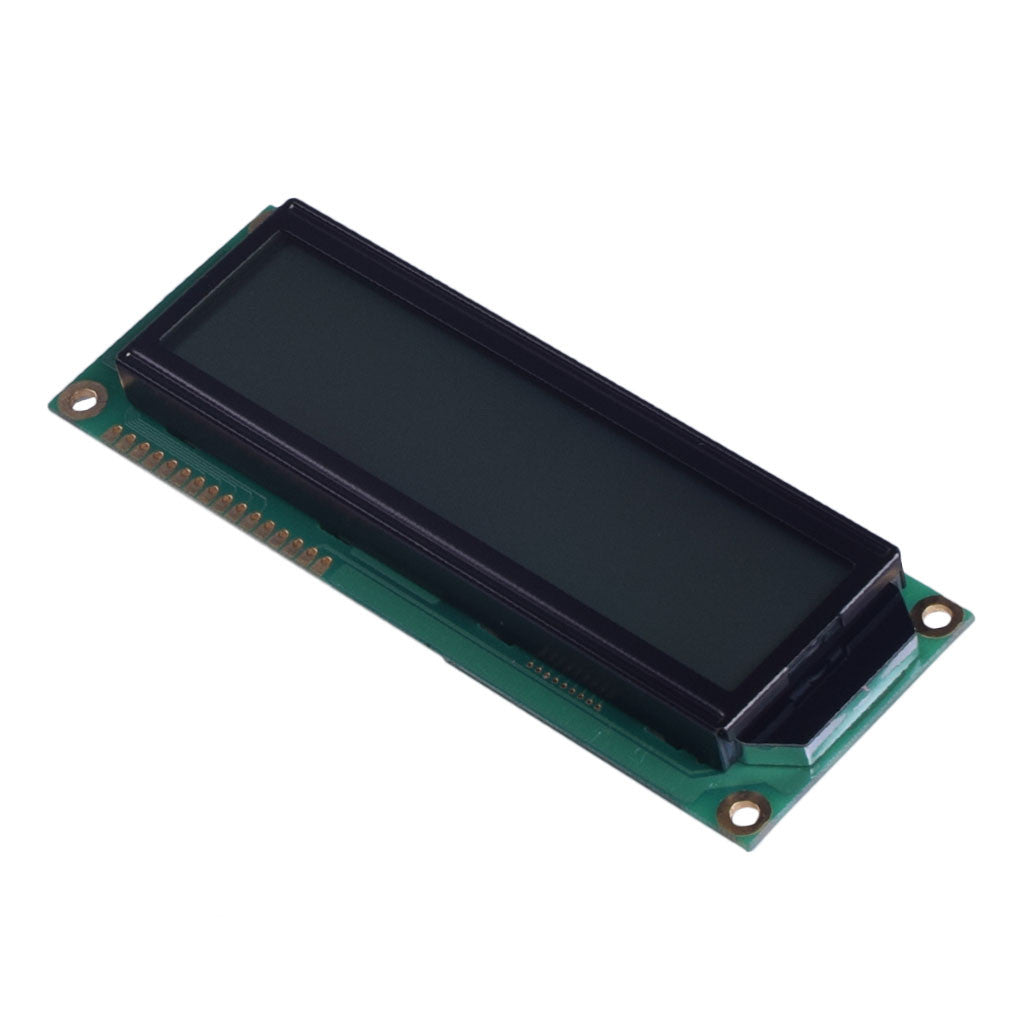
DM-LCD1602-427 is a 16-character by 2-line monochrome LCD module with an FSTN positive transflective display, white LED backlight, 6:00 viewing direction, ST7066U controller IC, and 6800-series parallel MPU interface.
The module has a 122.0 × 44.0 mm outline, a maximum depth of 13.6 mm, a 99.0 × 24.0 mm viewing area, and a 94.84 × 20.0 mm active area. It supports 4-bit and 8-bit data-bus operation from a nominal 5.0 V logic supply.
DM-LCD1602-427 uses a gray FSTN positive transflective LCD. DM-LCD1602-428 uses a blue STN negative transmissive LCD with different viewing-angle, contrast, and weight specifications.

DM-LCD1602-427 mechanical drawing with module outline, viewing area, active area, mounting-hole pattern, 16-pin footprint, and maximum depth.
Two Optical Versions
DM-LCD1602-427 and DM-LCD1602-428 share the same published module outline, controller, parallel interface, logic supply range, white LED backlight, response-time specification, and environmental limits. Their LCD modes and optical characteristics are different.
Gray Transflective or Blue Transmissive
The gray version can use reflected ambient light together with its backlight. The blue version is designed for backlit viewing.
FSTN Positive, Transflective
The transflective construction combines ambient-light reflection with white LED illumination. Readability also depends on the cover window, viewing position, contrast setting, and lighting environment.
- Weight
- 69.6 g
- View Angles
- Top 30°, bottom 60°, left and right 45°
- Contrast Ratio
- 5 typical
- View Direction
- 6:00
STN Negative, Blue, Transmissive
The blue negative transmissive LCD uses the white LED backlight for display visibility. Its published viewing cone and contrast ratio differ from the gray version.
- Weight
- 70.2 g
- View Angles
- Top 20°, bottom 40°, left and right 30°
- Contrast Ratio
- 3 typical
- View Direction
- 6:00
Technical Specifications
The general module values apply to both versions unless the parameter identifies DM-LCD1602-427 or DM-LCD1602-428 separately.
| Parameter | Published Specification |
|---|---|
| Primary Model | DM-LCD1602-427 |
| Blue Optical Version | DM-LCD1602-428 |
| Product Type | Monochrome character LCD module |
| Character Format | 16 characters × 2 lines |
| DM-LCD1602-427 LCD Mode | FSTN positive, transflective |
| DM-LCD1602-428 LCD Mode | STN negative, blue, transmissive |
| Viewing Direction | 6:00 |
| Duty | 1/16 |
| Module Outline | 122.0 ± 0.5 × 44.0 ± 0.5 mm |
| Maximum Module Depth | 13.6 mm maximum |
| Viewing Area | 99.0 × 24.0 mm |
| Active Area | 94.84 × 20.0 mm |
| Character Size | 4.84 × 9.66 mm |
| Character Pitch | 6.0 × 10.34 mm |
| Dot Size | 0.92 × 1.10 mm |
| Dot Pitch | 0.98 × 1.16 mm |
| Mounting-Hole Centers | 115.0 × 37.0 mm |
| Mounting Holes | Four 3.5 mm plated through holes with 6.5 mm pad diameters |
| Interface Footprint | 16 plated through holes with 1.0 mm hole diameter on 2.54 mm pitch |
| Controller IC | ST7066U |
| MPU Interface | 6800-series parallel interface |
| Data-Bus Modes | 4-bit or 8-bit parallel data transfer |
| Logic Supply Voltage | 4.5 V minimum, 5.0 V typical, 5.5 V maximum |
| Logic Supply Current | 1.2 mA minimum, 1.5 mA typical, 1.8 mA maximum at VDD = 5.0 V |
| Low-Level Input Voltage | 0.6 V maximum |
| High-Level Input Voltage | 0.7 × VDD minimum, VDD maximum |
| Low-Level Output Voltage | 0.4 V maximum |
| High-Level Output Voltage | 3.9 V minimum, VDD maximum |
| Backlight | White LED |
| Backlight Voltage | 3.4 V minimum, 3.5 V typical, 3.6 V maximum |
| Backlight Current | 48 mA typical, 60 mA maximum |
| DM-LCD1602-427 Viewing Angles | Top 30°, bottom 60°, left 45°, right 45° |
| DM-LCD1602-428 Viewing Angles | Top 20°, bottom 40°, left 30°, right 30° |
| Response Time at 25°C | 300 ms typical, 400 ms maximum, specified as Tr + Tf |
| DM-LCD1602-427 Contrast Ratio | 5 typical |
| DM-LCD1602-428 Contrast Ratio | 3 typical |
| Luminance Test Value | 416 cd/m² minimum and 520 cd/m² typical, measured without the LCD |
| Operating Temperature | -20°C to +70°C |
| Storage Temperature | -30°C to +80°C |
| DM-LCD1602-427 Weight | 69.6 g |
| DM-LCD1602-428 Weight | 70.2 g |
| Connection Format | 16-pin, 2.54 mm pitch through-hole footprint. An installed header or cable assembly is not specified. |
Electrical and Optical Design Details
The logic supply, parallel interface, LCD contrast input, and LED backlight use separate published electrical limits.
5 V Logic Interface
At a 5.0 V module supply, the minimum specified high-level input is 3.5 V. A standard 3.3 V output may not satisfy this limit, so a level translator may be required between a 3.3 V host and the LCD inputs.
The bidirectional data bus can also return high-level output voltages from 3.9 V up to VDD. Host input-voltage tolerance is therefore relevant when read operations or busy-flag checking are used.
Transflective Viewing
The 427 version uses reflected ambient light and white LED illumination. Window tint, surface finish, enclosure depth, contrast voltage, and viewing angle affect the finished appearance.
300 ms Typical Response
The published Tr + Tf response time is 300 ms typical and 400 ms maximum at 25°C. The module is designed for character information, values, menus, and equipment status rather than fast animation.
Separate Backlight Load
The LCD logic draws 1.5 mA typical, while the white LED backlight draws 48 mA typical. The power design should include both loads and keep the LED voltage and current within the published limits.
Luminance Test Scope
The 416 cd/m² minimum and 520 cd/m² typical values are specified as measurements without the LCD. They are not published as the final on-axis luminance of the complete display.
Mechanical Integration
The enclosure and PCB layout should account for the module outline, viewing window, active area, mounting holes, pin footprint, component depth, and header clearance.
Module Envelope
The front outline measures 122.0 ± 0.5 mm by 44.0 ± 0.5 mm. The side-view drawing specifies a maximum module depth of 13.6 mm.
Four Mounting Holes
The drawing specifies four 3.5 mm plated through holes with 6.5 mm pad diameters on a 115.0 × 37.0 mm center pattern.
16-Pin Footprint
The interface uses 16 plated through holes with a 1.0 mm hole diameter and 2.54 mm pitch. The 15 pin intervals span 38.1 mm.
Viewing Window
The 99.0 × 24.0 mm viewing area is larger than the 94.84 × 20.0 mm active character area and should be considered when sizing the enclosure opening.
Character Geometry
Each character uses a 4.84 × 9.66 mm field on a 6.0 × 10.34 mm pitch. Individual dots measure 0.92 × 1.10 mm.
Connector and Parallel Interface Details
The 16-position interface separates the logic supply, LCD contrast input, control signals, bidirectional data bus, and LED backlight terminals.
4-Bit and 8-Bit Operation
In 8-bit mode, DB0 through DB7 transfer a complete byte. In 4-bit mode, DB4 through DB7 transfer the high-order nibble first and the low-order nibble second.
DB0 through DB3 are not used for data transfer in 4-bit mode. DB7 carries the busy flag during a read-busy-flag operation.
Power and Contrast
Control Signals
Bidirectional Data Bus
White LED Backlight
ST7066U Controller Functions
The ST7066U integrates the MPU interface, display memory, character generators, instruction decoder, cursor and blink control, timing generator, and LCD common and segment drivers.
80×8-Bit DDRAM
The controller provides display data RAM for up to 80 character positions. In two-line mode, the first line starts at address 00H and the second line starts at 40H.
240 Character Fonts
The controller includes a 13,200-bit character-generator ROM supporting 240 character patterns in the available 5×8 or 5×11 formats.
Eight Custom Characters
The 64×8-bit CGRAM supports eight programmable 5×8 character patterns. The two-line module configuration uses 5×8 characters and 1/16 duty.
Instruction Timing
Clear Display and Return Home require 1.52 ms at the stated 270 kHz oscillator condition. Many other instructions are specified at 37 µs.
Published Environmental Test Conditions
The module datasheets list storage, operating, humidity, thermal-shock, vibration, and static-electricity conditions for evaluating environmental suitability.
Operating Environment
The published operating range is -20°C to +70°C, and the storage range is -30°C to +80°C.
No numerical service-life or LED backlight-life value is stated in the supplied module datasheets.
High-temperature storage: 80°C for 200 hours.
Low-temperature storage: -30°C for 200 hours.
High-temperature operation: 70°C for 200 hours under electrical and thermal stress.
Low-temperature operation: -20°C for 200 hours.
Humidity operation: 60°C and 90% RH maximum for 96 hours under the stated no-load condition, excluding the polarizer.
Thermal shock: 10 cycles between the stated -20°C and +70°C conditions.
Vibration: 10 to 55 Hz with 15 mm total fixed amplitude, tested for 16 minutes in each X, Y, and Z direction.
Static electricity: 800 V with 1.5 kΩ resistance and 100 pF capacitance, applied one time.
Configuration Options for Project Integration
Project requirements can include the LCD optical mode, host logic voltage, 4-bit or 8-bit data bus, backlight circuit, connection format, enclosure dimensions, viewing direction, and order quantity.
Common Questions
What is the difference between DM-LCD1602-427 and DM-LCD1602-428?
DM-LCD1602-427 is an FSTN positive transflective gray display with a typical contrast ratio of 5. DM-LCD1602-428 is an STN negative blue transmissive display with a typical contrast ratio of 3. Their viewing angles and weights also differ.
Can the module operate in 4-bit mode?
Yes. In 4-bit mode, DB4 through DB7 transfer each byte in two steps. The high-order nibble is transferred before the low-order nibble, while DB0 through DB3 are not used for data transfer.
Can it connect directly to a 3.3 V microcontroller?
Direct compatibility is not guaranteed by the published module limits. At a 5.0 V supply, the minimum high-level input is 3.5 V. Read operations can also return logic levels approaching the module supply, so level translation may be required.
How much current does the module use?
The LCD logic current is 1.5 mA typical at VDD = 5.0 V. The white LED backlight is specified separately at 48 mA typical and 60 mA maximum.
Is a pin header installed?
The mechanical drawing defines a 16-position, 2.54 mm pitch through-hole footprint. It does not specify an installed header or mating cable assembly.
Can the gray version be viewed without the backlight?
The DM-LCD1602-427 uses a transflective LCD mode that can use reflected ambient light. Readability without the backlight depends on ambient lighting, contrast adjustment, viewing angle, cover-window material, and enclosure design.
Is 520 cd/m² the finished display brightness?
No. The datasheets identify 416 cd/m² minimum and 520 cd/m² typical as luminance measured without the LCD. A separate finished-display luminance value is not published.
How many custom characters are available?
The ST7066U character-generator RAM supports eight programmable 5×8 character patterns. The two-line module configuration uses the 5×8 font mode and 1/16 duty.
What information is useful for a quotation?
Useful information includes the required model, order quantity, host logic voltage, 4-bit or 8-bit interface choice, connector requirement, enclosure dimensions, viewing direction, backlight-control method, and delivery schedule.
Download Official Datasheet
Use the module datasheets for dimensions, pin assignments, electrical limits, optical values, interface timing, mechanical drawings, and environmental test conditions.
The ST7066U document provides controller-memory details, instruction timing, initialization information, and 4-bit or 8-bit MPU interface operation.