



How to Choose a PMOLED | Key Specs, Interface Options
Choosing a PMOLED comes down to five decisions in a fixed order: the size and pixel density the content needs, the colour scheme the interface requires, the interface the host can drive, the multiplex ratio the brightness and lifetime budget allows, and the mechanical envelope. Deciding them out of order is what produces modules that fit electrically but fail optically, or that meet the drawing but fade inside a year.
Start with content and viewing distance
PMOLED panels exist in character formats and small graphic formats. Character displays are specified by lines and characters — 16×2, 20×4 — and are the right answer for text-only interfaces that have to be integrated quickly, because the controller handles font rendering in hardware.
Graphic displays are specified in pixels and are the right answer when the interface uses icons, bars or custom fonts. The pixel density follows from the viewing distance: a readout viewed at arm's length needs roughly 0.2 to 0.3 millimetres of pixel pitch to look smooth; a small icons-only display can use coarser pitch.
Decide the colour scheme early
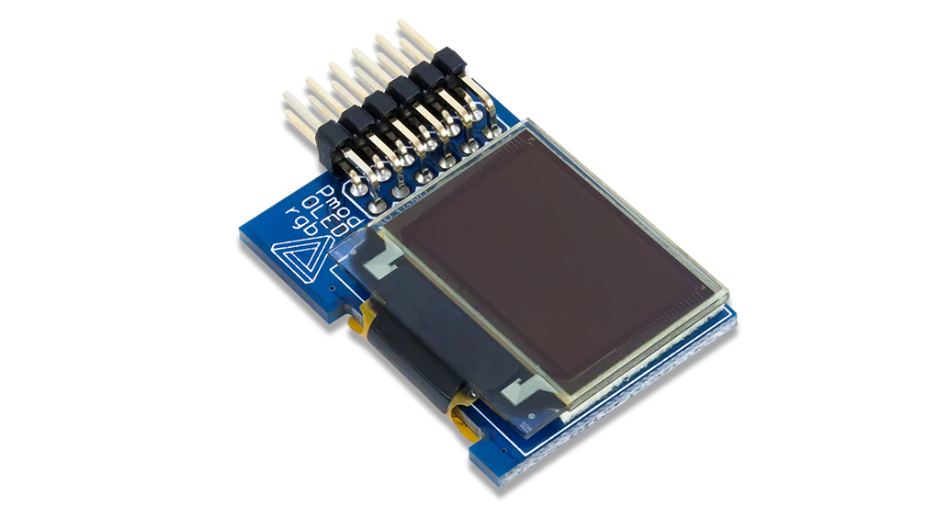
Most PMOLED modules are monochrome — white, yellow or green on black — which suits status text and high-contrast icons. Area-colour modules add a second colour region, typically a coloured band for a title bar or a status strip. Full-colour PMOLED exists mostly in small, low-resolution formats, and is usually the expensive route for an interface that only needs text.
The colour choice is worth settling before mechanical design, because the module height, the polariser and the available brightness differ between the options.
Interface and controller
Three interface families appear in PMOLED modules: I²C, SPI and parallel (6800/8080-style). I²C keeps wiring small and is adequate for character displays that update slowly. SPI is the usual choice for graphic panels, where the data volume per frame is higher. Parallel interfaces offer the most bandwidth and cost the most pins.
Check whether the controller is integrated or external, and how much display RAM it carries. A controller with its own RAM lets the host write only what changed; one without forces a full-frame refresh and raises the host's bus load. For a small microcontroller running other tasks, that difference decides whether the display fits the available CPU budget.
The multiplex ratio sets a lasting trade
In a passive matrix, the multiplex ratio is the number of rows driven in a frame, and it trades brightness against lifetime. A higher ratio means each row is on for a shorter share of the frame, so the instantaneous current needed for a given brightness is higher and the organic material ages faster.
For a given panel this trade is fixed by the row count, but across candidate modules it is a selection variable: a smaller panel with fewer rows can hit the required brightness at a lower peak current. If the interface is text and the size can shrink, that is often the cheaper route to a durable design.
Lifetime and brightness belong in the same sentence
Ask for lifetime at the brightness the product will use, not at the module's maximum. Two modules quoted at the same lifetime can differ substantially in what brightness that lifetime applies to, and the difference shows up as field failures two years in.
For products that stay on continuously at high brightness, a backlit LCD often wins on lifetime simply because its degradation path is different; PMOLED is strongest where the display is dimmed, pulsed or dark much of the time.
Mechanical and environmental envelope
- Overall thickness including any cover glass, and the keep-out zone around the FPC.
- Connector type and pinout, with a drawing rather than a part number alone.
- Operating temperature range, and whether the display must function at cold start.
- Encapsulation and moisture handling, especially for sealed enclosures.
Where selection usually goes wrong
Four mistakes account for most of the rework in PMOLED integration. Choosing colour after the mechanical design, so the module's height no longer fits. Choosing a controller without enough display RAM, forcing full-frame refreshes and starving the host's bus. Specifying brightness at maximum and lifetime at a lower level, then discovering the product cannot run at the brightness the specification assumed. And treating the multiplex ratio as a panel property rather than as a trade the design has to live with.
Each is cheap to avoid at the start of a project and expensive after tooling. The pattern behind all four is the same: a decision made in isolation that constrains a later one.
A practical selection order
Content decides format; format decides controller; controller decides interface; interface and brightness decide the host's bus and power budget; and brightness decides lifetime. Mechanical envelope constrains all of them, so it is worth establishing as a hard boundary at the start rather than as a check at the end.
PMOLED modules in character and graphic formats are listed in the PMOLED display collection, character formats specifically under character OLED displays and graphic formats under graphic OLED displays. Luminance, contrast and uniformity should be requested with their measurement basis, standardised in ISO 9241-307[1].

Choose a PMOLED by settling content and viewing distance first, then colour, then interface and controller memory, then the multiplex-ratio trade, and finally the mechanical envelope. Ask for lifetime at the brightness you will actually run, and the specification stops being ambiguous.
References
- ISO 9241-307:2008 — Ergonomics of human-system interaction — Part 307: Analysis and compliance test methods for electronic visual displays. International Organization for Standardization. https://www.iso.org/standard/40102.html
더 읽기

AMOLED utilizes TFT to independently drive pixels, achieving a contrast ratio exceeding 100,000:1 and dominating the market for displays larger than 5.
PMOLED leverages a TFT-free architecture to significantly reduce manufacturing costs, featuring an ultra-fast response time of 10μs and a wide viewing.
댓글 남기기
이 사이트는 hCaptcha에 의해 보호되며, hCaptcha의 개인 정보 보호 정책 과 서비스 약관 이 적용됩니다.