



Industrial LCD Panel Selection | Operating Temperature, Lifecycle & Reliability
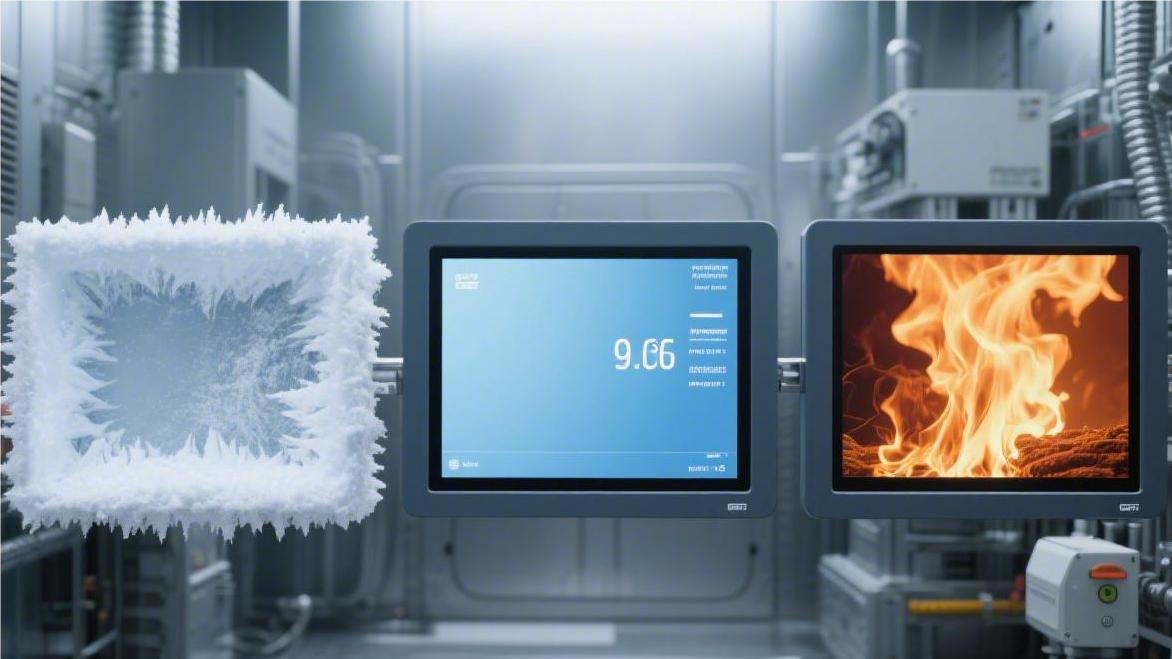
Industrial LCD screen selection must look for the wide temperature standard of -20°C to 70°C.
In terms of lifecycle, it is essential to verify data reports showing an MTBF greater than 50,000 hours.
In practice, EMC certifications and shock resistance parameters must be strictly checked to ensure extreme reliability in harsh environments.
Operating Temperature
The operating temperature of industrial panels is divided into semi-wide temperature (-10~60°C), standard wide temperature (-20~70°C), and ultra-wide temperature (-40~85°C).
Under solar radiation, the enclosure of outdoor equipment will generate a heat accumulation of 15~20°C, causing the internal temperature of the equipment to exceed weather forecast values.
If the panel temperature exceeds the liquid crystal clearing point (Tni, typically 105°C), large black spots will appear on the screen;
In a -30°C environment, the viscosity of liquid crystal molecules increases, and the response time extends from 8 milliseconds (ms) to over 3 seconds, requiring the configuration of an ITO transparent heating film to maintain normal display.
Common Temperature Specifications
The temperature specifications of industrial LCD panels are divided into three clearly defined tiers. Each tier corresponds to a specific nematic liquid crystal formula, driver IC heat resistance level, and backlight module heat dissipation architecture. Engineers match the hardware based on the geographical latitude and altitude of the equipment deployment.
Semi-wide temperature panels have a nominal operating range of -10°C to 60°C and a storage temperature set at -20°C to 70°C. The interior of the panel uses conventional Twisted Nematic (TN) or In-Plane Switching (IPS) liquid crystal materials, with the physical thickness of the liquid crystal layer maintained between 3.2 microns and 3.5 microns.
These specifications are mostly used in indoor industrial facilities with relatively controllable environments. For an assembly line operating terminal at a car manufacturing plant in Munich, Germany, the workshop runs the HVAC system year-round, keeping the room temperature stable within the parameter range of 22°C plus or minus 5°C.
At the critical high point of 60°C, the backlight power consumption of semi-wide temperature panels is maintained at 15 to 25 watts, and overall heat generation is kept low. Motherboard components use regular commercial-grade SMD capacitors with a rated operating life of about 40,000 hours and a humidity tolerance set to 10% to 80% (non-condensing).
When equipment is moved from a thermostatic workshop to semi-outdoor or fully outdoor areas, the physical structure of the panel must withstand drastic climate changes. Standard wide temperature panels lower the operating limit to -20°C and raise the upper limit to 70°C to adapt to irregular day-night temperature difference cycles.
The glass substrate uses heat-resistant alkali-aluminosilicate glass with a thickness of 0.5 mm or 0.7 mm. The alkali-aluminosilicate material can effectively resist the thermal expansion stress generated at 70°C, preventing the glass panel from undergoing microscopic bursts during the physical pulling of alternating hot and cold conditions.
Digital ticket machines at open-air train stations in Chicago, USA, are affected by the cold winds of Lake Michigan in winter, and the enclosure surface temperature often drops to -15°C. The wide-temperature liquid crystal fluid inside the standard wide temperature panel increases its viscosity to 300 centipoise (cP) at -20°C, but the screen refresh rate can still be maintained at 30 Hertz (Hz).
The panel IC driver board switches to industrial-grade inductors and solid capacitors with a temperature resistance rating of 85°C. The PCB copper-clad laminate material is upgraded to TG150 (glass transition temperature 150°C) to prevent the motherboard from undergoing physical delamination in a sealed enclosure under high temperature and high humidity of 70°C.
| Specification Tier | Nominal Operating Range | Nominal Storage Range | LC Layer Viscosity Critical Reference | Typical Backlight Life (L50) | PCB Substrate Material |
|---|---|---|---|---|---|
| Semi-Wide Temp | -10°C ~ 60°C | -20°C ~ 70°C | 150 cP at -10°C | 40,000 hours | TG130 |
| Standard Wide Temp | -20°C ~ 70°C | -30°C ~ 80°C | 300 cP at -20°C | 50,000 hours | TG150 |
| Ultra-Wide Temp | -40°C ~ 85°C | -40°C ~ 90°C | 800 cP at -40°C | 70,000 hours | TG170 |
Extreme geographical locations and high-pressure working environments exceed the physical endurance limits of standard wide temperature panels. Ultra-wide temperature panels have an operating range of -40°C to 85°C. The front polarizer uses a specially formulated iodine-based high-temperature and humidity-resistant recipe.
Under a double-85 test environment of 85°C and 85% relative humidity, the blistering rate of the panel is controlled below 0.1% after 1,000 hours of continuous operation. The silicone adhesive used for optical bonding does not yellow at 85°C, and the glue layer thickness is maintained between 1.5 mm and 2.0 mm.
In-vehicle display terminals for heavy excavators deployed in the oil sands mining areas of Alberta, Canada, face severe cold tests of -38°C in winter. Under -40°C, the ultra-wide temperature panel, driven by internal 5V or 12V bias voltages, can display the equipment's oil pressure readings with a physical response time of about 2 seconds.
At the upper limit of 85°C, the high Tni liquid crystal materials selected for ultra-wide temperature panels reach a clearing point of 105°C or even 110°C. The backlight LED chips use ceramic packaging substrates, dropping thermal resistance to 5°C per watt (5°C/W), ensuring continuous illumination for 70,000 hours at an 85°C ambient temperature.
The determination of the three tiers of temperature specifications must be completed in large environmental test chambers. According to the IEC 60068-2-1 and 60068-2-2 testing standards, prototypes remain at each nominal temperature limit point for at least 72 hours and undergo 10 to 20 cycles of high and low thermal shock tests.
Thermal shock tests require the environmental chamber temperature to suddenly rise from -40°C to 85°C within 5 minutes. The difference in expansion coefficients between the inner and outer layers of the panel generates massive mechanical stress, testing whether the frame sealant will develop microscopic gaps under a pulling force of 100 Newtons (N) leading to moisture intrusion.
The equipment's enclosure protection rating (such as NEMA 4X or IP66) greatly affects the rate at which external temperature conducts to the internal panel. Under solar radiation, the inner surface temperature of a 2 mm thick cold-rolled steel casing leaps from 25°C to 60°C within 30 minutes, forcing a rapid change in the panel's microenvironment.
Semi-wide temperature panels solely use passive heat dissipation aluminum fins, relying on natural air convection to dissipate 15 watts of heat. Standard wide and ultra-wide temperature panels are equipped with ball-bearing fans rotating at up to 4500 revolutions per minute (RPM) inside the chassis, exhausting air outward at 20 cubic feet per minute (CFM).
Shutdown storage temperatures in extreme cold are strictly calibrated; ultra-wide temperature panels can endure -40°C in a powered-off state. Upon repowering, the built-in Power Management IC (PMIC) executes a 2 to 3-minute soft-start sequence, limiting the inrush current to under 3 Amps (A).
The insulation material for the panel connection cables is physically replaced according to temperature specs. Semi-wide temp uses Polyvinyl Chloride (PVC) jackets, which harden and become brittle at -10°C. The LVDS video signal cables of ultra-wide temperature panels switch to Polytetrafluoroethylene (PTFE/Teflon), maintaining extremely high flexibility at -40°C, with a bending radius kept within 4 times the wire diameter.
Screen High Temperature
The interior of the LCD panel consists of a liquid crystal molecule layer approximately 3 to 4 microns (μm) thick sandwiched between two layers of glass. At a normal temperature of 25°C, the nematic liquid crystal molecules are arranged in a regular spiral to control the light deflection angle. An increase in ambient temperature intensifies the thermal motion of the liquid crystal molecules. When the glass surface temperature reaches the 60°C to 70°C range, the physical structure of ordinary commercial liquid crystal materials is destroyed.
The liquid crystal material transitions from an anisotropic liquid crystal state to an isotropic liquid state, known in the industry as the Clearing Point (Tni). Crossing the Tni threshold, the white light emitted by the backlight cannot undergo a 90-degree or 270-degree twist along the molecular gaps. The light is completely blocked by the outer polarizer, and the display area immediately shows irregular, massive black spots.
Outdoor terminal machines located in low-latitude areas like Houston or Dubai are often equipped with high-brightness panels reaching 2500 nits. Running at full power, high-brightness backlight modules generate 60 to 100 watts of heat. Solar Load at noon in summer can be as high as 1000 to 1200 watts per square meter.
The infrared transmittance of vandal-proof glass and touch screens is over 80%, and the thermal energy easily penetrates and is absorbed by the front black polarizer. Even when the external natural temperature is only 35°C, the internal microenvironment temperature of a sealed NEMA 4X-rated metal enclosure can climb to 85°C within 45 minutes. Regular screens will suffer physical damage after running continuously at 85°C for 15 minutes.
Targeting the extreme high temperatures of outdoor application environments, industrial manufacturers have developed specialized high Tni liquid crystal products with altered molecular formulas:
-
Tni 90°C: Suitable for semi-outdoor facility terminals with added sunshade canopies.
-
Tni 105°C: Standard configuration for the full-outdoor digital signage industry, tolerating all-weather sun exposure.
-
Tni 110°C: Extremely heat-resistant models used in equatorial desert zones or high-altitude aerial work platforms.
High temperatures not only alter the liquid crystal fluid but also destroy the direct-lit or edge-lit LED backlight systems behind the panel. The internal Junction Temperature of light-emitting diodes rises in sync with the enclosure's internal air temperature. The silicone lenses inside the LEDs gradually turn yellow under 80°C baking, giving the screen image a warm yellowish-green tint.
In standard 25°C indoor tests, the half-life of industrial LED backlight modules (L50, where brightness decays to 50% of the factory initial value) is nominally 50,000 hours. If the ambient temperature is maintained at 75°C, the half-life drastically shrinks to about 15,000 hours. The light-emitting lifecycle of the terminal equipment's screen is forcefully shortened by more than two-thirds.
Besides accelerated backlight brightness decay, the various optical thin films inside the panel also undergo irreversible physical deformation when exposed to heat:
-
Polarizer shrinkage: The edges of PET-based polarizers physically curl at a high temperature of 85°C.
-
OCA blistering: Optical clear adhesives for full bonding generate microscopic thermal expansion bubbles above 70°C.
-
Light Guide Plate yellowing: Acrylic (PMMA) light guide plates suffer a drop in transmittance when heated.
-
Diffuser film wrinkling: 0.1mm-thick brightness enhancement films experience wavy deformation under heat.
When iodine-based polarizers undergo a 1,000-hour aging test in a high-temperature, high-humidity environment (e.g., 85°C, 85% relative humidity), the iodine molecules are prone to sublimation. The film's degree of polarization drops from 99.9% to below 95%. The screen contrast plunges from the factory 1000:1 to 300:1, and the image exhibits severe light bleeding and washed-out whitening.
Hardware engineers must reserve a reasonable air insulation layer during the initial structural design. A physical gap of 8 to 12 mm should be maintained between the vandal-proof front glass and the LCD surface. A naturally convecting air layer can block about 30% of the infrared thermal radiation conducted from the vandal-proof glass to the LCD surface.
Outdoor display systems generating over 200 watts of heat require the installation of Cross Flow Fans for forced exhaust. The fan speed must reach over 3 meters per second to disperse the stagnant hot air accumulated at the back of the panel. For IP66-rated enclosures with extremely high sealing requirements, Peltier Coolers (thermoelectric coolers) are usually installed.
Peltier coolers utilize the Peltier effect. When supplied with 12V or 24V DC power, the cold-side surface temperature drops to 0°C within two minutes. The cooler is attached to aluminum heat dissipation fins and works with an internal circulating air duct to forcibly suppress the microenvironment temperature around the panel to a safe range of 50°C to 55°C.
The failure rate of electronic components on the A/D conversion board rises exponentially at high temperatures. The lifespan of Surface-Mount Device (SMD) Capacitors is halved for every 10°C increase in ambient temperature (the Ten-Degree Rule). An electrolytic capacitor with a nominal lifespan of 2,000 hours at 85°C can only sustain 1,000 hours in a sealed 95°C chassis.
For the thermal management layout of motherboard materials, strict industrial-grade electronic manufacturing specifications must be observed:
-
Use solid-state capacitors with a 105°C temperature resistance rating.
-
Apply thermal grease with a thermal conductivity of 5.0 W/m·K on the surface of control chips.
-
Use FR4 material for PCB boards with a TG (glass transition temperature) value greater than 150°C.
High-temperature testing is a necessary step to verify thermal fluid design. The finished prototype must be placed in a large walk-in alternating temperature and humidity test chamber. The terminal equipment runs continuously at full load, playing dynamic video streams for 168 hours in a 65°C high-temperature chamber. It can only proceed to mass production if the screen shows no black spots, the backlight has no local dark areas, and the IC does not underclock.
Screen Low Temperature
The nematic liquid crystal molecules inside the LCD panel exhibit excellent fluid characteristics at a normal temperature of 25°C, with a viscosity maintained between 20 and 30 centipoise (cP). When the ambient temperature rapidly falls below the 0°C freezing point, the physical state of the liquid crystal molecules begins to undergo a significant phase transition reaction.
In -20°C outdoor cold storage or high-latitude environments, the viscosity of the liquid crystal fluid climbs exponentially to over 300 cP. The black-and-white pixel flipping action, which originally took only 8 milliseconds (ms) at room temperature, is forcibly prolonged to 500 ms or even 800 ms.
The image refresh rate plummets from a smooth 60 Hertz (Hz) to single digits, and fast-moving video images drag out physical ghosting trailing for several centimeters on the screen. If the temperature continues to drop to -30°C, microscopic crystallization occurs in the liquid crystal layer, causing the polarizer's light transmittance to plummet below 15%.
Physical crystallization expansion will burst the liquid crystal cell gap, which is only 3.2 microns thick, causing irreversible mechanical interlayer fractures to the Thin-Film Transistor (TFT) array inside the panel.
To prevent extreme cold climates from physically destroying the panel structure, industrial HMI terminals deployed along the Alaska pipeline will have an Indium Tin Oxide (ITO) transparent heating film implanted on the inner side of the glass substrate. The light transmittance of the ITO film is kept between 85% and 90%, controlling the optical loss of the screen's initial brightness to within 100 nits.
When the main control board detects an ambient temperature below -10°C, it outputs a 12V or 24V DC voltage to the ITO heating film via a relay. The heating film generates thermal energy at a power density of 0.5 to 1.2 watts per square inch, prioritizing heating the liquid crystal layer during the cold start phase.
-
Startup Detection: The Negative Temperature Coefficient (NTC) thermistor reads a drastic resistance change at -40°C, preventing power-up to the backlight and TCON board, and only connecting the 50-watt to 100-watt heating loop.
-
Heating Ramp-up: The ITO film forces the microenvironment temperature on the glass surface up from -40°C at a rate of 8°C to 12°C per minute.
-
Threshold Unlock: When the surface temperature sensor reading reaches the preset physical safety line of 5°C, the motherboard releases the video LVDS signal and lights up the backlight module.
The cold start heating cycle usually takes 3 to 7 minutes, depending on the thermal conductivity of the enclosure material and external wind-chill effects. Outdoor self-service weather stations located in the Canadian Arctic Archipelago use 3mm-thick 316L stainless steel enclosures and require 15 minutes of preheating in a -45°C environmental storm before the operating interface appears.
Low temperatures not only freeze liquid crystal molecules but also alter the photoelectric conversion efficiency of LED backlight modules. Under extreme cold states of -20°C to -30°C, the forward voltage drop (Vf) of the PN junction inside the LED chip rises by about 10% to 15%.
Originally requiring 3.2 Volts (V) of DC voltage to drive a single LED, driving the LED at -30°C requires the constant current driver board to provide 3.6 Volts or even higher transient startup voltage. The Boost Topology of the LED Driver must reserve at least 20% voltage redundancy to prevent screen flickering at low temperatures.
When silicon-based electronic components fall below -25°C, their internal carrier mobility drops significantly, and the horizontal and vertical synchronization signals (HSYNC/VSYNC) output by the Timing Controller (TCON) easily suffer timing skews of over 50 nanoseconds (ns).
There are physical differences in the thermal expansion and contraction ratios between the PCB substrate and the copper cladding. Low-temperature shrinkage generates tens of Newtons (N) of shear force on solder joints in stress concentration areas. The FPC flexible cables of industrial panels use Polyimide (PI) substrate to withstand mechanical bending caused by equipment vibration in a -40°C environment.
To correct image distortion at extremely low temperatures, ultra-wide temperature panels flash multiple sets of temperature compensation Look-Up Tables (LUTs) into the TCON board. When the ambient temperature drops to -20°C, the Microcontroller (MCU) automatically calls the low-temperature LUT algorithm, raising the overall Gamma Voltage driving the liquid crystal by 0.5V to 1.0V.
-
Sealant: Discard normal-temperature epoxy resin and switch to specialized silicone sealant that retains Shore A40 elasticity even at -40°C to prevent moisture penetration.
-
Polarizer Substrate: Use low-temperature shrinkage-resistant TAC (Triacetyl Cellulose) film to prevent physical peeling at the film edges at -30°C.
-
Enclosure Cables: Abandon ordinary PVC jackets that harden and become brittle at 0°C, and standardly equip Teflon (PTFE) insulated wire harnesses resistant to -60°C low temperatures.
Low temperatures cause microscopic shifts in the optical refractive index of the backlight Light Guide Plate (LGP). Acrylic (PMMA) LGPs have a physical shrinkage rate of 0.2% at -30°C, widening the gap between the edge and the LED light bar from 0.5 mm to 1.2 mm, resulting in dark light-bleeding areas several millimeters wide appearing around the screen.
Power-off Storage Temperature specifications in extremely cold regions are exceptionally harsh. For heavy trucks parked in open-pit mines in Siberia, Russia, the temperature inside the cabin plummets to nearly -50°C after the engine is turned off at night. All materials inside the panel must maintain absolute physical form integrity during deep freezing lasting up to 12 hours.
In the IEC 60068-2-1 standard test of the environmental laboratory, the prototype is placed in a -40°C freezing chamber for up to 72 hours. Testing equipment injects a 10 Amp (A) surge current every 4 hours to record whether the tantalum capacitors on the motherboard experience physical breakdown shorts under low-temperature hardened conditions.
The cold brittleness of the panel's glass substrate increases sharply as the temperature drops. In a -35°C environment, the physical impact tolerance of a 0.7mm thick TFT glass drops from 1.5 Joules (J) at room temperature to 0.4 Joules. The equipment enclosure must be fitted with a 6mm thick Polycarbonate (PC) vandal-proof outer screen to absorb the kinetic energy of external physical impacts.
Lifecycle
Consumer-grade screens have a discontinuation period of 6-12 months, whereas industrial-grade manufacturers standardly provide long-term supply agreements spanning 3 to 7 years.
In terms of physical indicators, industrial LCDs require the LED backlight to reach a half-life of 50,000 to 100,000 hours under 24/7 full-load operation.
When manufacturers issue an End-of-Life (EOL) notice, they standardly offer a 6 to 12-month Last Time Buy (LTB) period, reducing the frequency and capital expenditure of repeatedly applying for UL or CE safety tests for the equipment.
Three Stages of the Supply Chain
Developing an HMI interface for a North American heavy CNC machine tool or a commercial HVAC system takes 18 to 24 months from project initiation to mass production. The production lines for consumer-grade displays experience generational shifts within 9 to 12 months. Industrial panel manufacturers get involved in early-stage R&D via New Product Introduction (NPI) processes, submitting a product roadmap spanning 3 to 7 years to procurement engineers. This chart outlines the production and phase-out milestones for liquid crystal glass substrates and backlight modules.
During this stage, the panel factory fixes all 72 primary and secondary components in the BOM (Bill of Materials). The 0.3mm thick Corning Eagle XG glass substrate, along with its matching LVDS control IC, are all included in long-term supply agreements. The bending radius of the screen flexible printed circuit (FPC) is fixed at 5 mm, and mounting hole tolerances are controlled within ±0.15 mm. Over the multi-year production period, capacity reallocations at upstream semiconductor wafer fabs may trigger the discontinuation of secondary materials.
Manufacturing factories issue Product Change Notification (PCN) documents to equipment manufacturers 3 to 6 months in advance. The document contains an explanation for the change, a comparison list of the old and new BOMs, and includes 20 to 50 test samples from the new batch for client validation. Upon receiving the samples, engineers conduct a double-85 test inside a constant temperature and humidity chamber at 85℃ and 85% RH for up to 500 hours.
Material replacement items that trigger the change process usually include:
-
Change in LED backlight lamp bead supplier
-
Polarizer transmittance deviation exceeding 2%
-
Timing control IC manufacturing node upgrading from 55nm to 40nm
-
Anti-Glare (AG) coating haze value fluctuating up or down by 5%
The software team calibrates the LVDS signal timing on an oscilloscope to ensure the pulse width of the vertical sync signal meets the triggering threshold of the new IC. The testing cycle occupies a North American test center for two weeks, with a single Electromagnetic Interference (EMI) scan billing roughly $4,500. As the panel lifecycle nears its end, the manufacturer issues an EOL notice through the system.
A 6 to 12-month buffer period is left before the production line completely shuts down. Based on historical shipment data and maintenance/repair needs for the next 5 years, the procurement department calculates the exact quantity of spare parts. Entering the Last Time Buy window, the company issues a one-time buyout order to the panel factory. After the order is placed, all inventory is transferred and sealed in nitrogen cabinets, with the temperature kept constant at 22℃ and relative humidity maintained below 45%.
Desiccants and humidity indicator cards inside the anti-static shielding bags are replaced every 6 months. After the final shipping date passes, the panel factory accepts no further add-on orders. Enterprises unable to execute large buyout procurements must initiate hardware replacement plans.
Common supply chain adjustment solutions for panel obsolescence include:
-
Finding pin-to-pin compatible replacement panels
-
Selecting models with identical physical outline dimensions
-
Procuring goods from third-party independent distributors at a 30% premium
-
Modifying the underlying Linux kernel device tree to adapt new code
If utilizing pin-compatible substitute screens, the active area dimension variance must be less than 0.5 mm. If a 1mm offset occurs in the display area, the CNC machining toolpath files for the HMI panel enclosure must be rewritten. North American injection molding plants charge a baseline unit price of $12,500 to modify the hot runners and ejector pin positions of steel molds, and the mold re-testing cycle lasts up to 45 days.
Minor modifications to hardware structure trigger the reassessment process for full-machine safety certification. After replacing the LCD panel model, the equipment must be packaged and sent to TÜV or UL testing agencies. Technicians apply 8kV contact discharge and 15kV air discharge to test antistatic capabilities. Radiated emission testing is performed in a 10-meter semi-anechoic chamber, with frequency sweeps covering 30MHz to 1GHz.
A single complete set of UL 61010-1 industrial equipment safety standard tests entails a 6 to 8-week scheduling wait. The invoice for the test items reaches $18,000 per round. To maintain continuous operation of production lines, North American warehouses stockpile 800 legacy finished devices as transitional inventory, tying up over $2,000,000 in capital liquidity.
Lifespan Decay
The light-emitting diodes of commercial displays drop to 80% of their factory-set brightness after 15,000 hours of operation. Operating terminals in North American heavy industry workshops implement 24/7 continuous duty, keeping screens on 24 hours a day. Panel manufacturing factories set the LED drive current to 20mA, standardizing the illumination half-life at 50,000 to 100,000 hours.
Half-life is represented as L50 in engineering terminology, referring to the point in time when the panel's luminance slips from an initial 1000 nits (cd/m²) down to 500 nits. Reaching the 50,000-hour test milestone, the industrial screen image still maintains basic visual status.
Operating panels for open-pit excavators in North American mines use the L70 standard to measure the decay rate. After 35,000 hours of operation under intense light, the backlight brightness maintains 70% of its initial setting, relying on the remaining 700 nits of brightness to combat ambient light reflection.
For every 10℃ increase in Junction Temperature, the physical lifespan of the LED light source halves. Driver chips produced by Texas Instruments output 50 Volts DC on the constant current backlight board, lighting up light bars composed of 40 LEDs wired in series. The thickness of the heat-dissipating aluminum backplate is increased from 0.8 mm to 1.5 mm, lowering the total system thermal impedance by 2.5℃/W. The chassis operating temperature is physically suppressed via conduction mechanisms below 65℃, preventing the yellow phosphor coating on the lamp beads from carbonizing.
The compounding effect of ambient temperature and continuous panel illumination time accelerates the downward curve of beam transmittance. R&D laboratories use large thermostatic ovens to verify panel brightness loss rates across different temperature steps. A random sample of 30 panels undergoes continuous optical tracking for up to 10,000 hours while powered on.
| Test Environment Temperature | LED Drive Current Setting | Time for Luminance to Drop to 50% | Spectral Wavelength Shift |
|---|---|---|---|
| 25℃ (Normal pressure, temp controlled) | 20mA (Full load output) | 100,000 Hours | < 2 nm |
| 55℃ (Heavy industry workshop) | 15mA (Derated setting) | 70,000 Hours | 3 - 5 nm |
| 85℃ (Extreme load) | 10mA (Deeply derated) | 35,000 Hours | 8 - 10 nm |
An 8-nanometer shift in spectral wavelength triggers a Color Shift phenomenon, causing white screen backgrounds to yellow. Polarizers laminated on the surface of the liquid crystal glass undergo hydrolysis and fracture under the assault of high temperature and high humidity. The iodine-based Triacetyl Cellulose (TAC) support layer is exposed to an 85℃, 85% relative humidity environment for 1,000 hours. Transmittance data slides from the factory 43.5% down to 38.2%, and contrast loss exceeds 15%.
The 50-micron thick acrylic pressure-sensitive adhesive applied to the polarizer edges loses its molecular stickiness when heated. 0.5-millimeter visible bubbles appear on the panel's four edges, and fine dust from the external environment infiltrates the optical film stack through these crevices. Nematic liquid crystal molecules injected between two 0.5mm thick glass substrates experience chemical chain cleavage during the physical decay period. After 3,000 hours in an ultraviolet environment above 75℃, the birefringence of the liquid crystal molecules undergoes a parameter drift of ±0.02.
When the panel driver IC applies a 5V toggle voltage, the leakage current of the TFT array increases from 1 nanoampere to 5 nanoamperes. The static screen contrast drops from 1000:1 to 600:1, and black backgrounds exhibit grayish-white light bleeding patches. When heavy machinery operators wearing polarized sunglasses read instrument dials, the screen's horizontal viewing angle narrows from 89 degrees to 65 degrees. The hardware engineering team deploys three physical isolation measures to delay the decay rate of optical components:
-
The packaging system uses a moisture-proof inorganic silicone coating to block environmental water vapor from seeping into the 0.2mm LED emitting chips.
-
The outer glass is coated with an anti-UV layer to filter harmful short-wave radiation below the 380nm wavelength.
-
Brightness Enhancement Film (BEF) micro-prism structures reshape the light path, outputting 800 nits of surface brightness at a low 15mA current.
Ambient light sensors mounted on the roofs of North American factory buildings detect when indoor illumination drops below 300 lux, sending dimming commands via the I2C bus. The duty cycle of the backlight driver board is tuned down from 100% to 40%, and the light bar heating power drops from 8.5 watts to 3.4 watts. During a single 8-hour night shift schedule, the panel junction temperature drops by 12℃, slowing optical component decay by 40%.
The aluminum electrolytic capacitors equipped on the TCON motherboard dictate the electrical decay of the display drive section. A 105℃-rated industrial standard capacitor has a nominal lifespan set at 8,000 hours inside an 85℃ environmental test chamber.
For every 10℃ drop in the hardware circuit's operating temperature, the electrolyte volatilization rate halves, and the capacitor lifespan doubles to 16,000 hours. The 3.3V ripple voltage output by the Power Management IC is consistently kept under 50 millivolts, preventing screen flickering caused by uneven liquid crystal polarity deflection.
The equipment maintenance team at the North American plant mounts a timing daemon process at the bottom layer of the Linux kernel. Every 24 hours, the motherboard's flash memory chip logs the cumulative screen-on time data.
When the cumulative time crosses the 45,000-hour threshold, the HMI interface of the CNC machine pops up a yellow maintenance warning code. During scheduled annual downtime maintenance, the workshop facility supervisor allocates 45 minutes of labor to replace the entire panel module. The physical panel decay progress translates into 100% quantifiable asset depreciation data within the equipment lifecycle management system.
Screen Obsolescence Costs
When North American industrial equipment manufacturers receive a discontinuation notice for a 10.4-inch LCD panel, their engineering and compliance departments immediately incur a knock-on liability of $50,000 to $150,000 on the books. All 72 associated parts within the original Bill of Materials (BOM) face matching validation within the 6-month buffer period. The probability of finding a replacement with perfectly identical physical Active Area dimensions is less than 3%.
Panels of the same resolution normally exhibit a tolerance jump of 0.8 mm to 1.2 mm in the thickness of their metal bezels. Mechanical engineers modify the 3D CAD models, recalculating the internal assembly clearances of the aluminum alloy enclosure. The toolpath program for the CNC machining of the 6061-T6 aluminum front frame is rewritten, and the machining precision must be tightened to within ±0.05 mm.
North American injection mold factories charge a base starting fee of $12,500 for modifying the hot runners of P20 steel molds for a single HMI front bezel, and the overall physical mold alteration takes up to 45 days.
The exit position of the 40-pin LVDS Flexible Printed Circuit (FPC) on the back of the panel produces a physical displacement of 5 to 15 mm between different brands. Hardware teams discard original interface adapter boards and redesign the PCB routing. Prototyping a 4-layer FR4 circuit board, requiring impedance controlled at 100 ohms ±10%, incurs a one-time NRE engineering fee of $3,500.
The prototype manufacturing cycle consumes 3 weeks, subsequently entering the more time-consuming software underlying adaptation phase. Changes in the display Timing Controller (TCON) chip demand code refactoring for the embedded system:
-
Linux Device Tree Update: Modifying the hexadecimal code of the LCD initialization timing parameters takes a senior software engineer 80 man-hours.
-
VCOM Voltage Calibration: Writing a register voltage of 3.2V via the I2C bus to eliminate screen rippling occupies 40 man-hours.
-
PWM Dimming Frequency Matching: Raising the backlight drive frequency from 200Hz to 1kHz to prevent industrial scanners from catching strobe flicker takes 24 man-hours.
The average outsourcing billing rate for North American embedded software engineers is $120 per hour. Just the adaptation stage for the underlying firmware racks up $17,280 in labor costs on the books. Merely lighting up the screen to output a stable image represents only 30% of the total validation workload. Alterations in radio frequencies instantly trigger shifts in the full-machine Electromagnetic Compatibility (EMC) metrics.
The new panel operates at a 65MHz clock frequency, radiating Electromagnetic Interference (EMI) noise at different bands. The original FCC Part 15 Class A emissions compliance certificate is invalidated, and the equipment must be sent back to an independent third-party lab for re-testing.
Even increasing the routing length of the LVDS signal line by a mere 2 mm will cause the radiated emission energy in the 300MHz band to exceed the CISPR 32 standard limit by 3dB.
The compliance team schedules testing slots in a 10-meter semi-anechoic chamber. The site rental fee for North American labs is $2,000 a day, and basic frequency sweep testing requires booking the facility for 3 consecutive days. Radiated immunity testing machines blast a 10V/m electromagnetic wave at the screen surface to verify that the operating interface maintains normal touch functionality across the 80MHz to 1GHz band.
Micro-adjustments to the hardware structure synchronously initiate reassessment procedures for safety certifications (UL/CE). Testers apply 1,500V AC to the new screen's insulation layer for a 60-second withstand voltage test, in accordance with the UL 61010-1 industrial equipment standard. Validation items targeting polymer materials are detailed as follows:
-
UL File Update: Submitting an Engineering Change Notice (ECN) to review the new LCD's UR recognition mark incurs a single review fee of $4,500.
-
Flame Retardant Rating Test: Placing the backlight module into a combustion chamber to verify the UL94 V-0 vertical flame standard involves a 2-week scheduling wait.
-
Electrostatic Discharge Immunity: According to IEC 61000-4-2, continuously applying 8kV contact discharge to the glass surface costs $1,800 per test.
During the up to 6 months of engineering validation and safety re-testing, to prevent supply chain breaks and production line halts, the procurement department executes a Last Time Buy (LTB). Stockpiling 2,000 panels of the soon-to-be-obsolete model at a unit price of $85 instantly drains $170,000 of cash liquidity. Transferring inventory to climate-controlled warehouses brings ongoing warehousing attrition.
Climate-controlled warehouses in the Midwest charge a monthly leasing fee of $1.50 per square foot. The ambient temperature is forcibly locked at 22℃, and relative humidity is controlled below 45%. For liquid crystal modules stored for more than 18 months, the capacitance of their internal electrolytic capacitors suffers a 15% physical decay.
For every extra month of storage, the amortized warehousing and maintenance cost for a single LCD module rises by $0.85, continuously dragging down the terminal profit margin of the hardware equipment.
Before assembly on the production line, the aged inventory must enter a 40℃ constant-temperature oven for 24 hours of burn-in testing to reactivate the dielectric oxide layer. Custom metal structural parts scrapped due to dimensional mismatches pile up in the corner of the warehouse. Sheet metal parts valued at $45,000 are ultimately disposed of at a scrap metal recycling price of $0.12 per pound. The $120,000 in expenses generated by the entire changeover process vastly outweighs the $15 on-paper price difference per unit of a consumer-grade panel.
Reliability
The MTBF (Mean Time Between Failures) for consumer-grade screens is about 15,000 hours, whereas industrial-grade panels require an MTBF of 50,000 to 100,000 hours, supporting 24/7 continuous operation for 5 to 11 years.
In terms of physical protection, panels must pass the 50G mechanical shock test of the IEC 60068-2 standard and MIL-STD-810G vibration specs.
The front panel of the enclosure meets IP65 or IP67 dustproof and waterproof ratings.
Regarding electromagnetic compatibility, they comply with EN 55032/55035 standards, exhibiting no screen flickering or signal loss under a 10V/m EMI field strength.
Vibration Testing
The interior of an LCD panel consists of multiple layers of stacked glass, polarizers, and hundreds of microscopic electronic components. Under sustained external forces from 10Hz to 500Hz, physical fractures easily occur at cable connections with 0.5mm pitches.
The US military standard MIL-STD-810G is a common evaluation system in the industrial sector. The testing process is split into sine vibration and random vibration. Sine vibration testing secures the device on a vibration table, applying an acceleration of 2G and sweeping frequencies between 10Hz and 500Hz, with a single cycle lasting 15 minutes.
The physical waveforms generated by heavy machinery are completely erratic. Random vibration testing simulates complex external force fields within a broad frequency band, with test magnitudes reaching 1.04 Grms. The panel must undergo at least 30 minutes of continuous vibration on each of the three mutually perpendicular spatial axes (X, Y, and Z).
High-frequency amplitudes will loosen the latches on ordinary ZIF connectors. Industrial-grade LCD panels replace signal cables with ruggedized Hirose series connectors featuring barbed latches. The thickness of the gold plating on the terminal contact areas is increased from the standard 1u" to 30u" to prevent electrical impedance from rising due to long-term physical friction.
FPC flexible printed circuit boards will experience resonance tearing when suspended. Assembly specifications require applying UV glue or RTV silicone dispensing along the connection edge between the FPC and the PCB board for curing. The Shore hardness of the glue needs to reach A45 to A60 to provide buffered deformation space for absorbing low-frequency energy.
Besides continuous vibration, equipment also encounters sudden drops or hard object impacts. The IEC 60068-2-27 standard regulates the evaluation parameters for mechanical shock. Testing equipment uses a half-sine wave to simulate impacts, applying a massive gravity acceleration of up to 50G to the panel in a brief 11 milliseconds.
Conventional edge bonding techniques leave a 0.3mm to 1mm air layer between the TFT glass and the outer touch screen. Instantaneous physical impact easily causes the two glass layers to collide and shatter. The Optical Bonding (full lamination) process uses liquid optical clear adhesive or solid OCA to fill the gap.
The thickness of the cured optical adhesive is typically controlled between 0.175mm and 0.2mm. The high-molecular polymer colloid acts as an elastic shock-absorbing layer for the entire screen. According to ASTM D2240 testing, LOCA adhesives with a Shore hardness between A10 and A20 can absorb and disperse over 60% of the initial physical impact force.
Customized buffer gaskets are used on the contact surfaces between the backlight module and the metal outer frame. The material is mostly PORON microcellular polyurethane foam. When subjected to 25% compression, a 1.5mm thick PORON gasket's open-cell structure begins to deform, forcibly absorbing external forces of up to 20G acceleration.
Consumer-grade monitors mostly use 0.8mm thick plastic or stamped iron back covers. The supporting skeleton for industrial panels utilizes 1.2mm to 1.5mm thick SGCC galvanized steel plates or 5052 aluminum alloys. The four corners on the back of the panel are fastened to the cabinet using M3 size screws paired with spring washers.
| Test Axis | Frequency Sweep Range (Hz) | Power Spectral Density (G²/Hz) | Single Axis Test Duration | Hardware Acceptance Spec |
|---|---|---|---|---|
| X-Axis (Lateral) | 15 - 500 | 0.04 | 45 Minutes | No backlight flicker, no FPC detachment |
| Y-Axis (Longitudinal) | 15 - 500 | 0.04 | 45 Minutes | No pixel anomalies, no connector displacement |
| Z-Axis (Vertical) | 15 - 500 | 0.04 | 45 Minutes | No TCON board reboot, no frame deformation |
The ISTA 2A standard specifically evaluates the comprehensive physical performance of product packaging. Panel packing boxes lined with pearl cotton and packed in anti-static bags must undergo multiple free-fall tests from a height of 970mm.
The drop points encompass one corner, three edges, and six faces. After completing 10 consecutive drops, the panel is taken out, powered up, and evaluated using a colorimeter to measure brightness uniformity across 9 test points on the screen. Any deviation value exceeding 10% will be judged as physical displacement of the internal light guide plate.
Polar or aerospace equipment simultaneously faces physical impact and extreme temperature changes. Ordinary double-sided tape used inside components becomes brittle and loses stickiness at minus 30 degrees Celsius. Panel manufacturing must employ 3M VHB acrylic foam tape to secure side edges, maintaining a constant peel strength across the -40℃ to 90℃ range.
BGA chip solder pads on the driver board are prone to fatigue fracture amid long-term vibration. X-Ray equipment is used on factory production lines to inspect the voidage rate inside the solder joints. The IPC-A-610G Class 3 standard mandates that the total sum of cross-sectional void areas in a BGA solder joint must not exceed 25% of the total pad area.
Intense shaking coupled with high-humidity air can trigger short circuits on metal pads. The front and back of the TCON board are sprayed with acrylic or silicone-based conformal coating. Ranging from 25μm to 75μm thick, this coating forms a solid envelope over the circuit board surface, further reinforcing the metal pins of surface-mount components.
Surface Protection Ratings
The IEC 60529 standard establishes physical barrier parameters for enclosures against foreign objects and water. The prefix number 6 denotes that the enclosure entirely blocks dust particles larger than 50 microns in diameter from penetrating the case. The suffix number 5 requires the equipment to endure a low-pressure water jet from a 6.3mm nozzle at a distance of 3 meters, spraying at a flow rate of 12.5 liters per minute for up to 3 minutes.
Outdoor mining equipment and display terminals on ship decks face intense water pressure physical impacts. The IP66 test switches to a 12.5mm nozzle, with water flow set at 100 liters per minute, continuously spraying all sides of the enclosure. The IP67 protection parameter requires submerging the panel in a 1-meter deep water tank for 30 minutes, after which the internal TCON board and backlight module must maintain normal impedance and generate no leakage currents when taken out and powered up.
Heavy construction machinery and food processing assembly lines use high-temperature, high-pressure water guns to blast equipment surfaces. The IP69K test dictated by the DIN 40050-9 standard utilizes 80℃ high-temperature water jets with the flow rate set between 14 to 16 liters per minute. The nozzle is fixed at a position 100 to 150 millimeters from the panel, and water pressure is adjusted to 8000 to 10000 kPa, spraying for 30 seconds each from four physical angles: 0, 30, 60, and 90 degrees.
The North American market widely uses the NEMA 250 standard to define enclosure parameters. The NEMA 4X rating adds strict quantitative indicators for corrosion resistance on top of dust and water proofing. A 304 or 316L stainless steel front frame must be exposed for at least 200 hours in an ASTM B117 salt spray chamber containing a 5% sodium chloride solution. Post-test, the area of red rust on the enclosure surface must not exceed 1% of the total surface area.
The Mohs hardness of ordinary soda-lime glass is only 5 to 5.5. Screen manufacturers place cover glass into a 400℃ potassium nitrate solution, generating chemically strengthened glass by replacing surface sodium ions with potassium ions. The treated glass surface achieves a compressive stress over 700 MPa and can endure wiping tests using 7H to 9H pencil hardness.
-
Ion exchange layer depth: 30-50 microns
-
Ball drop impact parameters: 130g steel ball, 80cm free fall
-
Pencil test load: 750g downward pressure at a 45-degree angle
-
Surface tensile strength: ≥1000 MPa
AG (Anti-Glare) treatment utilizes hydrofluoric acid for chemical micro-etching on the top layer of the glass, forming a rough particle array with Ra 0.1 to 0.2 microns. Incident light undergoes physical diffuse reflection on these micro-particle facets. The 8% to 10% light reflectance of conventional glass is physically reduced to below 2% via this process.
After the surface roughness is altered, measurement parameters from a gloss meter at a 60-degree incident angle will drop to 50 to 70 GU. Machine oil from factory operators' hands can form oil films on the screen. AF (Anti-Fingerprint) coatings employ vacuum deposition machines to deposit a 10 to 20-nanometer-thick fluoride nano-film onto the glass, expanding the surface water drop angle parameter from the standard 60 degrees to between 110 and 115 degrees.
-
AG etching roughness: Ra 0.1-0.2μm
-
AR (Anti-Reflective) film layers: 3 to 5 layers of alternating oxide deposition
-
AF coating water drop angle: ≥110 degrees
-
Total surface reflectance: ≤2%
-
Hexadecane contact angle: ≥65 degrees
The ASTM G154 testing protocol utilizes UVA-340 lamps to simulate 340nm wavelength sunlight. At a radiant irradiance of 0.89 W/(m²·nm), the panel prototypes undergo alternating cycles of 8 hours of 60℃ UV exposure and 4 hours of 50℃ deionized water condensation, with a total test duration spanning 1000 hours.
After 1000 hours of photochemical aging treatment, the drop in screen transmittance measured by a spectrophotometer must be contained within 2%. The physical deviation of the yellowing index Δb* read by a colorimeter is required to be less than 1.5. A UV-resistant PET film laminated on the inside of the cover glass blocks 99.9% of the ultraviolet spectrum below 380nm, protecting the underlying TFT array from photochemical degradation.
Assembly workshops use RTV single-component silicone rubber for dispensing and sealing along the inside of the front frame. The motion trajectory precision of the 3-axis dispensing robot is set to 0.1 millimeters. The extruded bead width is strictly controlled in the 1.5 to 2.0 mm range, and physical compression during assembly reaches 30% to form a watertight barrier.
-
RTV silicone tack-free time: 15-30 minutes at room temperature
-
Assembly physical compression rate standard: 30%-40%
-
VHB tape physical thickness: 0.4mm-1.1mm
-
Tape constant peel strength: ≥30 N/cm
Factory assembly lines often use isopropyl alcohol, MEK, or a 5% sodium hydroxide solution to wipe off industrial grime from equipment surfaces. Chemical resistance testing establishes a wiping protocol based on the ASTM D5402 standard. After soaking a cotton cloth with solvent, a 1-kilogram downward pressure weight is applied, rubbing back and forth over the glass and enclosure surface for 100 cycles. Post-wiping, the coating's physical structure must not peel, and water drop angle readings must remain above 105 degrees.
Electromagnetic Interference Protection
High-frequency alternating magnetic fields penetrate the polycarbonate enclosure and act on the physical driving circuits inside the LCD panel. Power frequency magnetic fields of 50Hz to 60Hz superimposed with several hundred kHz of transient pulses can disrupt the TCON board's 60-times-per-second refresh timing, causing screen rippling or random pixel flickering.
CISPR 11 specifies the physical limits for electromagnetic emissions from industrial and scientific radio frequency equipment. Test antennas are positioned at a 3-meter or 10-meter distance inside an anechoic chamber. The receiver sweeps the physical frequency band from 30MHz to 1GHz, reading the electromagnetic field strength radiated outward by the panel itself.
Within the 30MHz to 230MHz band, the quasi-peak radiation limit at a 10-meter measuring distance must be strictly controlled to a level below 40 dBμV/m.
During the PCB routing phase of the panel, strict physical impedance control specifications must be introduced. The routing impedance of the LVDS differential signal lines is constrained within a range of 100 ohms ±10%. Engineers place 100nF ceramic decoupling capacitors in parallel at both ends of the high-speed signal lines, bypassing high-frequency noise to the ground plane, thus slashing the common-mode current radiated into space.
The panel's physical tolerance for absorbing external radiation is evaluated according to the IEC 61000-4-3 standard. An RF signal generator paired with a power amplifier produces a swept-frequency physical signal from 80MHz to 6GHz. The test antenna projects a modulated electromagnetic field with a strength of 10 V/m towards the screen from 3 meters away, during which the panel must maintain the image without distortion or color shift.
-
Modulation waveform parameters: 1kHz sine wave, 80% amplitude modulation
-
Sweep frequency step: 1% of the preceding physical frequency
-
Single frequency point dwell time: Continuous test of at least 3 seconds per point
-
Hardware performance judgment: Class A (no deviation in functional data during testing)
Physical shielding covers block the penetration and propagation of electromagnetic waves in space. Industrial display modules are fitted with 0.8mm to 1.2mm thick tinplate or 5052 aluminum alloy shields on the back. The metal enclosure wraps the internal high-frequency components to form a Faraday cage. A 300MHz electromagnetic wave suffers over 60dB of physical attenuation when penetrating a 1mm thick aluminum plate.
Physical assembly gaps between the shielding cover and the chassis generate slot radiation. Production line workers use conductive foam or beryllium copper finger springs to fill the physical gaps at joints. The conductive foam is wrapped in nickel-copper conductive fabric, yielding a physical impedance measurement below 0.05 ohms/sq. When physical compression reaches 20% to 30%, the gap is completely sealed shut.
The instant human fingers contact the screen surface or metal bezel, high-voltage static electricity surges into sensitive digital ICs along physical loops. The IEC 61000-4-2 standard establishes a quantitative physical model for Electrostatic Discharge (ESD) immunity testing.
A 150pF energy storage capacitor combined with a 330-ohm discharge resistor simulates the current waveform of human skin physically discharging onto the panel, restricting the rise time to 0.7 to 1 nanosecond.
The ESD simulator gun aims at the display's mounting screw holes and interface shells to perform continuous contact discharges. The test voltage level is set at ±8kV, with each physical discharge spaced 1 second apart, completing at least 10 cycles overall. For non-conductive glass panel surfaces, the discharge gun switches to an air physical discharge mode, and the test voltage is elevated to ±15kV.
-
TVS diode physical response time: less than 1 nanosecond
-
Clamping voltage control: 5V DC systems limited to 9V to 12V
-
Peak pulse current: Withstands physical current shocks of up to 30A
-
Component junction capacitance: Required to be under 1 pF on high-speed data transmission lines
Touch ICs feature baked-in hardware filtering algorithms to skip specific physical noise frequency peaks. An extra ITO (Indium Tin Oxide) shielding layer is added inside the sensor glass. This 20 to 50-nanometer-thick ITO film, when physically grounded, absorbs 80% of the high-frequency interference charges on the screen surface.
Electrical fast transient/burst testing under the IEC 61000-4-4 standard injects high-frequency high-voltage pulses into the panel's power input end. At a 5kHz frequency, each pulse comprises high-voltage physical spikes with an amplitude of ±2kV and a duration of 15 milliseconds.
Physical signal transmission uses high-density copper-braided twisted pair cables with an aluminum foil shield, boasting a braid coverage of over 85%, to guide interference currents to the cabinet's common ground.
The IEC 61000-4-8 standard mandates that equipment operates normally in continuous magnetic fields of 50Hz or 60Hz with a field strength of 30A/m. Power inductors with high saturation current parameters are wired in series within the panel backlight's constant current drive circuit. The closed-magnetic-circuit physical shielding design ensures exceptionally low flux leakage, maintaining a constant inductance value even in intense magnetic fields.
더 읽기
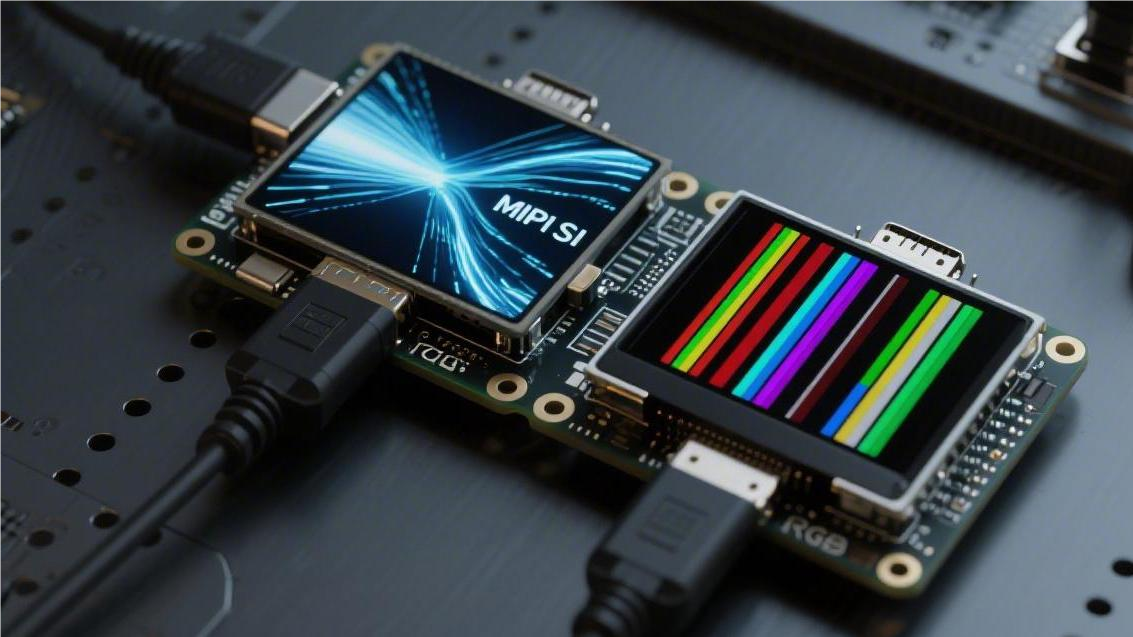
The MIPI DSI single-lane bandwidth reaches up to 4.5 Gbps, requiring only 4 sets of differential lines to support 4K high resolution. It features strong anti-interference capabilities and is extrem...
Sunlight readable TFT displays must feature a high brightness of over 1000 nits and a contrast ratio of 800:1. Operationally, an anti-glare (AG) coating needs to be applied to the screen surface co...
댓글 남기기
이 사이트는 hCaptcha에 의해 보호되며, hCaptcha의 개인 정보 보호 정책 과 서비스 약관 이 적용됩니다.