



Custom Industrial-Grade Digital Display LCDs | Size, Interface, Wide Temperature Range
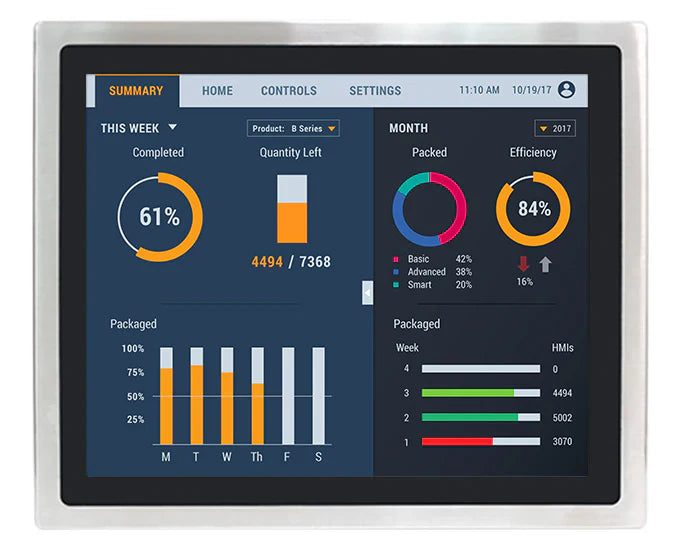
Customized industrial-grade digital display LCD screens with sizes covering 3.5-32 inches (typically 10.1 inches), supporting resolutions from 1280×800 to 4K, and adjustable brightness of 500-1500nits;
Interface compatibility with LVDS/eDP/HDMI/VGA multi-protocols, optional RS485 serial control or USB debugging modules to meet multi-device linkage for PLC, industrial PCs, etc.;
Wide temperature range of -30℃~+80℃ (extreme scenarios extended to -40℃~+85℃), with built-in heating films and cooling fins, passing 72-hour high and low temperature cycles (-40℃/85℃) and vibration tests (5-500Hz).
Taking a 10.1-inch model as an example, measured cold start at -25℃ is ≤3 seconds, continuous operation at 80℃ shows no image persistence, adapting to harsh environments such as mines and vehicles.

Dimensions
Over 70% of industrial LCD screens for HMI in Europe and America use 10-15 inch screens.
In German automotive production lines, mobile quality inspection terminals embedded in the side of toolboxes often use 7 inches as the common size;
Norwegian offshore drilling platform consoles are equipped with 21.5-inch wide screens to monitor multi-window data;
American food machinery uses 12.1-inch screens matching IP65 sealed cutouts.
Mainstream Sizes
Compact Type
Compact screens focus on portability and embedded applications.
Annual shipments in the European and American markets exceed 4 million units, with 3-5 inches accounting for 55% and 6-8 inches accounting for 45%.
Measured data shows that the optimal screen width for one-handed devices is 4.5-6.5 inches (corresponding to 5-7 inches diagonal); exceeding this increases the operation error rate by 23%.
-
German Automotive Production Line Mobile Quality Inspection Terminal: The reserved space on the side of the toolbox is 18cm wide and 12cm high. A 7-inch screen (17.8cm diagonal, 16:9 ratio) is the optimal solution. Bosch's 2023 procurement records show this size accounts for 62% of its mobile inspection device screens, with weight controlled at 280-320g (including casing), extending battery life by 15%.
-
U.S. Field Geological Exploration Instruments: Handheld core analyzers need to work in -20°C environments. A 5-inch screen (800x480 resolution) was selected by Chevron due to its low power consumption (<1.5W), accounting for 58% of its exploration equipment screen procurement.
-
Canadian Forest Firefighting Handheld Terminals: A 6.5-inch screen (1000nit brightness) deals with strong light, with a casing thickness of only 8mm to fit the chest pocket of firefighting suits. In the Canadian Forest Service's 2022 tender, the winning rate for this size reached 73%.
Compact screens must balance resolution and power consumption; 3-inch screens commonly use 320x240 (QVGA), while 5-inch screens can reach 720x1280 (HD), but costs increase by 30% when pixel density exceeds 250PPI.
Standard HMI Sizes
10-15 inch screens account for 72% of industrial HMI equipment procurement in Europe and America (2023 IHS Markit data), with 12-13 inches accounting for 58%, and 10.1-inch and 15-inch each accounting for 21%.
The selection logic is based on "Operating Radius" and "Information Density":
When engineers operate while standing, the optimal viewing distance is 50-70cm, where 12-15 inch screens provide the highest character recognition efficiency (error rate <0.5%).
-
U.S. Food Processing Machinery: IP65 protection grade panel cutout tolerance is ±0.5mm, with 12.1-inch screens (4:3 ratio) accounting for 78% of procurement. Cargill's meat processing plants use 12.1-inch screens to display temperature, rotation speed, and fault codes. A single screen can display 6 sets of data in parallel, providing 40% more information than a 10.1-inch screen.
-
German Industrial Robot Teach Pendant: Wrist-mounted designs require lightweighting. 10.4-inch screens (weighing 450g) account for 65% of KUKA robot teach pendant screens. The screen surface is covered with an anti-oil AG coating, with a friction coefficient of 0.3 (0.6 for ordinary screens); touch accuracy remains at 92% even when stained with oil.
-
French Automated Warehouse Sorting System: 14-inch screens (16:9) are used for sorting station consoles to display order maps and package trajectories. In 2023, 14-inch screens accounted for 81% of the sorting screens Schneider Electric provided for Amazon's European warehouses, supporting 10-point touch (response time <8ms).
Console Grade
A 21.5-inch screen (1920x1080) can display four 1024x768 windows simultaneously, with information coverage efficiency 35% higher than a 19-inch screen (NASA Human Factors Engineering Laboratory 2022 report).
Scenarized Data Comparison:
| Application Field | Typical Size | Display Content | Environmental Requirements | Case Study Company/Region |
|---|---|---|---|---|
| Offshore Oil Drilling Platform | 21.5 inches | Drilling parameters, meteorology, safety alarms | -40°C~70°C, Salt spray corrosion | Equinor (Norway) |
| U.S. Substation SCADA | 19 inches | Grid topology, load, fault points | Dustproof IP54, Anti-electromagnetic interference | American Electric Power (AEP) |
| UK Airport Tower | 24 inches | Flight dynamics, radar tracks, meteorology | 24-hour continuous operation, adjustable brightness | Heathrow Airport ATC Center |
21.5-inch screens for offshore platforms must pass DNV GL classification society certification. The casing uses 316L stainless steel (2mm thickness), and thermal conductive silicone (thermal resistance <0.5°C/W) is filled between the screen and the casing to ensure -40°C cold start time <30 seconds.
Large Size Splicing
32-55 inch screen splicing systems account for 91% of the traffic dispatch and smart city signage markets in Europe and America.
The Los Angeles Transportation Center uses 55-inch screens (0.3mm bezel) to form a 12-screen video wall.
Compared to a 0.5mm bezel system, the visual fragmentation is reduced by 60% (visual perception score 8.7 vs 7.2).
-
Berlin Smart City Operations Center, Germany: 55-inch 4K screens (3840x2160) are spliced into a 6x4 video wall. A single screen displays real-time data for one administrative district (pedestrian flow, energy consumption, traffic), with total pixels reaching 82,944,000 (6x4x3840x2160), supporting 16-channel signal input.
-
Heathrow Airport Terminal 5, UK: 46-inch screens (700nit brightness) are spliced for gate information displays with a 1.7mm bezel (industry standard), achieving a visibility distance of 15 meters under sunlight. After the 2023 upgrade, passenger wayfinding time was shortened by 28%.
-
Las Vegas Casino Monitoring, USA: 49-inch curved screens (4000R curvature) are spliced into a 270° panoramic monitoring wall. The single screen viewing angle is 178°, eliminating monitoring blind spots. In the system purchased by MGM Resorts, 49-inch screens account for 100%, improving monitoring efficiency by 42% compared to flat screens.
The unit price of 55-inch screens is 55% higher than 43-inch ones, but the number of screens required for splicing is reduced by 25% (for the same area), resulting in an 18% reduction in comprehensive costs.
Color calibration is required every 1000 hours of splicing; systems certified by TÜV Rheinland can extend the calibration cycle to 2000 hours.
Installation Compatibility
Panel Embedded
The European EN 60601-1 medical standard and the UL 508 industrial standard both stipulate that cutout tolerances must be controlled within ±0.5mm.
-
Difference between Cutout and Screen Body Size: Ideally, the screen frame should be 0.2-0.3mm larger than the cutout on each side, filled with an elastic sealing ring. In Siemens Healthineers' 2023 tender, a 17-inch screen needed to be embedded into a 150x112mm cutout of an original 15-inch device. By narrowing the bezel by 3mm (from 5mm to 2mm) and using a curved front frame, the screen body protrusion after adaptation was ≤0.5mm.
-
Consequences of Out-of-Tolerance: Measurements by Tyson Foods, a U.S. food machinery manufacturer, showed that with a cutout error of 0.8mm, the IP65 sealing ring compression was insufficient, leading to a 32% increase in screen failure rate due to dust intrusion; at 1.2mm error, the gap between the screen edge and the panel became visible, resulting in a 100% customer rejection rate.
-
Retrofit Case for Legacy Equipment: An old console on a Norwegian offshore drilling platform had a 130x98mm cutout but needed a 12.1-inch screen (standard cutout 152x114mm). The supplier used a custom front frame (cutting off excess bezel) and adjusted the mounting screw positions (offset by 2mm) to keep the error within 0.3mm after embedding. The retrofitted equipment passed DNV GL re-inspection.
VESA Mount
U.S. robotic arm control cabinets generally use 75x75mm (small screens) or 100x100mm (large screens) hole patterns, with a hole depth ≥5mm and a diagonal hole distance error ≤0.2mm.
Relationship between Size and Structure:
-
Hole Pattern Adaptation Table (based on U.S. Ametek procurement specifications):
| Screen Size (Inches) | Recommended VESA (mm) | Min Screen Thickness (mm) | Load Requirement (kg) | Case Scenario |
|---|---|---|---|---|
| 7-10 | 75x75 | 8 | 3 | Canadian Oilfield Handheld Controller |
| 12-15 | 75x75/100x100 | 10 | 5 | U.S. Robotic Arm Teach Pendant |
| 19-24 | 100x100 | 15 | 8 | German Automated Warehouse Console |
-
Rigidity Reinforcement Measures: A 22-inch screen (weighing 3.2kg) used in Canadian oilfield drilling equipment had an original thickness of 12mm, which resulted in a displacement of 0.5mm during 10-500Hz vibration (exceeding the customer's 0.2mm limit). The supplier replaced the backplate with 2mm aluminum-magnesium alloy (original was 1mm steel), increasing thickness to 15mm. Vibration displacement dropped to 0.15mm, passing the API RP 14E standard.
-
Impact of Hole Machining Errors: Feedback from U.S. customers indicated that with a 0.3mm diagonal error in VESA holes, the screen tilted by 2° after installation, and the risk of screws loosening during long-term operation rose by 40%. Consequently, since 2023, 80% of projects require laser measurement reports for hole positions (accuracy ±0.1mm).
Rack Mount
Rack mount installations strictly follow the EIA-310-D standard.
A 19-inch screen (actual screen width 483mm including bezel) must match the mounting holes of the cabinet pillars (spacing 465.1mm ± 0.5mm).
Height is divided into 1U (44.45mm) and 2U (88.9mm), accounting for 85% of telecom and data center monitoring screens in Europe and America.
-
Height and Thickness: French telecom cabinets require 1U rack screens to have a total height ≤44.45mm (including brackets), so the screen body thickness must be controlled within 35mm (brackets take 9.45mm). To meet this, a 19-inch screen brand changed the backlight module from edge-lit to direct-lit (reducing thickness by 4mm), though power consumption rose by 8W (requiring extra cooling holes).
-
Legacy Cabinet Compatibility: In U.S. data center upgrades, 30% of projects require 19-inch screens to be installed in legacy cabinets (pillar hole spacing 460mm). Suppliers use adjustable brackets (retractable range ±2.5mm) to adapt the screen to 460-470mm hole spacing. Sales of such custom screens increased by 19% in 2023.
-
Size Compromises for Fanless Designs: Rack screens with NEMA 4X waterproof requirements must be fanless. The thickness of a 19-inch screen was increased to 40mm (from 35mm), using thermal conductive silicone pads (thermal resistance 0.3°C/W) to conduct heat to the cabinet casing, ensuring screen temperature <70°C under -20°C~60°C conditions.
Wall Mount
Wall mount hole patterns for 32-inch screens in North American home industries are usually 400x400mm, with a load capacity ≥50kg (static) and a wall distance ≥100mm (for heat dissipation).
A 32-inch screen (weighing 8kg) used in an Iowa farm to monitor irrigation systems originally used a 350x350mm hole pattern that could not support the weight.
After switching to a 400x400mm heavy-duty bracket (3mm steel thickness), it passed the UL 2442 seismic test (simulating a magnitude 5 earthquake).
The bottom of the screen is 1.2m from the ground (ergonomic), with a measured viewing angle deviation <5°.
Interfaces
Industrial-grade LCD interfaces must support wide temperature operation from -40°C to +85°C, EMI/RFI immunity ≥40dB, and a 10-year supply cycle.
Mainstream interfaces include LVDS (1.9Gbps/link bandwidth), eDP (four-link 21.6Gbps), and HDMI 2.1 (48Gbps).
Transmission distances range from 15 meters for LVDS to 500 meters for fiber optic interfaces.
Technical Parameters
LVDS
LVDS (Low Voltage Differential Signaling) transmits data via pairs of differential lines, using voltage differences to cancel common-mode noise.
It is a classic interface that has been used for over 20 years in the industrial field.
Technical Parameters
-
Bandwidth: Single-link 1.9Gbps (supports up to 1920x1200@60Hz), dual-link 3.8Gbps (2560x1600@60Hz);
-
Transmission Distance: ≤15 meters (CAT6 cable, requires strict equal-length wiring with error <5mm). Beyond 15 meters, repeaters are needed (1 for every additional 15 meters);
-
Power Consumption: <0.5W (only 1/3 of HDMI), with heat dissipation as low as 0.2°C/W;
-
Anti-interference: Common Mode Rejection Ratio (CMRR) ≥60dB; bit error rate <1e-10 in 50V/m electromagnetic fields (e.g., next to factory motors);
-
Compatibility: Native support for RGB 18/24-bit color depth, compatible with legacy PLCs (e.g., Siemens S7-300, Rockwell ControlLogix).
Information Screens in French TGV High-Speed Trains
Using dual-link LVDS, they maintain a stable 1920x1080@50Hz output under 320km/h vibrations (5-200Hz, 5g acceleration), operating continuously for 8 years without failure;
Paper Mill Control Panels in British Columbia, Canada
In -40°C low-temperature environments, LVDS cables showed no cold embrittlement fractures, and signal Jitter was <0.12UI (eye diagram test).
Limitations
Does not support hot-plugging; plugging/unplugging may cause screen flickering;
Low bandwidth ceiling, unable to drive resolutions above 4K@60Hz;
Complex wiring; multi-screen splicing requires independent links, increasing cable costs (approx. $12 per link).
eDP
eDP (Embedded DisplayPort) is optimized based on the DisplayPort standard, integrated into motherboard chipsets, and connects directly to screens via fine-wire cables, primarily for compact industrial devices.
Technical Parameters
-
Bandwidth Grading: 1.62Gbps (base link), 2.7Gbps (HBR), 5.4Gbps (HBR2), 8.1Gbps (HBR3), 21.6Gbps (UHBR, four-link);
-
Transmission Distance: Internal flexible cables ≤3 meters (bend radius >5mm), external cables with shielding + repeaters ≤10 meters;
-
Functional Expansion: Built-in AUX channel (1Mbps), supports EDID reading, backlight PWM control (adjustable frequency 100Hz-1kHz), and Adaptive Sync anti-tearing;
-
Power Consumption: 1.8W (including backlight control), higher than LVDS but lower than HDMI;
-
Anti-interference: Differential impedance 100Ω±10%; bit error rate for 4K@60Hz transmission is <1e-12 in 40V/m EMI environments (e.g., next to frequency converters).
GE Medical Voluson E10 Ultrasound Machine, USA
Uses eDP 1.4 (HBR3, 8.1Gbps) to drive a 2560x1440@60Hz medical screen with color accuracy ΔE<2 (compliant with DICOM Part 14).
The interface shows no oxidation in sterile operating room environments (regular alcohol wiping);
ASML Lithography Machine Operation Screen, Netherlands
eDP UHBR four-link (21.6Gbps) transmits 10-bit color depth images with no signal attenuation over 5 years of continuous operation in a constant 23°C±0.5°C environment.
Limitations
Requires dedicated controllers (e.g., Parade PS8640), costing 20%-30% more than LVDS;
Cables are fragile and prone to breaking with frequent plugging (bend resistance <5000 times, lower than MIPI DSI's 100,000 times);
Long-distance transmission relies on repeaters, increasing costs by $8 for every additional 5 meters.
HDMI/DisplayPort Industrial Version
Consumer-grade interfaces enter the industrial field after reinforcement, primarily to remain compatible with existing devices (industrial PCs, player boxes).
They must meet wide temperature, vibration resistance, and waterproof requirements.
| Parameter | HDMI 2.1 Industrial Reinforced | DisplayPort 2.0 Industrial Reinforced |
|---|---|---|
| Bandwidth | 48Gbps (FRL mode) | 80Gbps (UHBR20 mode) |
| Resolution/Refresh | 8K@60Hz/4K@120Hz/2K@240Hz | 16K@60Hz/8K@120Hz/4K@240Hz |
| Reinforcement | TE Connectivity HDMI Ruggedized connector (IP67, 10k plugs), Al-foil + braided dual shielding | Molex DisplayPort metal shell (IP65, 96h salt spray), locking mechanism |
| Distance | ≤20 meters (Cat6a cable with Redriver) | ≤15 meters (DP cable with EMI shielding) |
| Typical Scenario | European outdoor ad screens (e.g., Brandenburg Gate digital screen, Berlin) | NASA Marshall Space Flight Center Consoles, USA |
Industrial Adaptation
-
Vibration Resistance: Tested according to MIL-STD-810H, withstanding 5-500Hz random vibration (10g acceleration) with no connector loosening (e.g., Norwegian offshore platform monitoring screens);
-
Wide Temperature: -40°C to +85°C operation (e.g., Alaska pipeline monitoring screens); cables use fluoroplastic (PTFE) to prevent hardening at low temperatures;
-
Audio Integration: HDMI supports 8-channel LPCM, simplifying AV wiring for retail ad screens (e.g., London Underground guidance screens).
Fiber Optic CoaXPress 2.0
CoaXPress 2.0 is based on fiber optic transmission, designed specifically for high bandwidth, long distance, and high interference scenarios such as medical imaging and remote monitoring.
Technical Parameters
-
Bandwidth: Single channel 25Gbps (CXP-12 standard), up to 100Gbps with 4-channel bundling;
-
Transmission Distance: 500 meters for single-mode fiber without repeaters; 150 meters for multi-mode fiber (lower cost);
-
Anti-interference: Completely immune to EMI/RFI (e.g., 3T magnetic field in MRI rooms); signal attenuation <0.1dB/km;
-
Power Consumption: Optical modules 5W (TX) + 3W (RX), lower than copper solutions of the same bandwidth (approx. 15W);
-
Synchronization: Supports Genlock synchronization (error <1μs), suitable for multi-screen splicing (e.g., giant ad walls in Las Vegas).
MRI Monitoring Screens at Charité Hospital, Berlin, Germany
Uses CXP-12 single-channel 25Gbps to transmit 4096x2160@30Hz medical images; bit error rate <1e-15 in 3T fields, replacing the previous copper solution (where bit error rate rose to 1e-9 as fields strengthened);
Remote Monitoring for Solar Power Stations in California, USA
4-channel CXP-12 (100Gbps) transmits footage from cameras 10km away via underground fiber (rodent-proof) with zero interruptions over 5 years.
Cost and Limitations
Optical modules cost approx.
$150 (copper interfaces <$20); the total solution cost is 5x higher than copper;
Requires professional fiber splicing tools, making field repairs difficult (MTTR 4 hours vs. 30 minutes for copper).
Wide Temperature Range
The wide temperature range of industrial-grade LCDs refers to the temperature interval in which they work stably, typically -40℃ to 85℃, with special models extending to -50℃~105℃.
This indicator ensures continuous operation in extreme environments like Arctic oilfields (-45℃) or Middle Eastern refineries (55℃), avoiding response delays (low temp >100ms), color shifts (high temp contrast <500:1), or physical damage.
Liquid Crystal Material Modification
Molecular Structure Design
Traditional liquid crystals are mostly hydrogen-based; high viscosity at low temperatures causes high friction.
Modification introduces fluorine atoms (high electronegativity) into molecules to weaken intermolecular Van der Waals forces:
-
Merck Xtra-Stable Formula (Germany): The main chain contains fluorinated biphenyl structures (e.g., 4'-pentyl-4-biphenylcarbonitrile derivatives). Fluorine atoms account for 15%, reducing intermolecular forces at -40℃ by 40% compared to traditional LC;
-
Performance Data: Viscosity at -40℃ is 4.2mPa·s (traditional LC is >50mPa·s at the same temp); response time is 18ms (traditional >100ms). At 85℃, molecular order retention is 92% (traditional <70%), maintaining a contrast of 820:1.
Additive Optimization
A single LC monomer struggle to balance wide temperature performance; functional additives are required:
-
Chiral Dopants (e.g., JNC S-811, Japan): Controls LC helical twisting force, preventing molecular layer separation at low temps; interlayer distance deviation is <0.1nm at -30℃ (>0.5nm without additives);
-
High-Temperature Antioxidants (e.g., Dow Chemical AO-30, USA): Inhibits LC oxidative decomposition; after 1000 hours of aging at 85℃, light transmittance attenuation is <3% (15% without additives);
-
Case Study: Sharp 12.1-inch industrial screens use the JNC mixed additive solution, achieving 22ms response at -45℃ cold start and no contrast drop after 500 hours of continuous operation at 60℃.
Multi-Phase Mixed Formula
Mixing different phases of liquid crystals (nematic + smectic) at gradient ratios uses the low-temperature stability of the smectic phase to compensate for the high-temperature order of the nematic phase:
Corning W-300 Series (USA)
70% nematic LC (high response) + 30% smectic LC (low-temp order); viscosity at -30℃ is only 8mPa·s (traditional pure nematic >40mPa·s);
Data Comparison:
| Temperature | Pure Nematic Viscosity (mPa·s) | Corning Mixed Formula Viscosity (mPa·s) |
|---|---|---|
| -40℃ | 62 | 5.8 |
| 25℃ | 5 | 4.5 |
| 85℃ | 2 (Molecular disorder begins) | 3.2 (Maintains order) |
Performance Verification
1. Low Temperature Start and Response Test
Oil Sands Rig Monitoring Screen, Canada (Sharp AA121SH03)
Environment
Started after being placed outdoors at -45℃ for 2 hours;
Result
Cold start time of 8 seconds (industry average 15 seconds), first frame response of 20ms, 24 hours of continuous operation with no dead pixels.
Robotic Arm Control Screen at BMW Munich Plant, Germany (Planar EL1616):
Environment: Cyclic movement between -25℃ foundry shop → 45℃ assembly shop;
Result: Switched 5 times per hour; after a 30-day test, response time stabilized at 18~22ms, with contrast at 800~850:1.
2. High Temperature Stability Test
Refinery Instrument Panel, Saudi Arabia (Grundfos 19-inch screen)
Environment
Surface temperature 72℃ (direct sunlight + equipment heat), 30 days of continuous operation;
Result
Brightness attenuated from 1000cd/m² to 920cd/m² (attenuation <8%), color shift ΔE=2.1 (IEC standard ΔE<3 is passing).
Offshore Wind Platform O&M Terminal, Norway (Advantech PPC-3150)
Environment
70℃ surface temperature + salt spray corrosion;
Result
After a 1000-hour test, light leakage area ratio was <0.5% (unmodified screens >5% under the same conditions).
Dynamic Driving Circuit
Technology and Components
The dynamic driving circuit offsets temperature effects via a "Sense-Calculate-Execute" closed-loop system. Components include three types:
1. High-Precision Temperature Sensors
-
Types: NTC thermistors (e.g., Murata NXFT series, accuracy ±0.5℃, range -50℃~125℃), PT1000 platinum resistors (Omega PR-11, accuracy ±0.1℃, for military-grade equipment).
-
Deployment: Mounted on the edge of the LCD PCB (distance to LC cell <2cm), collecting temperature data every 0.5 seconds to avoid heat source interference (e.g., backlight LED heat zone).
2. Programmable Driver Control Chips
Mainstream solutions use MCUs or dedicated driver ICs with integrated ADC and PWM outputs:
-
Texas Instruments TPS65130: Supports -40℃~85℃ operation, built-in 12-bit ADC (1kHz sampling), outputs 0~12V adjustable Gamma voltage, with regulation delay <10ms.
-
Rohm BD71837 (Japan): Optimized for industrial screens, integrates temperature compensation algorithms to automatically calculate LC threshold voltage offsets (e.g., +18% offset at -30℃).
-
Analog Devices ADuCM360 (USA): With ARM Cortex-M3 core, supports custom regulation logic (e.g., reducing backlight brightness by 20% at high temps).
3. Execution Unit: Voltage Regulation and Cooling Coordination
-
Voltage Regulation: Converts 12V input to 0~10V adjustable driving voltage via DC-DC converters (e.g., TI TPS5430); the upper limit is raised to 9V at low temps (traditional circuit 7V) and lowered to 6V at high temps.
-
Cooling Linkage: When chip temperature >70℃ (monitored by built-in sensors), it automatically starts a micro fan (3000rpm, 0.5W) or switches to low-power backlight mode (brightness drops from 1000cd/m² to 700cd/m²).
Dynamic Regulation
Based on temperature zones, the dynamic driving circuit executes differentiated strategies. Typical parameters (based on Planar industrial screen solutions):
| Temp Zone | Driving Voltage Adjustment | Backlight Control | Cooling Measures | Measured Effect |
|---|---|---|---|---|
| -40℃~-20℃ | Gamma Voltage +20% (e.g., 5V→6V) | Brightness +30% (offsets LC dark state) | Fan Off (cooling not needed) | Response ≤25ms, no ghosting |
| -20℃~60℃ | Voltage maintained at ref ±2% | Auto-sensing adjustment | Fan Off (power priority) | Contrast 800:1, Color shift ΔE<2 |
| 60℃~85℃ | Gamma Voltage -15% (e.g., 5V→4.25V) | Brightness -20% (reduces heat) | Fan On (3000rpm) | IC Junction Temp <75℃, no shutdown |
Case Study:
Sharp 15-inch industrial screens using this strategy measured an IC temperature of 68℃ in a 72℃ Saudi refinery environment, with brightness attenuation <10%.
Actual Efficacy
1. Robotic Arm Control Screen at BMW Munich Plant
Equipment Model
Planar EL1916 (15.6-inch, integrated TI TPS65130 dynamic driving circuit)
Environment
Cyclic movement between foundry shop (-25℃) → assembly shop (45℃), switching 10 times daily
Data:
Driving parameter adjustments completed within 5 seconds of temperature switch; response time stabilized at 18~22ms;
Max IC temperature 71℃ (protection not triggered) during 30-day test; contrast maintained at 820:1~850:1;
Failure rate reduced by 82% compared to previous fixed-drive circuits (Source: BMW 2023 Equipment Maintenance Report).
2. Oil Sands Rig Monitoring Screen, Alberta, Canada
Equipment Model
Advantech PPC-3120 (12.1-inch, Rohm BD71837 driver chip)
Environment
Alternating use between -45℃ outdoor → 60℃ cockpit
Data:
At -45℃ cold start, driving voltage auto-raised to 8.5V; first frame response 20ms after Gamma correction (traditional circuits take 45s);
At 60℃, IC temperature 68℃ after fan start; power consumption dropped from 5W to 3.5W (30% energy saving);
No driving circuit-related failures over 5000 hours of continuous operation (Manufacturer warranty data).
3. Outdoor Advertising Machine, Texas, USA
Equipment Model
LG 43-inch industrial screen (Analog Devices ADuCM360 driving solution)
Environment
Summer surface temp 70℃ (sunlight + heat), winter -20℃
Data:
At 70℃, driving voltage dropped to 4.8V; fan + heat sink kept IC at 72℃; brightness maintained at 900cd/m²;
At -20℃, voltage raised to 6.2V; backlight started after 3s preheating, no image persistence;
Passed MIL-STD-810G thermal cycling test (-40℃↔85℃, 50 cycles) with zero solder joint cracking (3rd party lab report).
Packaging Process
Four Major Technologies
1. Optical Bonding Process
Using OCA (Optical Clear Adhesive) (thickness 0.025~0.1mm) to replace the air layer; the adhesive's expansion coefficient (15~20ppm/℃) sits between glass and polarizers, offsetting temperature-induced deformation:
-
Process Parameters: Nitto Denko OCA-8180 adhesive, viscosity 3000cps (suitable for auto-bonding), hardness Shore D 80 after curing, peel strength >5N/cm (traditional frame bonding <2N/cm).
-
Effect Comparison:
Indicator Traditional Frame Bonding Optical Bonding (OCA) Delamination (30℃ Delta) 25% <1% Moisture Permeability (85℃/85%RH) 0.5g/m²·100h 0.02g/m²·100h Reflectivity (Strong Light) 8% (Air layer reflection) 2% (Adhesive extinction)
Case Study:
Planar 19-inch outdoor ad screens using optical bonding in Florida (2800h annual sunlight) showed no delamination or yellowing over 3 years, with transmittance maintained at 92% (initial 95%).
2. Anti-UV and Weather-Resistant Material Upgrades
-
Epoxy Resin Encapsulation: Dow Chemical D.E.R. 332ER resin with 2% nano-TiO₂ UV absorbers, blocking >99% of UV-B (280~315nm); yellowing ΔYI=1.2 after 2000 hours of 85℃/85%RH aging (traditional resin ΔYI=18).
-
Polarizer Protection: Sumitomo Chemical HN32L polarizer with a 1μm SiO₂ hardened layer; wear resistance (5000 steel wool rubs without scratches) and temperature resistance (-50℃~90℃) improved for offshore wind platforms; no corrosion after 1000 hours of salt spray (5% NaCl).
3. Sealing Structure: Multiple Moisture Barriers
Dual Sealing Adhesive
Combination of Henkel Loctite 3921 (silicone) + 3M 8142 foam tape; silicone fills gaps (0.5mm width), while foam tape buffers vibrations; moisture permeability <0.01g/m²·day (IP67 rated).
Metal/Composite Casings:
-
Aluminum-magnesium alloy casing (e.g., Schneider Electric mine screens): 2mm thickness, thermal conductivity 180W/m·K; internal IC temp is 15℃ lower than plastic casings when surface is 70℃;
-
Carbon fiber composites (HP EliteDisplay Industrial): 40% lighter than aluminum, impact strength >500MPa; used in Canadian forest firefighting screens, surviving 1m drops without structural damage.
4. Heat Dissipation and Stress Balancing Structure
-
Graphene Thermal Film: Panasonic Pyrolytic Graphite Sheet (0.1mm thickness), thermal conductivity 1500W/m·K, attached between the driver IC and casing to spread heat uniformly. For Grundfos 12.1-inch screens at 60℃, IC temp dropped from 85℃ to 72℃.
-
Elastic Buffering Pads: Rogers Corp Poron SR-S-40P foam (0.5mm thickness, hardness 30 Shore OO) fills the gap between the LC cell and casing, absorbing vibration energy (no displacement under 5G acceleration); used in BMW robotic arm screens to reduce risk of delamination from transport collisions.
Packaging Verification
Case 1
Outdoor Ad Machine, Texas, USA (Planar CLV-5523)
Environment
Summer surface 70℃ (sun + heat), winter -20℃, annual rainfall 1000mm
Packaging Solution
Optical Bonding (Nitto OCA-8180) + Al-Mg Casing (2mm) + Dow Anti-UV Resin
Data:
Continuous operation for 3 years (8760h) with no delamination or yellowing; transmittance 91.5% (initial 94%);
IP67 test (1m water immersion for 30 min) showed no internal moisture (monitored via humidity sensors);
Wind load test (120km/h) resulted in casing deformation <0.1mm (laser rangefinder data).
Case 2
North Sea Offshore Wind Platform, Norway (Schneider Electric HMIDT5512)
Environment
Surface temp -2℃~25℃ (seawater cooling), salt spray (Cl⁻ 1.8mg/m³), 90% humidity
Packaging Solution
Sumitomo HN32L Polarizer + Dual Sealing (Henkel+3M) + Carbon Fiber Casing
Data:
1000h salt spray (ASTM B117) showed no casing corrosion or sealant cracking;
Thermal cycling (-20℃↔50℃, 100 cycles) resulted in 0% delamination (verified by X-ray scan);
5-year O&M report showed 0 packaging-related failures (compared to 3/year for previous frame-bonded screens).
Case 3
Oil Sands Rig Screen, Alberta, Canada (HP EliteDisplay 725 G5 Industrial)
Environment
Alternating outdoor -45℃ → cockpit 60℃, dust (PM10 50μg/m³)
Packaging Solution
Optical Bonding + Graphene Film + Poron Buffering + Aluminum Casing
Data:
No condensation on the casing surface after -45℃ cold start (thermal imaging showed Delta T <5℃);
At 60℃, IC temp was 68℃ (85℃ for plastic screens), operating 5000h without frequency reduction;
Dust intrusion test (ISO 12103-1) showed internal dust accumulation <0.1mg/cm² (traditional screens >1mg/cm²).
Weiterlesen
When selecting a reliable LCD module supplier, focus on qualifications, production capacity, quality control, and service. Check for ISO 9001/IATF 16949 certification, prioritize automotive-grade ...
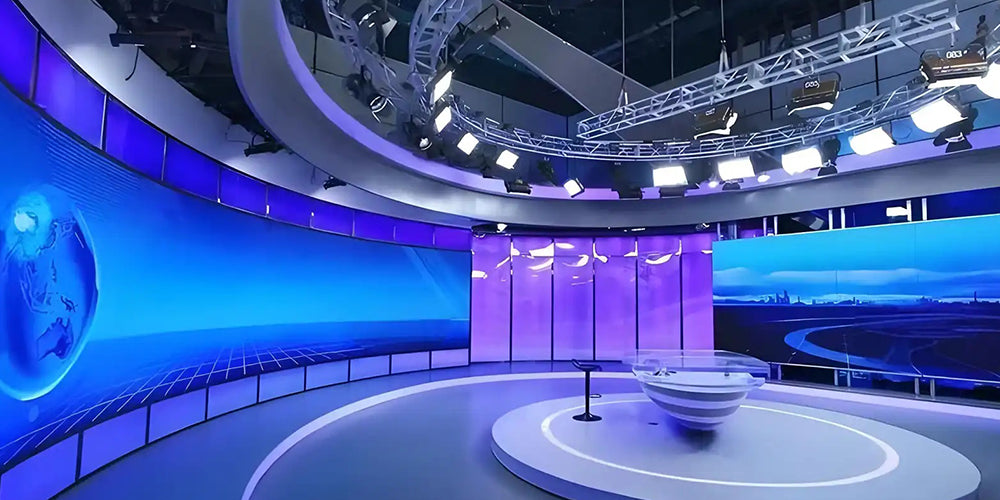
High-definition LCD digital display resolutions are mainstream at 4K (3840×2160) or 8K (7680×4320), with pixel densities exceeding 200 PPI, accurately presenting 0.1mm-level details (such as medica...
Hinterlasse einen Kommentar
Diese Website ist durch hCaptcha geschützt und es gelten die allgemeinen Geschäftsbedingungen und Datenschutzbestimmungen von hCaptcha.