


AMOLED Display Modules for Wearables | Bend Radius, Power Savings & Sunlight Visibility
An AMOLED module suits a wearable because it emits per pixel: black pixels draw almost nothing, the panel can be thin enough to curve, and contrast does not depend on a backlight. The three specifications that decide whether it works in a product are the bend radius the module survives, the average power at the brightness your UI actually uses, and the contrast the screen holds in daylight.
Why emissive suits a watch
A watch face is mostly dark. With an emissive panel, dark pixels are off, so the average power follows the lit area rather than the panel size. A liquid-crystal module of the same diagonal carries a backlight that runs whenever the screen is on, whatever the image.
It also shapes the UI: bright text on black is cheaper than the reverse, and a full white background is the most expensive request you can make.
What sets the bend radius
Flexible AMOLED modules are built on a polyimide substrate a few tens of micrometres thick, with thin-film encapsulation replacing the rigid glass lid. Because the substrate is thin, the mechanical neutral axis can be placed inside the stack, and the strain at the emitting layer stays small even at a tight radius.
Three factors move the achievable radius. The thickness of the stack above and below the neutral axis sets the strain for a given bend. The encapsulation and the barrier films set how much moisture and oxygen the edge can resist after bending. The driver integration sets whether the chip sits on the flex or on the substrate, because a chip on the bend is a stress concentrator.
Suppliers usually quote a radius with a direction attached: inward fold, outward fold, or both. A module rated for a tight inward fold may not survive the same radius outward, where the cover layers are in tension.
Static versus dynamic bending
A static radius is the curvature a module holds for its life. A dynamic radius is the curvature it is flexed through repeatedly. The second is usually the harder number, and it depends on cycle count as much as on geometry.
For a watch, the case holds the module at a fixed curvature, so the static figure matters most. For a band that flexes as the wrist moves, the dynamic figure governs, and the qualification should follow the real motion: how far it bends, how often, and at what temperature.
Power at the system level
Panel power is only part of the budget. The driver, the display interface, the touch controller and the graphics work all contribute. Three levers matter most.
First, refresh rate. Driving a static image at a low rate rather than a high one cuts the power spent refreshing the panel, and low-temperature polysilicon oxide backplanes make very low refresh rates practical for always-on content. Second, lit area. A watch face that lights a few hundred pixels costs far less than one that lights the whole panel at the same luminance. Third, luminance. Emitted power rises with brightness, so running the panel at the lowest level that stays legible indoors is the largest single saving in most designs.
State the target as average current per mode — active use, always-on, screen off — measured with final firmware. Datasheet typical power rarely matches a product with a bright default watch face.
Always-on without burning the panel
Always-on mode trades refresh rate, lit area and luminance for battery life. The usual approach shifts the content to a reduced layout, dims it, and refreshes slowly, often at one update per second or less.
The constraint is lifetime. A static bright element left on for hours stresses the same subpixels continuously, so an always-on layout should move, dim, and avoid large saturated areas. Check the supplier's lifetime figure at the luminance and duty cycle your always-on mode will use, not at the manufacturer's reference condition.
Dimming at low brightness
Below a certain level, brightness is controlled by switching the pixels on and off quickly rather than by lowering the current, because low current causes colour shift and luminance instability. The switching frequency and the depth of the modulation decide whether sensitive users perceive flicker.
Many modules dim this way, and many combine it with current control: current sets the coarse level, modulation sets the fine level. Ask for the modulation frequency at the brightness levels your UI uses, and test with a camera at a short exposure, which shows banding that the eye may not consciously notice.
Sunlight visibility
Outdoors, the limiting factor is usually reflected ambient light rather than emitted light. Sunlight bounces off the cover glass and the panel surface, and that reflection adds to the image. Contrast falls because the black level rises, not because the white level is too low.
Peak luminance helps, and high-brightness modes raise it for short periods. The figure that matters is the sustained level under the thermal conditions of the product, not the peak in a press release. A useful specification pairs luminance with the fraction of the screen lit during the measurement, since a small bright area can be driven harder than a full white field.
ISO 9241-307 describes compliance test methods for electronic visual displays and gives a defensible way to state viewing angle, ambient illumination and measurement geometry in a specification.[1] Write the conditions down; a luminance figure without them cannot be compared with a competitor's.
The polarizer trade
Many AMOLED modules include a circular polarizer to suppress reflection from the metal electrodes behind the emitting layer. It works well: the black level outdoors improves substantially, and the panel looks black rather than grey in sunlight.
The cost is emitted light. A circular polarizer absorbs a large share of the light leaving the panel, so the same drive current produces less luminance at the eye. Some designs trade the polarizer for a different back-stack and rely on higher peak brightness instead.
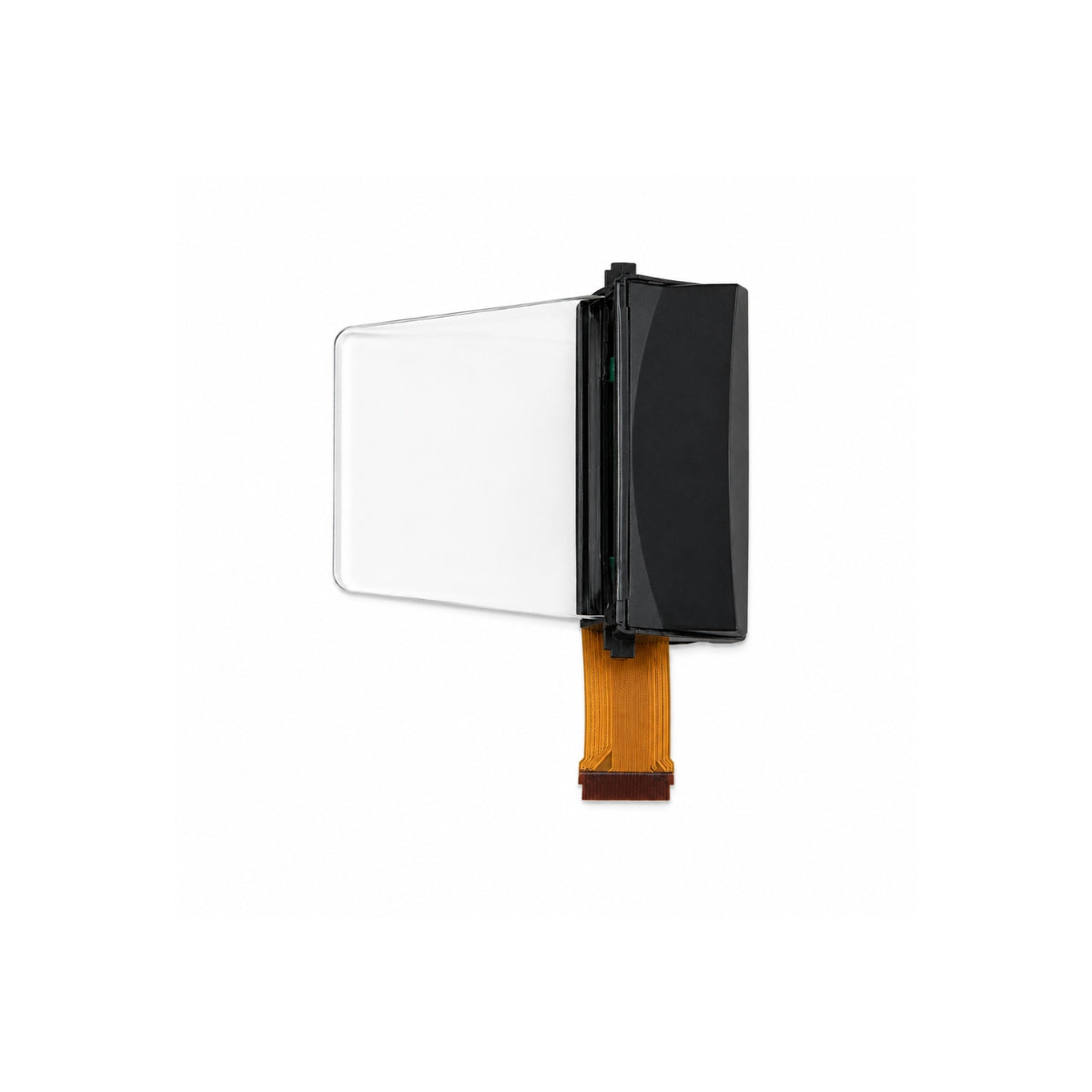
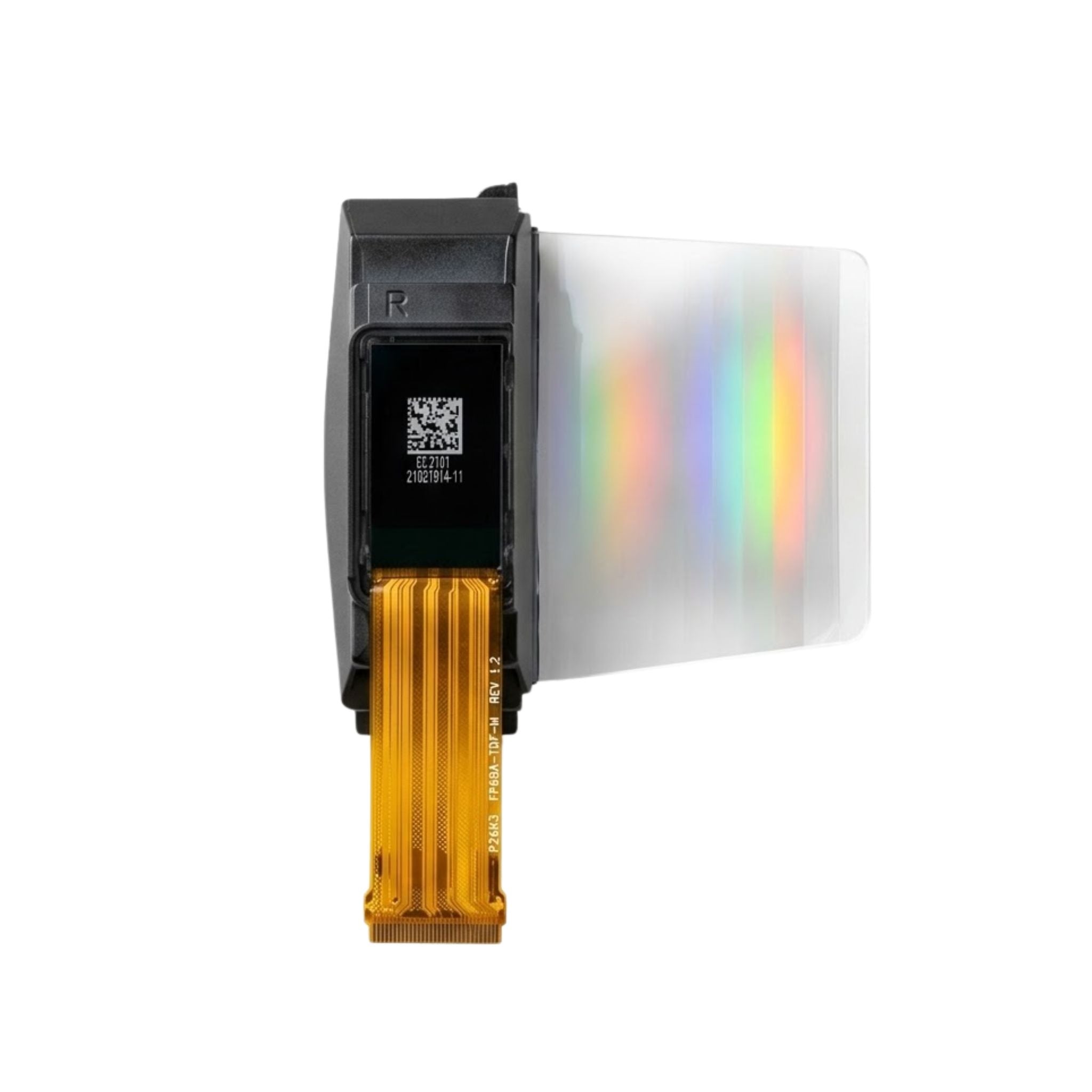
For near-eye products the same logic applies with optics added: the waveguide or combiner loses a large fraction of the light, so the panel's luminance must be specified at the eye, after the optical path.[2]
Heat and lifetime
Emissive materials age faster at high brightness and high temperature. A watch case is a small, sealed volume with a battery and a radio inside it, so heat has nowhere to go. Sustained high-brightness mode therefore runs into a thermal ceiling, and firmware steps brightness down when the case reaches its limit.
Lay out the panel so its brightest content is not directly over the battery, avoid long periods at maximum brightness in always-on mode, and verify the step-down behaviour in a warm chamber rather than on a desk.
Module checklist
| Specification | What to require | Why it matters |
|---|---|---|
| Bend radius | Static and dynamic, with direction and cycle count | Assembly and wear stress differ |
| Luminance | Sustained value at stated lit-area fraction and temperature | Peak figures mislead |
| Reflectance | Measured with the final cover glass and bonding | Sets outdoor contrast |
| Dimming | Modulation frequency at the low brightness levels used | Flicker perception |
| Lifetime | Hours to a stated luminance loss at your duty cycle | Always-on accelerates ageing |
| Stack | Touch layer, polarizer, bonding and cover glass defined | Transmission and thickness |

Integration details that bite
Curving the module changes the optical stack. A bonded cover glass needs an adhesive that stays clear through thermal cycling, with uniform thickness, or the panel shows mura near the curve. An on-cell touch layer saves thickness but must be characterised after bending, because electrode resistance can shift at the curved edge.
For wearable formats, the AMOLED display modules collection covers round and rectangular panels with bonded cover glass; rigid alternatives are in the OLED range, and round formats are grouped under round screens.
Deciding quickly
Confirm the static radius with the real stack, the sustained luminance in a warm case, and the average current in always-on mode. Those three measurements decide whether the module is viable.
References
- ISO 9241-307:2008 — Ergonomics of human-system interaction — Part 307: Analysis and compliance test methods for electronic visual displays. International Organization for Standardization. https://www.iso.org/standard/40102.html
- Hilsum, C. (2010). Flat-panel electronic displays: a triumph of physics, chemistry and engineering. Philosophical Transactions of the Royal Society A, 368(1914), 1027–1082. https://doi.org/10.1098/rsta.2009.0247
더 읽기

Driving a Micro OLED requires a 4-lane MIPI DSI interface supporting 1080P and a high frame rate of 90Hz, with a lane bandwidth reaching 1Gbps. The MCU.

The tooling cost for a custom PMOLED is approximately $2,000 to $5,000, supporting circular or custom-shaped cutting. During operation, a CAD drawing.
댓글 남기기
이 사이트는 hCaptcha에 의해 보호되며, hCaptcha의 개인 정보 보호 정책 과 서비스 약관 이 적용됩니다.