



Do You Need Adjustable Diopters?
Not necessarily. Adjustable diopters are useful when you want to view a headset without glasses and its focus range can accommodate your eyes. Choose independent adjustment if each eye needs a different setting. You can usually skip it if the virtual image is already clear, either unaided or with glasses, contacts, or compatible prescription inserts. Sharing a headset makes adjustment convenient, not mandatory. A spherical focus control does not correct astigmatism or replace an eye examination [1][2].
For a near eye display module, the decision depends on the wearer, the virtual image distance, and the available correction options. Check the adjustment range in both directions, whether each eye adjusts separately, and whether your eyewear fits. Do not choose a module simply because its advertised diopter range is wider.
When Adjustable Diopters Are Worth Having
- You want to use the headset without glasses. Adjustment may compensate for the spherical component of your refractive error, provided the required setting is within the supported range. Residual blur from astigmatism can remain [1][2].
- Your eyes need different focus settings. Independent left and right controls let you set each optical path separately. A single shared control cannot provide two different settings. Existing glasses or inserts may already handle that difference.
- Several people will use the device. Accessible controls and a readable scale can simplify handover. However, a fixed-focus headset can still be shared by people using their own suitable correction.
- Glasses interfere with the fit. Focus adjustment is an option to evaluate, not a guaranteed replacement for the full prescription. Check whether compatible inserts would solve the clearance problem instead.
When Fixed Focus Is Enough
Fixed focus is a reasonable choice when you can read the intended content clearly at the module's virtual image distance and maintain the correct viewing position. That can mean clear unaided vision, comfortable glasses or contacts, or suitable prescription inserts. A prescription does not have to be mild for fixed focus to work with appropriate correction [1].
In a fixed-focus design, the optics establish the virtual image distance without a user focus control. This does not mean every wearer needs glasses. Conversely, an adjustable module does not mean every wearer can remove them.
| Your situation | Practical choice | What to confirm |
|---|---|---|
| Clear image with your normal eyewear | Fixed focus may be sufficient | Frame clearance, eye relief, and usable field |
| Glasses-free viewing is important | Evaluate adjustable focus | Range, sign convention, and residual blur |
| Different focus needed for each eye | Per-eye adjustment or suitable prescription correction | Independent controls and each eye's usable setting |
| Shared device | Either design can work | Reset procedure and correction options for each wearer |
| Blur remains at every setting | Do not assume a wider range is the solution | Fit, optical quality, prescription, and professional eye-care advice |
How Virtual Image Distance Affects the Decision
The display panel's physical position is not the distance at which your eyes focus. In a conventional fixed-focal-plane headset, optics create a virtual image at an apparent optical distance. Adjusting diopters changes the focus setting; it is not the same as changing the depth of objects rendered in a scene.
For an emmetropic eye, or an eye appropriately corrected for distance, the nominal accommodative demand of a virtual image at distance d metres is approximately 1/d diopters. These are optical calculations, not measurements of comfort or the correction range a particular wearer needs [2].
| Virtual image distance | Nominal accommodative demand |
|---|---|
| 1 m | 1.00 D |
| 2 m | 0.50 D |
| 3 m | About 0.33 D |
| 4 m | 0.25 D |
| Optical infinity | Approximately 0 D |
Moving the virtual image from 1 m to 4 m reduces this nominal demand by 0.75 D. It does not prove that a headset will be comfortable, remove a distance prescription, or resolve binocular viewing problems. Accommodation and refractive error must not be treated as interchangeable specifications.
What a Product Page Can Tell You
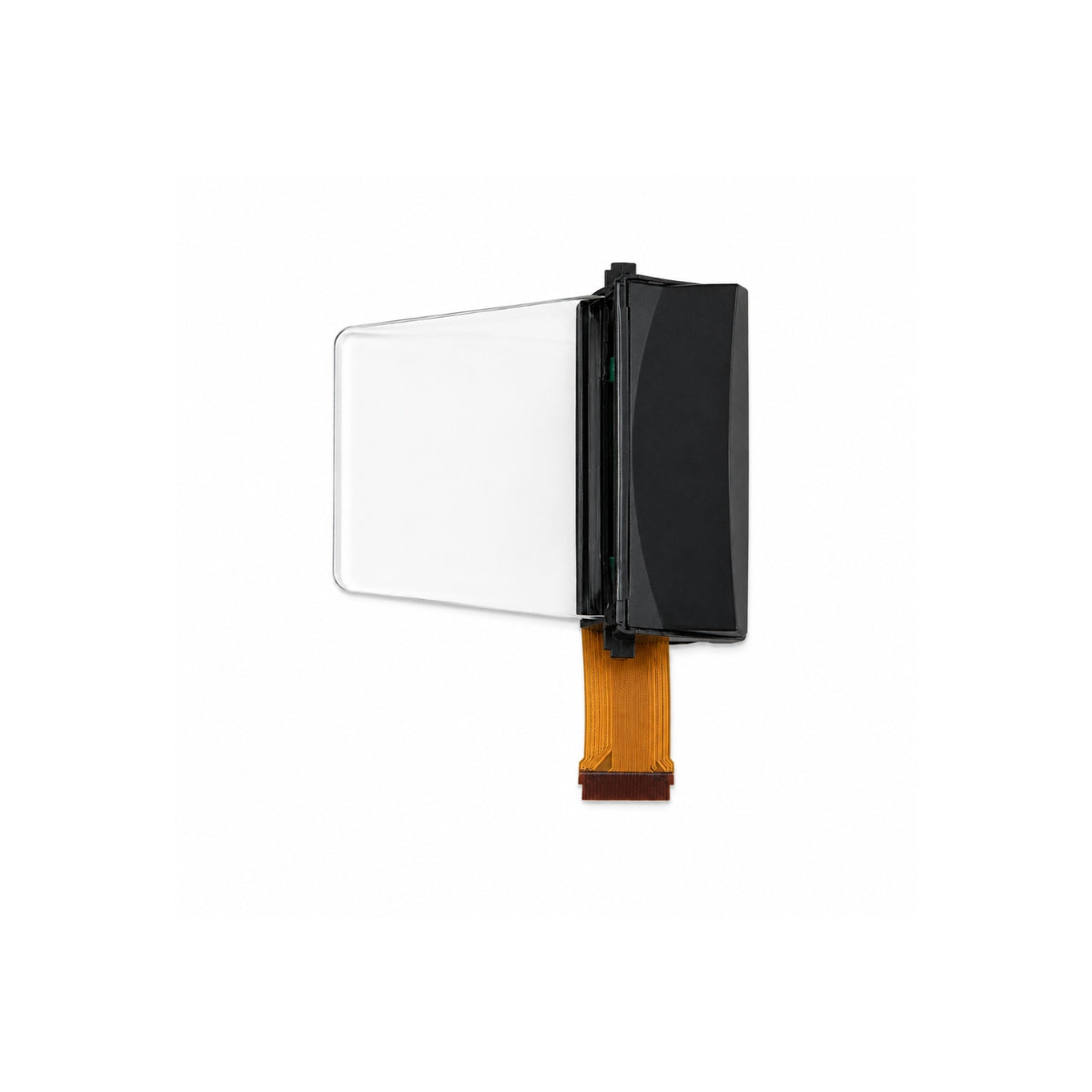
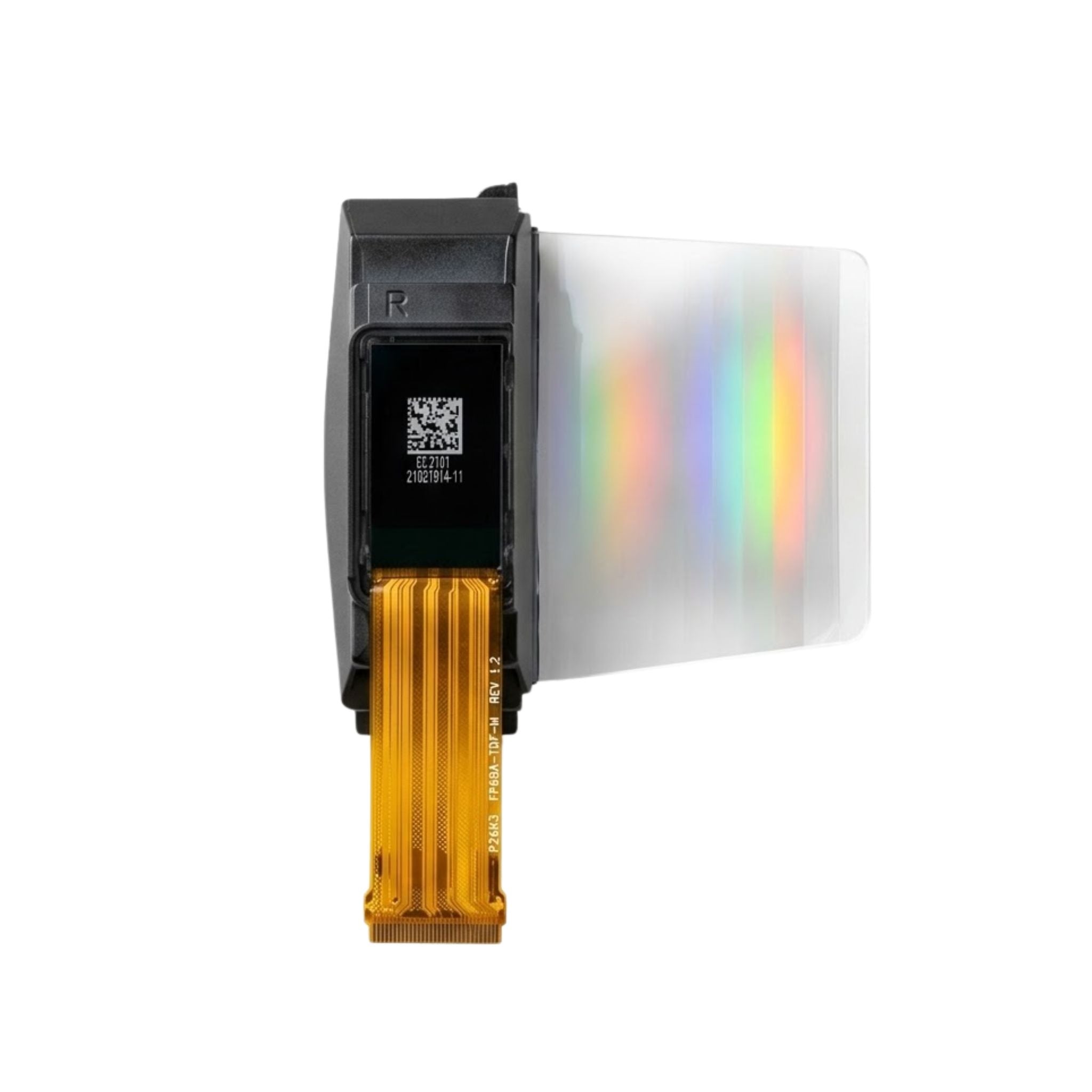
On the DMGTX0068WUNA waveguide module page, the product title lists a 0.68-inch Micro-OLED panel, a 50° field of view, and a 105-inch virtual image. Those headline figures do not, by themselves, establish the virtual image distance or the supported prescription range. Ask for those specifications separately.
This is a product-page comparison, not a hands-on test. It illustrates a useful purchasing check: apparent image size, field of view, virtual image distance, and diopter adjustment answer different questions. Do not substitute one for another when selecting a near eye display module.
What Focus Adjustment Cannot Fix
Astigmatism and Presbyopia
A spherical adjustment changes focus equally in all meridians. It does not supply the cylindrical correction needed for astigmatism. Glasses, suitable contacts, or compatible prescription inserts may therefore remain necessary [2].
Presbyopia is the age-related loss of near-focusing ability, usually noticeable after age 45 [3]. The relevant headset specification is its virtual image distance, not the distance from the panel to your face. A farther virtual image reduces nominal near-focus demand, but a focus knob does not restore accommodation.
Fit and Pupil Alignment
Interpupillary distance (IPD) aligns the two optical paths with your pupils. Eye relief is the viewing distance from the eyepiece; the eyebox describes the region in which your eye can access the intended image. Incorrect positioning can cause clipping or dim edges even when focus is correct. The distinctions in field of view, exit pupil, and eye relief help separate a fit problem from a focus problem.
For a simplified circular-pupil example, a 6 mm exit pupil and a 4 mm eye pupil leave (6 − 4)/2 = 1 mm of lateral offset before full containment is lost. This is a geometric illustration, not a measured headset eyebox or a promise of free head movement. Actual usable viewing regions need measurement, as discussed in eyebox and virtual image distance for near-eye displays.
Binocular Discomfort and Eye Health
In stereoscopic headsets, rendered depth can require the eyes to converge at a different distance from the optical focal plane. Diopter adjustment alone does not make that focal plane follow every rendered object. Vergence-accommodation conflict is one contributor to visual discomfort discussed in the research on XR visual performance [4]. ISO 9241-392 provides ergonomic recommendations for reducing potential discomfort and fatigue from stereoscopic images; citing it is not evidence that a module is certified [5].
Stop using the headset if you develop double vision, eye pain, dizziness, or a headache. If symptoms persist, or one eye remains blurry despite adjustment and correct fit, seek advice from a qualified eye-care professional rather than forcing a stronger setting.
What You Trade for Adjustable Focus
Depending on the mechanism, adjustable optics can add parts, depth, mass, calibration work, or sealing requirements. Request model-specific dimensions, weight, and pricing rather than assuming a universal penalty.
- Optical performance. Ask for sharpness, distortion, and usable field at the centre and both ends of the range. Panel resolution alone does not establish through-optics readability, a distinction discussed in the Sony Micro OLED module analysis.
- Repeatability. Check whether a wearer can return to a recorded setting after removing and replacing the headset. A marked scale helps record a setting but does not prove repeatability.
- Mechanical fit. Confirm that adjustment does not compromise eye relief or frame clearance. Ask about locks, adjustment force, dust protection, and rated mechanism life.
When comparing Micro OLED panels, keep panel specifications separate from the optical assembly. Refresh rate and colour performance, covered in near-eye Micro OLED display trends, do not tell you whether a user focus mechanism is necessary.
How to Evaluate a Sample Without Guessing
Use the following procedure to compare a fixed-focus and an adjustable near eye display module. It is a proposed evaluation method, not a report of completed testing or a clinical assessment.
Confirm the Specifications
- Request the virtual image distance, adjustment range in both directions, control type, and step size or continuous-adjustment resolution. Ask how the manufacturer defines zero and the plus/minus convention; do not assume a dial label maps directly to a spectacle prescription.
- Request the measurement conditions, including pupil size, eye relief, IPD, and focus position. IEC 63145-20-10 covers measurement conditions and methods for the optical properties of eyewear displays using virtual image optics. Its public scope is not proof that every requested supplier plot has been produced under that standard [6].
Compare Fit and Readability
- Begin with the maker's fitting instructions and the wearer's appropriate correction. Set IPD and eye relief before evaluating focus.
- Assess each eye separately, then both eyes together. Use the same text, brightness, and content across samples. Note centre and corner readability rather than recording only a preferred dial position.
- Recheck the field during small, normal head movements. Record clipping separately from blur; they may require different remedies.
- Remove and refit the headset, then return to the recorded focus setting. Record whether readability and field coverage return. Define acceptance criteria before comparing samples.
- Repeat with the intended glasses or inserts. Note pressure points, clearance, and any change in usable field.
- Record the module identifier, correction used, left and right settings, IPD, eye relief, content, and observations. These records can support a genuine evaluation report; they should not be replaced with an unsupported claim that a module “works for everyone.”
Request measured virtual image distance, focus-performance data, and eyebox maps for the actual configuration. A single sharpness value at one focus setting is not enough to compare the entire adjustment range.
Discuss fixed or adjustable focus for your module
Share your target virtual image distance, IPD requirements, eyewear constraints, and acceptance criteria. Ask which configurations and measurement data are available.
Discuss Your Module RequirementsFAQ
Can Adjustable Diopters Replace My Glasses?
Sometimes for viewing that device, if its range and optical design meet your needs. They do not replace your prescription for other activities, supply cylindrical correction, or treat an eye condition. Confirm suitability with your eye-care professional.
Does a Wider Diopter Range Mean Better Quality?
No. Check performance across the required range, independent adjustment where needed, and setting repeatability. A broad advertised range does not establish image quality.
Will Larger Text Fix a Focus Problem?
Larger text may make content easier to read, but it does not change optical focus or correct refractive error. It is an interface adjustment, not a substitute for suitable optics.
Can Children Use Adjustable Headsets?
Follow the device maker's age restrictions and fitting instructions, supervise use, and seek professional advice about a child's vision or symptoms. An adjustable focus range does not establish suitability for children.
The Decision
Choose adjustable diopters when glasses-free focus is a real requirement and the module supports the needed settings. Choose independent controls when the two eyes need different settings without separate prescription correction. Otherwise, a fixed-focus XR optical module with suitable eyewear or inserts may be sufficient. Make the decision from the virtual image distance, fit, and sample evaluation, not from the range number alone.
This article provides general engineering information for optical-module evaluation, not medical advice. It makes no claim of vision treatment or safety certification. Consult a qualified eye-care professional about personal correction and persistent symptoms.
References
- National Eye Institute. Refractive Errors. Background on refractive error and correction options. Accessed 2026-11-06.
- University of Iowa EyeRounds. Introduction to Optics and Refractive Errors of the Eye. Diopters, emmetropia, and spherical versus cylindrical lens power. Accessed 2026-11-06.
- National Eye Institute. Presbyopia. Age-related near-focusing difficulty, usually after age 45. Accessed 2026-11-06.
- Frontiers in Virtual Reality. Visual performance standards for virtual and augmented reality (2025). Research review of XR visual performance and standards. Accessed 2026-11-06.
- International Organization for Standardization. ISO 9241-392:2015. Ergonomic recommendations for reducing visual fatigue from stereoscopic images. Public scope only; no certification claim. Accessed 2026-11-06.
- International Electrotechnical Commission. IEC 63145-20-10:2019. Fundamental measurement methods for optical properties of eyewear displays. Public scope only. Accessed 2026-11-06.
더 읽기
A Micro OLED monitor is a personal display that uses an OLED-on-silicon microdisplay and near-eye optics to present a virtual screen. You look through an eyepiece or wear the display rather than vi...
An LVDS cable can act as a connector or pinout adapter, but a passive cable is not a signal converter. It carries an existing LVDS signal; it cannot turn HDMI, DisplayPort, or MIPI DSI into LVDS. F...
댓글 남기기
이 사이트는 hCaptcha에 의해 보호되며, hCaptcha의 개인 정보 보호 정책 과 서비스 약관 이 적용됩니다.