



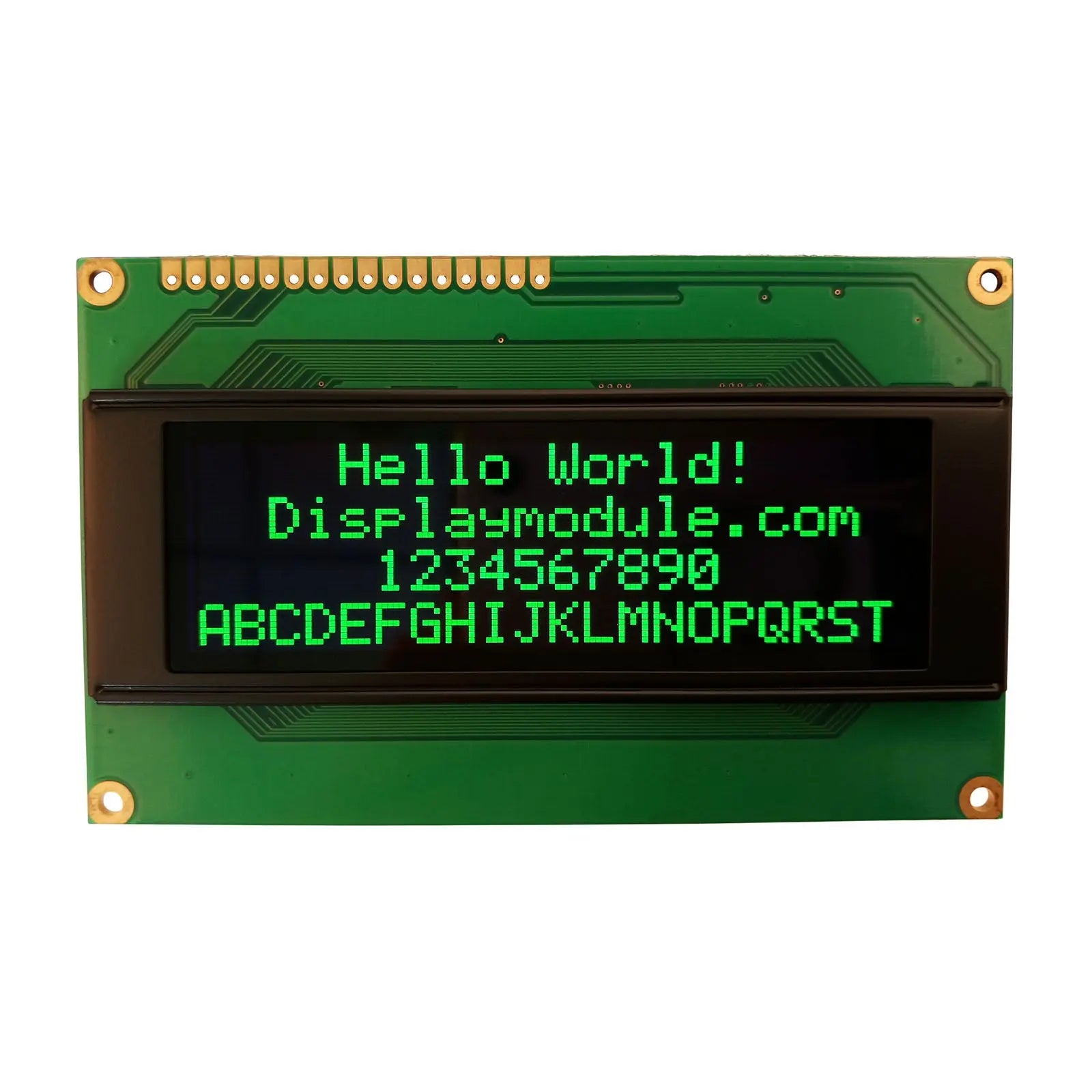
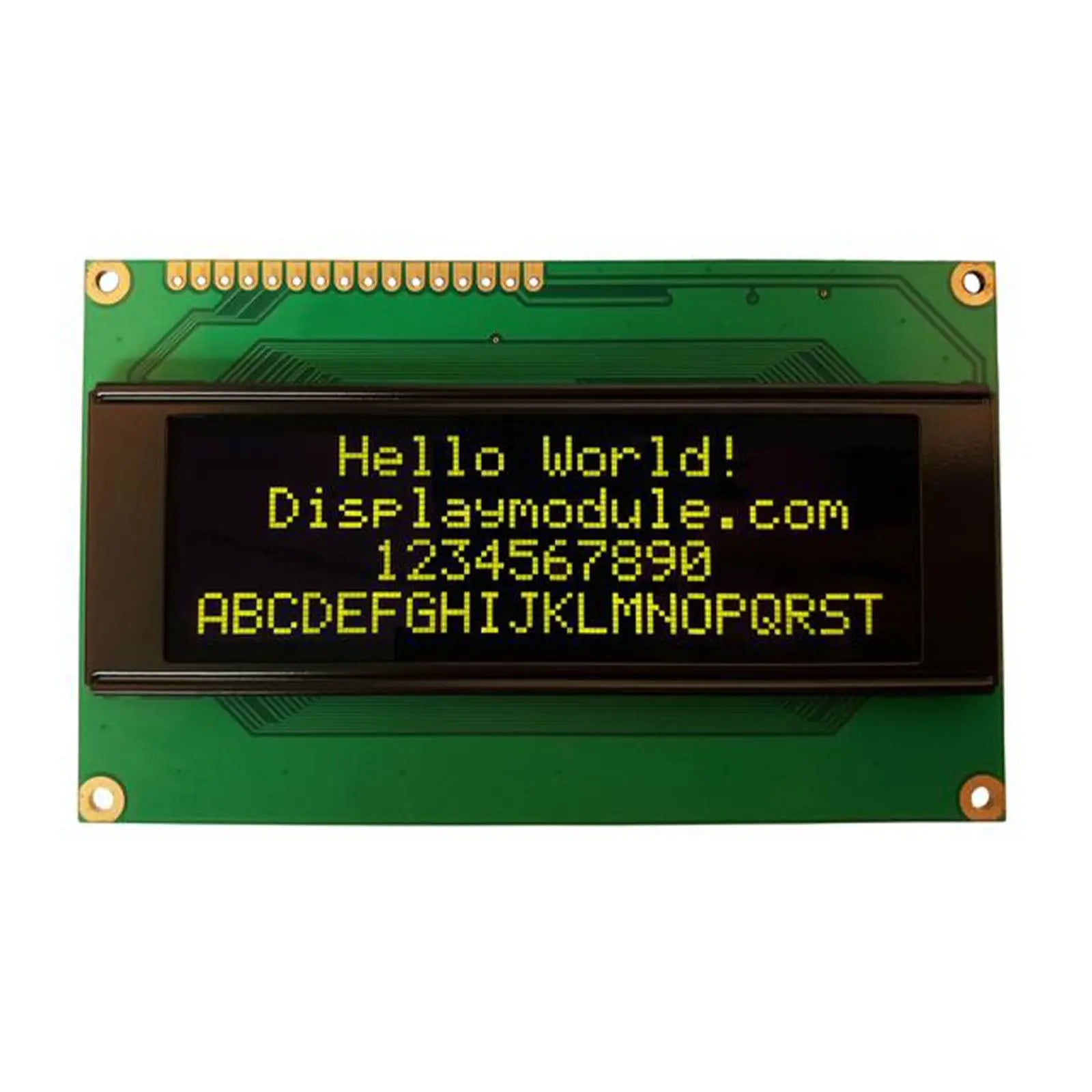
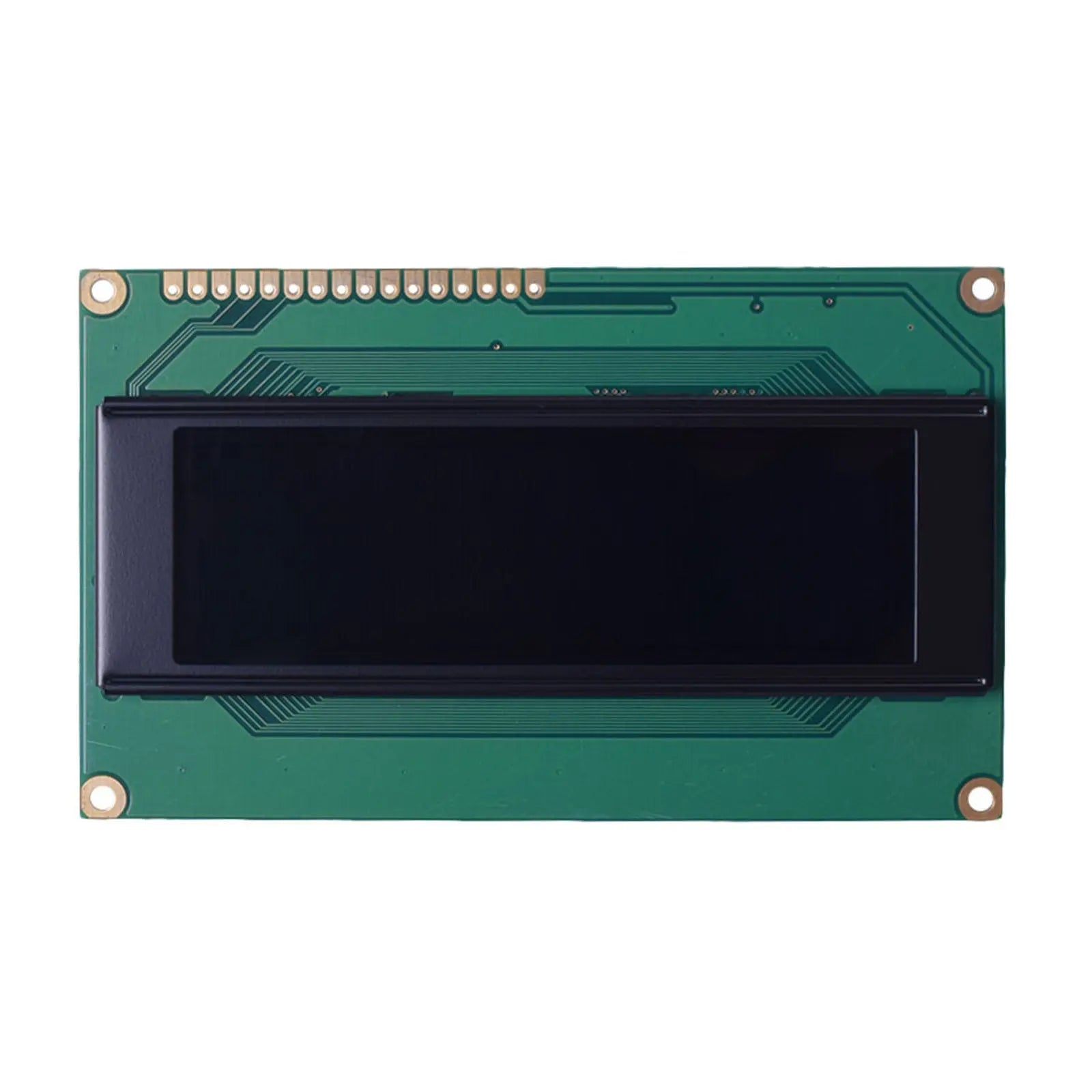
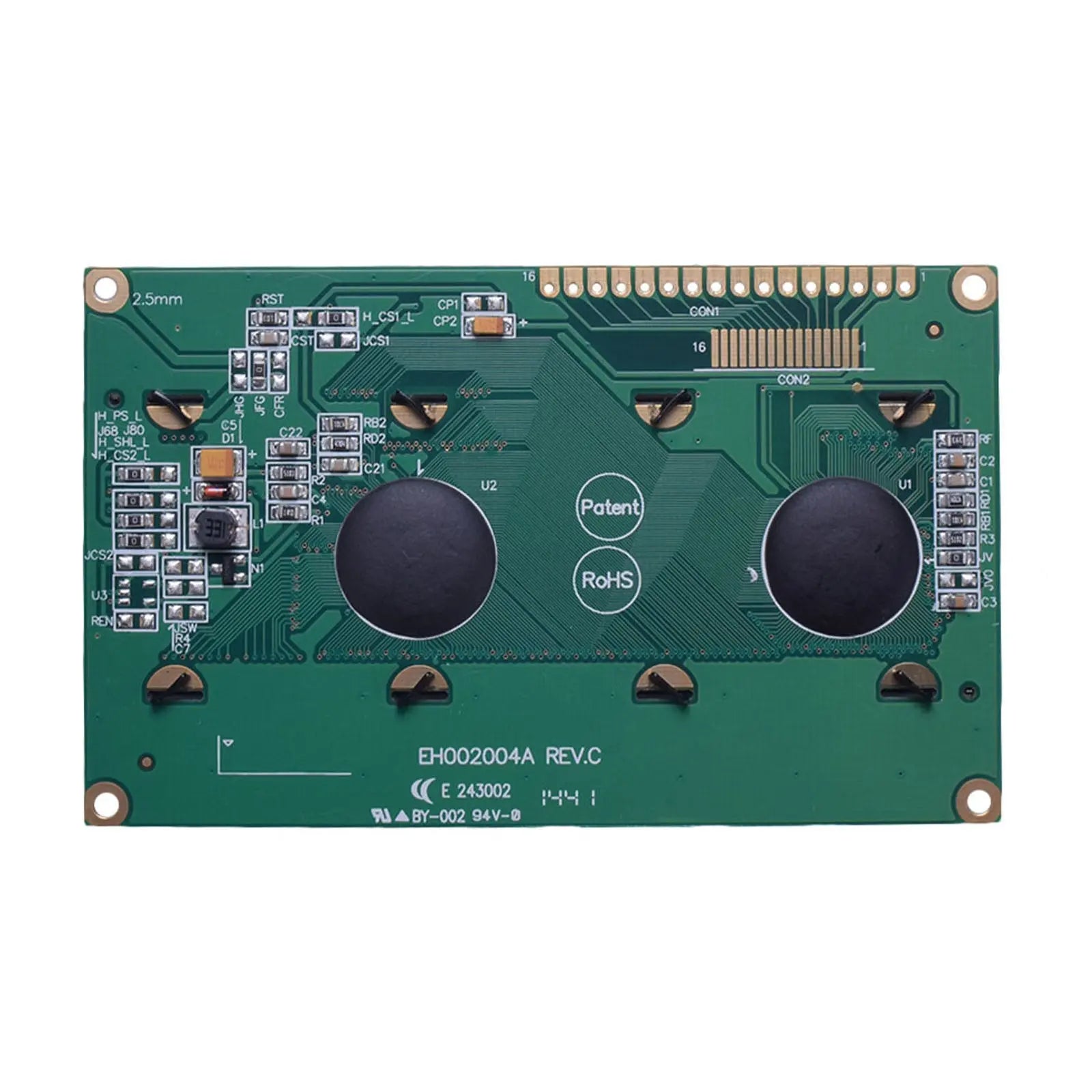

20x4 Character OLED Monochrome - MCU, SPI, I2C
- 💹 Enjoy a 20% discount for orders over 500
- 📉 A 15% discount is available for orders ranging from 200 to 499
- 🎁 A 10% discount is available for orders ranging from 50 to 199
- 🎁 A 5% discount is available when ordering 10-49
Interested in customizing this product? Get in touch with us.
Order samples, immediate delivery.
Factory bulk lead time: 3 weeks.
20x4 Character OLED Monochrome - MCU, SPI, I2C
- 💹 Enjoy a 20% discount for orders over 500
- 📉 A 15% discount is available for orders ranging from 200 to 499
- 🎁 A 10% discount is available for orders ranging from 50 to 199
- 🎁 A 5% discount is available when ordering 10-49
Resources & Downloads
20×4 Monochrome Character OLED Display with WS0010, 6800/8080 Parallel and 3-Line Serial Interface
DM-OLED2004-610 and DM-OLED2004-611 are passive-matrix monochrome character OLED modules with a 20-character by 4-line display format. The green and yellow variants share the same 98.0 × 60.0 × 10.0 mm module outline, WS0010 controller, 1/16 duty drive, and selectable parallel or serial MPU interface.
The supplied module datasheets specify 6800 parallel as the default configuration, with 8080 parallel and 3-line serial modes available through jumper selection. The module is intended for fixed-format equipment interfaces and should be evaluated within the electrical, thermal, and mechanical limits stated in the official datasheets.

Verified Technical Specifications
The following values are common to both color variants unless a model-specific value is shown.
| Parameter | Specification |
|---|---|
| Product Models | DM-OLED2004-610 (green) and DM-OLED2004-611 (yellow) |
| Display Format | 20 characters × 4 lines |
| Display Technology | Passive-matrix monochrome OLED character module |
| Controller IC | WS0010 |
| Native MPU Interfaces | 6800 parallel (default), 8080 parallel, or 3-line serial |
| Parallel Data Width | 4-bit or 8-bit MPU operation |
| Supply Configuration | 3.0 V or 5.0 V; electrical table lists VDD from 3.0 V to 5.3 V with 5.0 V typical |
| Operating Current | 60 mA typical and 65 mA maximum under the datasheet 50% operation condition |
| Module Outline | 98.0 × 60.0 × 10.0 mm |
| Viewing Area | 77.0 × 25.20 mm, according to the mechanical drawing |
| Active Area | 70.16 × 20.95 mm, according to the mechanical drawing |
| Duty | 1/16 duty |
| Module Weight | 41.4 g for DM-OLED2004-610; 41.6 g for DM-OLED2004-611 |
| Operating Temperature | -40°C to +80°C, absolute maximum |
| Storage Temperature | -40°C to +80°C, absolute maximum |
Optical Performance and Service-Life Data
These datasheet values provide a measurable basis for display selection and sample evaluation.
Self-Emissive Character Display
The OLED structure does not require a separate backlight. Optical performance is specified at module level for both the green and yellow variants.
Screen-saving operation is recommended when content remains static for long periods.
Mechanical Integration Details
Use the official drawing for PCB placement, enclosure clearance, bezel design, mounting-hole position, and connector alignment.
The drawing also identifies four mounting holes with 2.5 mm plated through-holes and 5.0 mm pads. Confirm all tolerances and keep-out areas from the official drawing before releasing the PCB or enclosure.
Connector, Interface, and Jumper Configuration
The interface mode is hardware-selected. Review the required jumper configuration before assembling the module into a controller board.
6800 Parallel
Default module configuration. Parallel operation uses the control lines RS, R/W, E, and the DB0-DB7 data bus.
8080 Parallel
Available through the documented jumper selection. Use the relevant 80-series timing information in the module datasheet.
3-Line Serial
The serial pin assignment identifies SCL, SDO, SDI, and active-low chip select. Serial mode uses its own jumper setting.
Documented Pin Functions
WS0010 Character and Memory Functions
The controller specification provides the following integration-relevant functions.
Character fonts: 5 × 8 and 5 × 10 dot-matrix modes are supported.
Four CGROM tables: English/Japanese, Western European I, English/Russian, and Western European II.
Display RAM: 128 × 8-bit display RAM with capacity for up to 128 characters.
Custom characters: 64 × 8-bit CGRAM supports either eight 5 × 8 fonts or four 5 × 10 fonts.
MPU speed: The controller specification lists a high-speed MPU interface up to 2 MHz at VDD = 5 V.
Reset behavior: Internal initialization is provided; the busy state remains active for 10 ms after VDD stabilization.
Reliability Conditions for Engineering Review
The module datasheets list the following endurance conditions. These conditions help customers review environmental tolerance before sample evaluation and product design.
Qualification conditions are not a substitute for validation in the final enclosure, power system, mounting method, and application environment. Review condensation notes, recovery conditions, and acceptance criteria in the official datasheet.
Engineering Notes Before Sample Evaluation
Use DM-OLED2004-610 for green emission or DM-OLED2004-611 for yellow emission. The model weight differs slightly.
Verify the 6800, 8080, or serial jumper setting before PCB bring-up. Do not assume that the module ships in a non-default mode.
Check VIL and VIH against the host MCU, allow the controller reset interval after VDD stabilization, and follow the documented initialization sequence.
The datasheet notes that screen-saving mode can extend OLED lifetime. Any additional brightness-management or content-refresh strategy should be validated in the final application.
Confirm Before Ordering
For production planning, confirm the exact model, interface jumper configuration, sample availability, current lead time, and any required mechanical or firmware support.
- Native I2C is not stated in the supplied datasheets.
- Use the official drawing for tolerances and mounting details.
- Validate the module in the final electrical and thermal design.
Typical Product Integration Areas
The fixed 20×4 character format can be evaluated for equipment interfaces where concise status, menu, measurement, or alarm text is required.
Industrial Control Panels
Status displays, process controls, machine settings, and operator feedback in equipment designed for the specified electrical and environmental limits.
Instrumentation
Measurement values, test states, channel information, and menu text for laboratory or benchtop equipment after system-level validation.
Appliance and Audio Controls
Text-based user interfaces for appliances, audio products, and embedded controllers that match the module size and interface requirements.
Frequently Asked Engineering Questions
Does the module natively support I2C?
The supplied DM-OLED2004 and WS0010 documents do not list native I2C. They list 6800 parallel, 8080 parallel, and serial MPU interfaces. Confirm any external I2C adapter arrangement before ordering.
What is the default interface?
The module datasheets identify 6800 MPU parallel as the default configuration.
Can the parallel bus run in 4-bit mode?
Yes. WS0010 supports 4-bit and 8-bit MPU operation. In 4-bit mode, DB4-DB7 are used and each transfer is completed in two parts.
Are green and yellow electrically different?
The supplied datasheets list the same main electrical, optical, interface, and mechanical values. The documented differences are emission color and module weight.
How many custom characters are available?
The controller CGRAM supports either eight custom 5 × 8 characters or four custom 5 × 10 characters.
What should be checked before PCB release?
Confirm the 16-pin footprint, 2.54 mm pitch, mounting-hole coordinates, interface jumper state, logic thresholds, power-up timing, and initialization sequence.
Download Official Technical Documents
Use the official documents to review dimensions, pin assignments, jumper selections, electrical limits, optical values, controller functions, initialization guidance, and reliability conditions.
Confirm the selected color model and interface configuration before production ordering.