

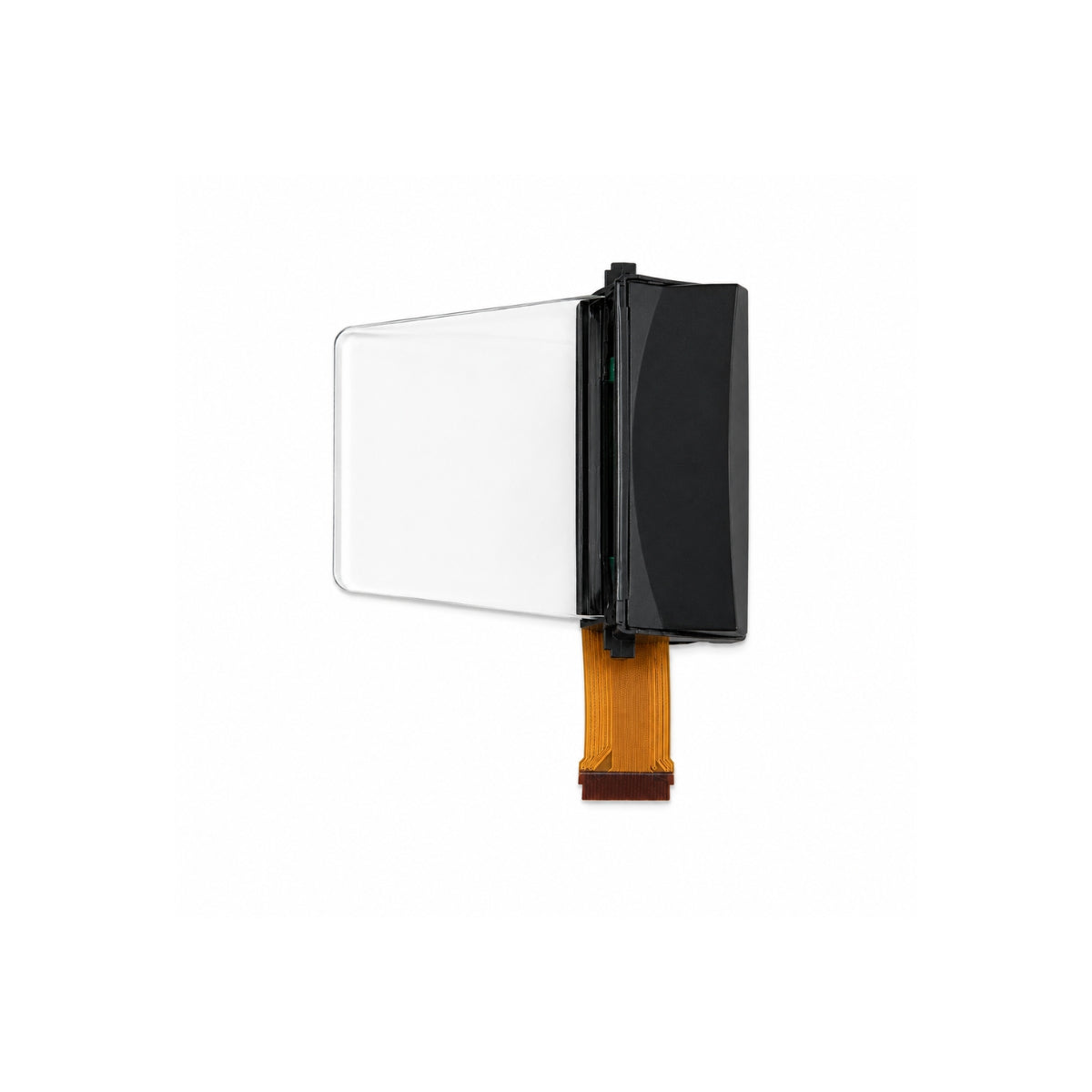
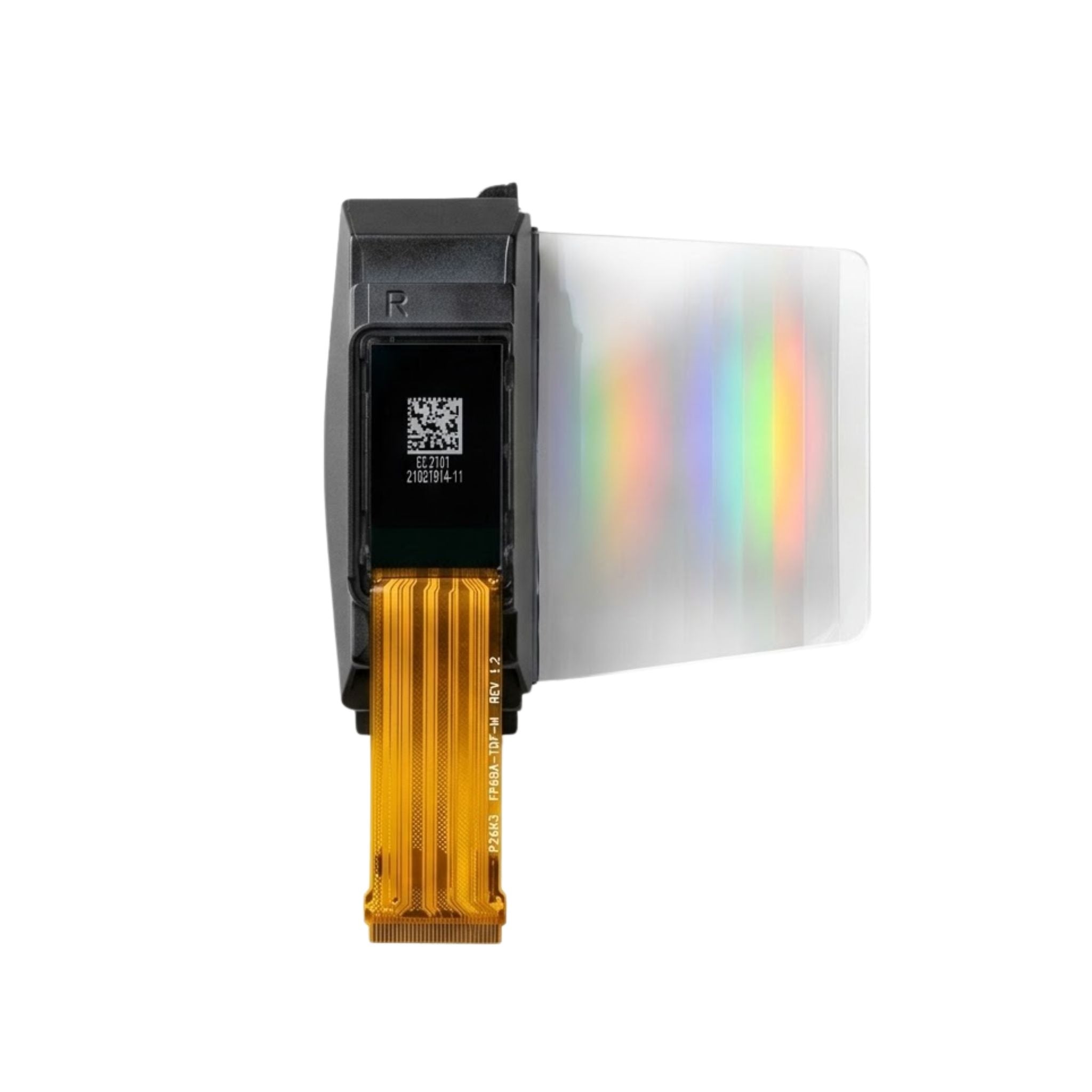


Graphic OLED Displays | Technology, Advantages & Application
Graphic OLED achieves a million-to-one contrast ratio and 10-microsecond response time through self-emittance, while its 1.2mm ultra-thin modules support 180-degree full-view precision display in medical wearables.
Technology
The total thickness of Graphic OLED modules is typically controlled between 1.0 and 1.5 mm.
It consists of an ITO anode, an organic emissive layer, and a metal cathode, with the organic layer thickness being only 100 to 500 nanometers.
Driven by direct current, electrons and holes recombine in the emissive layer.
For a typical 128x64 resolution panel, power consumption is approximately 25mW when 50% of pixels are lit, with a contrast ratio exceeding 10,000:1 and signal response within 10 microseconds at -40°C.
Physical Layer Structure
The bottom layer usually employs alumino-silicate glass with a thickness between 0.5 mm and 0.7 mm.
This material possesses an extremely low thermal expansion coefficient, maintaining dimensional stability during thin-film deposition at 300°C to 450°C.
For graphic display solutions requiring flexible characteristics, the substrate is replaced with a polyimide film of 15 to 25 micrometers in thickness, allowing the bending radius to shrink to 3 mm.
The surface roughness index of the substrate must be controlled below 0.5 nanometers to prevent microscopic protrusions from creating leakage paths in the subsequent ultra-thin functional layers.
Adhered to the substrate is an anode layer with a thickness of approximately 100 to 150 nanometers. The industrial standard uses Indium Tin Oxide (ITO), formed via DC magnetron sputtering. This layer possesses the following physical parameters:
- Transmittance: Exceeds 85% to 90% at a wavelength of 550 nanometers.
- Sheet Resistance: Controlled between 10 to 15 ohms per square to reduce current thermal loss.
- Work Function: Maintained between 4.5eV and 5.0eV. To further improve hole injection efficiency, the ITO surface undergoes UV-ozone treatment, raising the work function by approximately 0.3eV to lower the energy barrier with the organic layer.
Following this are multiple layers of organic semiconductor thin films, with a total thickness usually only between 150 and 300 nanometers.
First is a 20nm thick Hole Injection Layer (HIL), commonly made of Copper Phthalocyanine (CuPc) or PEDOT:PSS, which acts as a buffer for charge flow between the anode and the hole transport layer.
The Hole Transport Layer (HTL) is about 40nm thick, composed of small molecule materials like NPB, with a hole mobility reaching 10^-4 cm²/Vs.
The central functional layer is the Emissive Layer (EML), with its physical thickness strictly controlled between 20 and 30 nanometers.
This layer consists of a Host material and a Dopant material, with the doping ratio typically between 1% and 10%.
In monochromatic yellow Graphic OLEDs, Alq3 doped with Rubrene is often used.
Under an electric field, electrons and holes recombine here to form excitons.
The energy level transition of excitons produces photons, the wavelength of which is determined by the energy gap of the material's molecular orbitals.
For 550nm green emission, the bandgap is approximately 2.25eV.
| Functional Layer | Common Material Examples | Typical Thickness Scale | Physical Function Indicators |
|---|---|---|---|
| Hole Transport Layer (HTL) | NPB / TPD | 40 - 60 nm | Mobility 10^-4 cm2/Vs |
| Emissive Layer (EML) | Alq3:Dopant | 20 - 30 nm | Exciton recombination zone |
| Electron Transport Layer (ETL) | TPBi / BCP | 30 - 50 nm | Work function matching 2.8eV |
| Electron Injection Layer (EIL) | LiF / Cs2CO3 | 0.5 - 1.0 nm | Lowering cathode work function |
The Electron Transport Layer (ETL) is located above the emissive layer with a thickness of 30nm.
Its molecular structure is designed to block holes from passing through to the cathode, thereby improving recombination efficiency.
Between the ETL and the metal cathode, there is an extremely thin Electron Injection Layer (EIL), usually 0.5 to 1.0 nm of Lithium Fluoride (LiF).
Although LiF itself is an insulator, at such thickness, it can lower the aluminum cathode's work function from 4.3eV to below 3.0eV via quantum tunneling.
The metal cathode layer serves as the top layer of the physical structure, typically 100 to 200 nanometers thick.
In bottom-emission structures, the cathode uses high-reflectivity aluminum or silver (reflectivity >90%) to reflect light toward the substrate.
In top-emission structures, the cathode is replaced by a Magnesium-Silver alloy only 10 to 15 nm thick to achieve approximately 70% transparency.
Due to the sensitivity of organic materials to moisture and oxygen, physical encapsulation is vital.
Traditional glass encapsulation involves fusing a cover glass with the substrate glass, filled with high-purity nitrogen where oxygen and water content are below 1ppm.
Calcium oxide or zeolite getters are attached to the inner glass to absorb trace impurities.
Thin Film Encapsulation (TFE) technology uses a more complex physical stack, alternating inorganic thin films and organic buffer layers via PECVD and ALD:
- Inorganic Layer: Uses Silicon Nitride or Aluminum Oxide (approx. 50nm thick) to provide high density.
- Organic Buffer Layer: Uses Polyacrylate (1-2μm thick) to flatten microscopic particles and release mechanical stress from thermal expansion.
- Cycle Structure: This alternating structure is typically repeated 3 to 5 times.
Under such encapsulation, the operating temperature range of Graphic OLED can be widened to -40°C to 85°C.
Pixel Control Mechanism
In common 128x64 resolution modules, there are a total of 8,192 light-emitting units.
For graphic display, the driving system deconstructs image data into row and column signals.
Under Passive Matrix (PMOLED) architecture, the display lacks independent pixel storage units, and control logic is based on a duty cycle scanning mechanism.
When a row driver selects a specific row, the cathodes of all pixels in that row are grounded, and the column driver injects current into corresponding anodes based on image data.
Since the pixels are lit row by row, under a 1/64 duty cycle, each row is active for only 1.56% of a frame period.
To maintain an average visual brightness (e.g., 150 nits), the pixels must emit a burst of over 9,600 nits when selected.
This high-frequency pulse driving causes peak current surges, requiring column driver channels to dynamically adjust current between 10μA and 500μA.
| Control Parameter Dimension | PMOLED (Passive Matrix) Features | AMOLED (Active Matrix) Features |
|---|---|---|
| Basic Driving Components | Cross-wire array & external driver IC | Thin Film Transistors (TFT) & storage caps |
| Pixel Selection Logic | 1/N duty cycle scanning (30Hz-150Hz) | Continuous full-time driving |
| Typical Driving Voltage | 12V to 18V (Vcc high voltage) | 3.3V to 5V (Low voltage driving) |
| Data Retention | Relies on persistence of vision | Storage caps maintain gate voltage |
| Refresh Rate Limit | Limited by organic charging (~200Hz) | Limited by TFT mobility (Thousands of Hz) |
| Peak Current Loss | Increases exponentially with resolution | Maintains low nano-ampere levels |
In more advanced graphic requirements, Active Matrix (AMOLED) architecture introduces the 2T1C (two transistors, one capacitor) circuit.
Each pixel has a micro-control unit where the switching transistor receives charge signals and the driving transistor controls continuous current flow.
The storage capacitor locks the gate voltage during the remainder of the frame period.
This allows pixels to remain lit throughout the frame cycle (e.g., 16.6ms at 60Hz), avoiding the extreme pulse currents of PMOLED.
For resolutions above 300x300, AMOLED can reduce power consumption by over 50% and extend material lifespan.
Graphic OLED modules usually integrate dedicated Driver ICs like SSD1306 or SH1106.
These chips contain GDDRAM to buffer bitmap data from microcontrollers.
Controllers write 8-bit data words via I2C or SPI, where 1 represents "on" and 0 represents "off." Internal charge pumps boost the 3.3V logic level to approx.
12V for emission. For grayscale OLEDs, Pulse Width Modulation (PWM) is used to divide single-pixel brightness into levels (e.g., 16 levels for 4-bit grayscale), requiring nanosecond precision for gamma correction.
To handle signal delay from parasitic capacitance in large arrays, Driver ICs introduce Pre-charge technology.
Before injecting data current, a short high-voltage pulse (1-5μs) is injected to quickly cross the organic layer's turn-on threshold (2.5V-3.5V), significantly shortening response time and eliminating motion blur during scrolling.
Signal Transmission Protocols
The most widely used low-pin-count solution in industrial applications is the I2C protocol.
In this mode, the module communicates via SDA (data) and SCL (clock) lines. The physical address is determined by the SA0 pin, commonly 0x3C or 0x3D.
Frame transmission for a 128x64 OLED (1024 bytes) at 400kHz takes approx. 25-30ms, which is suitable for low-frequency monitoring like temperature or pressure but limits high-refresh animations.
I2C supports multi-master/slave architecture. Data is sent in 8-bit bytes. ACK signals occur on the 9th clock pulse. 4.7k ohm pull-up resistors are required.
Graphic OLEDs commonly support 4-wire or 3-wire SPI. In 4-wire mode, a Data/Command (D/C#) pin distinguishes between register instructions and GDDRAM data without interrupting the stream.
With clock frequencies up to 10MHz or 20MHz, transferring 1024 bytes takes less than 1ms, enabling smooth 60fps scrolling. Its push-pull structure is more stable against EMI over long distances compared to I2C.
High D/C level represents data; low represents commands. SPI does not support slave ACK. Clock polarity is often set to rising-edge sampling.
For maximum efficiency, 8-bit Parallel interfaces (8080 or 6800 standards) use D0-D7 lines for signal transmission.
Write cycles are typically 300-600ns. While it occupies more GPIO pins (~12+), it eliminates serial shift register overhead and lowers CPU occupancy, ensuring zero-latency feedback for aviation or high-speed monitoring.
8-bit bus supports bidirectional reading. Minimum write pulse width is 100ns. CS signal locks the module. Ideal for large SRAM exchange.
GDDRAM in chips like SSD1306 is divided into pages (Page 0-7 for 64-row height). Protocols include Addressing Mode Instructions: Horizontal, Vertical, and Page.
Horizontal mode automatically increments the column pointer, jumping to the next page after column 127, optimizing bus efficiency by reducing coordinate commands.
Logic levels typically range from 1.65V to 3.3V. Using 5V logic (e.g., traditional MCUs) requires level shifters to prevent damage to ESD protection diodes.
Timing requirements are strict: CS# setup time (0-20ns) and data hold time (>10ns).
Matching resistors (33-100 ohms) are often used to ensure signal integrity by absorbing high-frequency reflections.
Advantages
Graphic OLED achieves contrast ratios over 10,000:1 due to self-emissive pixels that reach near 0 nits in the black state.
Response times are under 10 microseconds—200 times faster than LCD.
Module thickness is below 1.5mm, and it operates without heaters from -40°C to 85°C.
When display occupancy is below 30%, power consumption is 40-60% lower than same-sized backlit LCDs.
Pure Black Display
LCDs rely on constant backlighting; even when showing black, liquid crystal molecules cannot completely block light, resulting in "light leakage" (grayish or bluish blacks). In contrast, Graphic OLED removes the backlight layer.
Every pixel is an independent emitter; for a 0-brightness command, the current is physically cut. In this state, the organic material produces zero photons, outputting 0 nits.
- Quantized Contrast: In 100-lux ambient light, industrial LCDs maintain 300:1 to 1000:1. Graphic OLED exceeds 100,000:1.
- Uniformity: Unlike LCDs with "clouding" from uneven backlights, OLED pixels work independently, ensuring identical black levels across the screen.
- Scattering Control: Without light guide plates or diffusers, light exits directly, minimizing internal reflections.
For industrial or medical devices, high contrast allows rapid data capture. In dark theme UIs (e.g., 10% pixel occupancy), OLED current is only a few milliamps, whereas LCDs consume 20-40mA to keep the backlight on. In pitch-black environments like maritime navigation, OLED presents data without polluting the observer's dark adaptation.
- Pixel-level Dimming: A 0.96" 128x64 screen effectively has 8,192 dimming zones.
- Outdoor Readability: Pure black backgrounds help maintain perceived contrast. With low-reflectivity (<1.5%) polarizers, it prevents the background from becoming a mirror under sunlight.
- Color Foundation: Absolute black prevents backlight from diluting color saturation, resulting in deeper, more vivid visuals.
Organic materials like Alq3 respond in microseconds.
During black-to-white transitions, there is no mechanical lag, eliminating ghosting for scrolling text or oscilloscope waveforms. At -40°C, where LCDs become sluggish due to viscosity, OLED remains fast.
TFE (Thin Film Encapsulation) prevents oxygen/moisture ingress, ensuring the black level remains pure for tens of thousands of hours.
Standby modes can light only a few pixels (e.g., a "breathing" border), consuming less than 0.5mW.
Ultra-Fast Response
LCD response time is measured by the physical rotation of liquid crystals (Tr/Tf), typically 100-250ms for industrial modules.
Graphic OLED response is based on carrier recombination in a nanometer-scale layer, completing in under 10 microseconds—virtually instantaneous.
| Temp (°C) | OLED Response (ms) | LCD Response (ms) | Performance Gap |
|---|---|---|---|
| 25°C | 0.01 | 15 - 30 | 1500 - 3000x |
| 0°C | 0.01 | 100 - 150 | 10000 - 15000x |
| -20°C | 0.02 | 300 - 500 | 15000 - 25000x |
| -40°C | 0.02 | 800 - 1200 | 40000 - 60000x |
In extreme cold, OLED ensures outdoor monitors or flight instruments provide real-time feedback without visual judgment errors caused by lag.
For high-speed waveforms (ECG, industrial oscilloscopes), OLED's microsecond response ensures "clean" lines without the "smearing" seen on LCDs.
| Content Type | OLED Visual Effect | LCD Visual Effect | Physical Cause |
|---|---|---|---|
| Fast Scrolling | Sharp text, easy to read | Blurred text, ghosting | Instant pixel shut-off |
| Dynamic Waveform | Sharp lines, real-time | Line dispersion, gray tail | No molecular lag |
| Flashing Alarms | Clear on/off, accurate | Gradual brightness, vague | No physical inertia |
| Analog Pointer | Smooth movement | Jumpy/residual path | Microsecond response |
Driver chips can employ higher frame rates (e.g., >100Hz) to reduce fatigue and increase interaction sensitivity.
OLED is more energy-efficient during high-frequency refreshes as it doesn't waste energy overcoming molecular viscosity.
Engineers don't need complex "overdrive" algorithms; OLED simply follows the data.
Thickness and Weight
LCDs require backlights, light guide plates, diffusers, and brightness enhancement films, making up 60% of the thickness.
OLED is self-emissive, reducing the stack to just substrate, organic layers, and encapsulation.
A standard 0.96" OLED is 1.0 to 1.4 mm thick, whereas a backlit LCD is 3.5 to 5.5 mm.
This 2mm saving allows for larger batteries or slimmer casings in medical wearables.
OLED organic layers are nanometers thick; the total thickness is primarily the 0.5mm or 0.3mm glass substrate.
A 128x64 OLED weighs less than 2 grams, compared to 5-8 grams for LCD. This weight reduction is crucial for head-mounted displays or aerospace instruments.
Being a solid-state component, its lower mass also translates to better shock resistance (higher G-force tolerance) during drops.
COG (Chip on Glass) technology allows for narrower bezels.
The ultra-thin structure reduces internal refraction, preventing the "parallax" effect or side-light leakage.
Installation is simplified to double-sided tape or light clips, avoiding the bulky frames needed for LCD backlights.
This allows for IP67+ sealing in tight spaces, marking the transition from mechanical assembly to pure semiconductor integration.
Application
Graphic OLED provides over 2000:1 contrast in 128x64 or 256x64 dots.
Module thickness is 1.5-2.5mm. It maintains 10μs response times from -40°C to 70°C.
Due to lack of backlighting, dark-interface power consumption is below 20mA—40% lower than LCD.
Supporting SPI/I2C and 160°+ viewing angles, it is widely used in precision instruments and handheld terminals.
Medical Device Displays
In portable medical equipment, the 1.2-1.8mm thinness of Graphic OLED provides space for compact structural designs.
Its 10,000:1+ contrast ensures readability in both 5-lux dark wards and direct sunlight.
For 0.96" 128x64 modules at 3.3V, 30%-pixel-on current is under 15mA—35-45% less than backlit LCDs.
In pulse oximeters, microsecond response ensures real-time PPG waveform clarity without dragging.
| Medical Parameter | 128x64 OLED Value | 128x64 STN-LCD Value | Medical Scenario Benefit |
|---|---|---|---|
| Module Thickness | 1.4 mm (±0.1) | 2.5 mm (inc. backlight) | Reduces device Z-axis by 1mm |
| Viewing Angle | 175° (All directions) | 60° (Viewing bias) | Side-viewing for multiple nurses |
| Response Latency | 10μs scale | 150ms scale (RT) | Captures ECG spikes without lag |
| Dark Brightness | 0 cd/m² | 0.8 cd/m² (Leakage) | No disturbance to patient sleep |
| Start-up Time | < 1 ms | 100 - 300 ms | Instant reading for emergency kits |
For insulin pumps or CGMs, OLED's COG packaging reduces PCB footprint.
These devices run on CR2032 batteries; OLED allows deep sleep with 1-5μA static current.
High PPI (e.g., 0.2mm pixels) fits 3-4 lines of text or trends on a small screen. 10MHz SPI/I2C ensures smooth interaction.
In lab biochemical analyzers, green (525nm) or yellow (570nm) OLEDs are used to reduce eye strain.
Lower EMI (no PWM backlight boost) prevents interference with sensitive EEG sensors.
With no polarizers to block light, paramedics wearing polarized sunglasses can still read defibrillator data clearly.
The solid structure survives 1.5m drop tests and frequent alcohol disinfection.
Industrial Control Terminals
OLED's solid-state structure contains no liquids, maintaining 10μs response from -40°C to +85°C, whereas LCDs lag by 2+ seconds in the cold.
A 2.4" OLED with 10,000:1 contrast remains sharp under 1000-lux factory lighting. The 1.4-2.0mm thickness saves 40% internal space for batteries or antennas.
Driver chips like SSD1309 support SPI/I2C/8-bit parallel; 10MHz SPI allows 60fps for motor speed curves.
At 3.3V, a 30%-pixel-on menu uses 15-18mA, allowing the device to be powered directly by 4-20mA current loops.
The 175° viewing angle eliminates "blind spots" on control cabinets.
| Industrial Parameter | Typical Value (2.42" OLED) | Reliability Standard |
|---|---|---|
| Operating Temp | -40°C to +85°C | IEC 60068 Harsh Environment |
| Brightness (Yellow) | 100 - 120 cd/m² | Indoor/Medium light factory |
| Response Speed | ≤ 10 μs | PLC high-frequency pulse feedback |
| Packaging | COG (Chip on Glass) | Anti-shock & vibration stability |
| L70 Lifespan | 50,000 Hours (50% on) | 8-year industrial service cycle |
| Communication Level | 1.65V to 3.3V | Wide MCU compatibility |
For smart meters, OLED L70 lifespan (yellow) reaches 50,000 hours at 100 nits.
Software "pixel shifting" prevents burn-in. Lack of high-frequency boost inductors ensures low EMI for lab instruments.
0.5mm pitch FPCs with gold finger soldering withstand 50G shocks.
Applications include sensor monitors (multi-line data), CNC handwheels (instant X/Y/Z updates), rail-mount power monitors (waveforms), and vibration analyzers (sunlight readable).
The 1-2mm glass margins allow for IP67 silicone gaskets to block oil and steam. SSD1309's 128x64 RAM latches content, reducing MCU refresh load and system power.
High-End Audio Interfaces
Common 2.42" or 3.12" modules (128x64 or 256x64) offer 10,000:1 contrast.
In 20-lux listening rooms, OLED's 0 cd/m² black level allows the screen to vanish behind brushed aluminum or acrylic until data (e.g., DSD512, 384kHz) is shown.
The lack of backlight boost circuits eliminates noise, preserving 120dB+ SNR for precision audio.
Modules work at 3.3V, with ~0.2mm pixels and <10μs response for 60fps animation.
For DAPs or network players, 16-level grayscale provides smooth dynamic spectrums and analog VU meter movements.
SSD1322/SSD1306 chips use PWM for flicker-free -60dB to +3dB needle jumps. The 175° view allows users to read gain or filter settings (e.g., Linear Phase) from the side.
Lifespan reaches 30,000 hours at 80 nits. 10MHz SPI ensures spectrum updates don't drain CPU. Constant-current driving minimizes power rail fluctuations.
COG packaging fits screens into narrow panels next to large potentiometers. Menus consume only 10-25mA.
Designers use OLED's dot-matrix for multi-language Unicode (Latin, Cyrillic, etc.).
In professional touring gear, OLED works consistently from -40°C. Solid-state construction resists speaker vibrations. Anti-reflective (AR) coatings eliminate indoor lamp reflections.
0.5mm pitch FPCs with ZIF connectors offer excellent RFI resistance. Small OLEDs (0.91"/1.3") are used above knobs on mixers for real-time EQ/Compression feedback.
Distributed low-power screens don't add heat to the console. GDDRAM allows asynchronous UI updates without interrupting audio streams.
Modules are RoHS 2.0 compliant; Class 2 ESD sensitivity (requires protection circuitry).
OLED's "off" state matches the texture of piano-black or sandblasted panels.
Grayscale allows for "vacuum tube glow" or "tape reel" visual textures, adding "analog warmth" to digital gear.
External DC-DC boost circuits can be isolated to prevent switching noise from leaking into analog stages, ensuring an absolute noise floor.
Read more
OLED holds an advantage in high-performance visual interaction with an ultra-high contrast ratio of >10,000:1 and an ultra-fast response time of <1ms, while LCD remains the preferred choice f...

By optimizing 0.5mm pitch FPC pins and customizing 1000-nit ultra-high brightness backlights, we can deliver high-precision prototypes of industrial-grade LCD modules supporting wide-temperature op...
Leave a comment
This site is protected by hCaptcha and the hCaptcha Privacy Policy and Terms of Service apply.