



LCD Display Module Price | Retail & Wholesale Guide
LCD module prices range from 2 for basic 16x2 character modules to 50+ for high-resolution TFTs. Wholesale prices drop 20-40% for orders of 1,000+ units. Key cost factors are size, resolution, and interface (RGB/MIPI cost more than SPI).
Retail
The price range of LCD display modules is extremely wide, ranging from under 10 RMB for basic character displays to over a thousand RMB for Full HD IPS touch modules used in high-end devices.
Its cost is not determined solely by size; more core influencing factors include resolution (e.g., from 128x64 to 1920x1080), panel technology (TN/IPS/OLED), interface type (SPI/RGB/MIPI), and whether touch functionality is integrated.
Retail Channels
Where to Buy:
1. Online Marketplaces:
-
Operation Model: Primarily operated by third-party sellers; the platform itself does not hold inventory. This leads to varying product quality and seller credibility.
-
Typical Platforms: Amazon (Sold by Amazon/Third-party), eBay.
-
Cost Details:
-
Amazon (FBA items): A generic 2.4-inch IPS module might cost around $12 - $18. The advantage is usually free Prime next-day delivery, but the price includes the platform's warehousing, picking, and delivery fees.
-
eBay: The same module might be as low as $8 - $15, but there may be a $3 - $6 shipping fee, and delivery time could be 1-3 weeks. The product might be used, salvaged, or refurbished.
-
-
Purchasing Advice: When buying on eBay, prioritize "Top Rated Sellers" with ratings over 1000 and positive feedback above 98%, and ask the seller for actual photos.
2. Professional Component Distributors:
-
Operation Model: They are authorized distributors of the original manufacturers, selling 100% genuine new products, providing complete technical documentation and quality assurance.
-
Typical Platforms: Digi-Key, Mouser, LCSC.
-
Service Process:
-
Search precisely on their website using parameters (size, resolution, interface) or driver IC model (e.g., SSD1306).
-
Immediately download the full datasheet, CAD model, and initialization code.
-
Choose different shipping methods, such as Standard (3-5 days), Express (2-3 days), or Expedited (1-2 days), with shipping costs ranging from $5 to over $50.
-
-
Price Example: A mid-range 3.5-inch capacitive touch module might cost around $35 - $55 on Digi-Key. This price includes reliable quality assurance and professional technical support.
3. Manufacturer Direct Sales:
-
Operation Model: Operated through the "Online Store" or "Sample Request" page on the manufacturer's website. It is not for retail profit but to provide convenience for potential customers.
-
Application Process:
-
Find the target model's page on the official website.
-
Click "Request Sample" or "Buy Sample".
-
Usually requires creating an account with a corporate email address (e.g., name@yourcompany.com) and briefly describing your project's purpose.
-
Samples may be free (shipping cost may apply) or purchased at a discounted price (15%-30% lower than distributors).
-
-
Advantage: You get genuine products from the latest batch directly and establish initial contact with technical sales.
How to Choose a Channel Based on Project Needs
| Procurement Scenario | Preferred Channel | Secondary Channel | Channels to Avoid | Reason |
|---|---|---|---|---|
| Weekend Maker Project | eBay, Amazon (Third-party) | LCSC | Manufacturer Direct Sales | Lowest cost, low requirements for quality and delivery speed |
| University Research or Graduation Project | LCSC, Amazon (Sold by Amazon) | Digi-Key (Standard Shipping) | Unrated sellers on eBay | Balance cost and reliability, need basic technical data |
| Startup Company Product Prototype | Digi-Key, Mouser | Manufacturer Sample Application | Third-party sellers on Amazon/eBay | Reliability is paramount, need reliable technical documentation and support |
| Replacement for Existing Device Repair | eBay, Specialized Component Search Platforms | All Channels | None | Searching for discontinued components, eBay is the main source |
Hidden Costs and Risk Analysis
-
Single-Item Logistics Cost: For a $10 module, the independent anti-static packaging, picking labor, packaging materials, and single-item shipping cost may total $4 - $8.
-
Technical Support Cost: The cost of support like datasheets and reference designs provided by distributors to retail customers is allocated into the unit price.
-
Compatibility Risk: The most often overlooked risk. Modules purchased from informal channels may have different pinouts or driver IC firmware versions compared to other batches, causing your code to fail to run directly, increasing debugging time costs.
Price Composition
Cost Breakdown of the Component Itself
This is the basis of the price, typically accounting for 40% to 60% of the retail price.
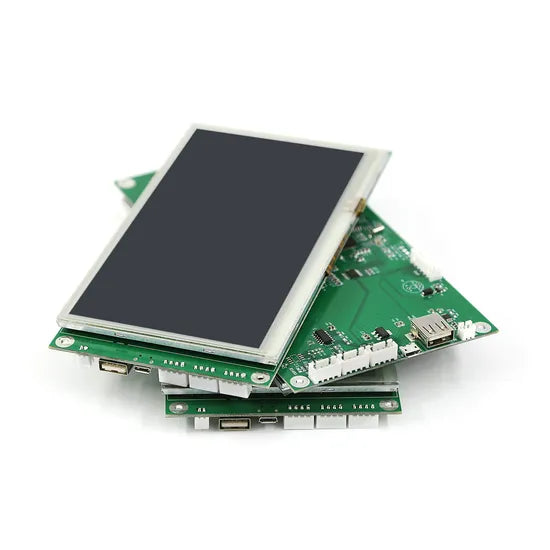
Taking a common 2.4-inch IPS TFT module (resolution 320x240, with resistive touch) as an example, its component cost is roughly broken down as follows:
| Component | Cost Range (USD) | Remarks |
|---|---|---|
| LCD Glass and Driver IC | $1.8 - $3.5 | Cost is directly related to resolution, refresh rate, viewing angle. IPS panels are about 20%-40% more expensive than TN panels. |
| FPC (Flexible Printed Circuit) | $0.3 - $0.7 | The golden ribbon cable connecting the screen to the main board; its length and quality affect the price. |
| PCB (Main Board) | $0.8 - $1.5 | 2-layer or 4-layer board, soldered with the main control chip, passive components, and interface. |
| Backlight LED and Light Guide Plate | $0.4 - $0.9 | Determines screen brightness. High brightness (>400 nits) LEDs cost significantly more. |
| Resistive Touch Film | $0.5 - $1.2 | Cost is much lower than capacitive touch (typically $2 - $5). |
| Subtotal (Component BOM) | $3.8 - $8.8 | This is the cost for the factory to purchase components in large quantities. |
For retailers or distributors, the price at which they purchase this finished module in small batches from the module factory might be between $5 and $10, depending on the purchase quantity.
Costs Added by the Supply Chain and Logistics Links
-
International Sea/Air Freight: Assuming a shipment of 500 modules from an Asian factory to a US warehouse, sea freight cost is about $0.3 - $0.6 per unit, while air freight could reach $1.5 - $3 per unit.
-
Import Tariffs: Depending on the commodity code (HTS code), the import duty rate for LCD modules might be between 0% and 3.5%. This cost is added on top of the goods cost.
-
Warehousing Cost: Distributors lease warehouses to store materials. The monthly rent for professional temperature/humidity-controlled, ESD-protected warehouses, allocated per module, might account for 1%-2% of its value, i.e., $0.1 - $0.2 per unit per month.
-
Single-Unit Order Processing Cost:
-
Picking: Warehouse personnel pick the item from the shelf according to your order.
-
Inner Packaging: To prevent ESD and physical damage, individual packaging with anti-static bags, foam padding is needed.
-
Outer Packaging: Using cardboard boxes, fillers.
-
The combined cost of picking, packaging labor, and materials for a single-unit order might be $2 - $4.
-
Service and Support Costs
-
Technical Support Cost: Companies like Digi-Key, Mouser employ application engineers to answer your technical questions. This labor cost is very high and is allocated into the product price. The average cost of a technical support request may exceed $50; these costs are allocated in small proportions to each item sold.
-
Online Platform Costs:
-
Self-operated Websites (e.g., distributor websites): Require development and maintenance investment, but transaction commissions are lower.
-
Third-party Platforms (e.g., Amazon): The platform charges a commission of 8% to 15% of the sales amount. This is one reason why third-party seller prices on Amazon are often higher.
-
-
Payment Processing Fee: For each credit card or PayPal transaction, the merchant pays about 2.9% + $0.30 in fees. For small orders, this fee is quite significant.
-
After-sales Service Cost: Logistics costs, inspection labor costs, and product devaluation losses incurred from handling returns and exchanges.
Retailer's Profit Requirement
-
Component Distributors: Due to providing high-quality service, their target gross margin is typically set at 30% to 40%.
-
Online Marketplace Sellers: Fierce competition may compress gross margins to 15% to 25%.
Comprehensive Cost Calculation Example
Assuming a module's factory cost is $7, let's see how its price to you is composed:
| Cost Item | Calculation | Amount (USD) |
|---|---|---|
| Goods Cost | Module Factory Price | $7.00 |
| Logistics & Tariffs | International Air Freight + Tariff (~$2.5) | $9.50 |
| Warehousing & Handling | Warehousing Fee + Single-Unit Order Processing (~$3) | $12.50 |
| Service & Platform | Technical Support Allocation + Payment Fee (~$1.5) | $14.00 |
| Retailer Profit | Calculated at 30% Gross Margin: $14 / (1 - 0.3) | $20.00 |
Therefore, it is common for a module with a factory price of $7 to have a retail price of $20.
If you choose a faster shipping method (like overnight), the shipping cost will add an extra $10 - $25, making the total price even higher.
Procurement Strategy
Step 1: Precisely Define Your Technical Requirements
Before looking at any product page, complete the following checklist. Vague requirements lead to procurement errors, resulting in additional time and money costs.
-
Essential Parameter Checklist:
-
Interface Type: Is it a simple I2C/SPI, or a parallel RGB/MCU interface? I2C requires only 2 data lines but has a low refresh rate, suitable for static displays; RGB interface requires 16-24 data lines but enables high-speed screen refresh.
-
Driver Chip Model: This is the most precise identifier. For example, SSD1306 drives OLED screens, ST7789/ILI9341 drives TFT screens. Knowing the driver chip allows you to directly find compatible code libraries and documentation.
-
Resolution: 128x64, 240x320, 800x480. Resolution directly determines image clarity and the required RAM size of the main control chip.
-
Size: Measured diagonally in inches, but also pay attention to the viewable area size.
-
Brightness: 250-300 nits is sufficient for indoor applications; over 500 nits are needed for automotive or outdoor use. Insufficient brightness makes it unreadable in strong light.
-
-
Recommended Action: Create a spreadsheet with the above parameters as columns, and fill in specific values for each of your project options.
Step 2: Utilize Professional Resources for Searching
Don't just search with generic terms on Amazon or eBay. Use a layered search approach.
-
Technical Data Search: Visit the Digi-Key or Mouser website and use their filters. You can filter by dozens of parameters like size, resolution, interface, brightness. The purpose of this step is not to buy immediately, but to quickly lock down a few specific models that meet the technical criteria.
-
Price Comparison Search: Use the models identified in the previous step (e.g., "Nokia 5110 LCD compatible 84x48" or "2.4 inch TFT ILI9341") as keywords to compare prices on platforms like Google Shopping, eBay. You will find price differences for the same model across different channels can be as high as 50%.
-
Scarcity Search: If your model is very old or niche, search on component inventory aggregator platforms like Octopart.com. It shows inventory and prices from dozens of distributors at once.
Step 3: Calculate Total Cost of Ownership, Not Just Unit Price
A "low price" in retail can be a trap. Total Cost = Product Unit Price + Shipping Cost + Tariffs + Potential Time Risk Cost.
-
Shipping Trap: A module on eBay is listed at $8.99, but shipping is $5.99, total $14.98. The same module on Digi-Key is listed at $12.50, but orders over $75 get free shipping.
-
Tariff Calculation: Shipping from another country or region (e.g., UK, Singapore) to your location may incur tariffs and VAT. For example, a $50 item entering the EU may require paying 15%-25% VAT. Large distributors usually pre-collect this fee at checkout, while small sellers might not inform you, leading to unexpected charges upon receipt.
-
Time Cost: A module that is $5 cheaper but takes 3 weeks to ship may delay your project. If the project has a clear timeline, choosing a supplier that provides reliable logistics tracking is more important.
Step 4: Specific Methods to Evaluate Supplier Reliability
For non-authorized distributors, verify their credibility through the following methods:
-
Check Actual Photos: Ask the seller for real photos, not product renderings, especially photos of the interface pins and the display when powered on.
-
Request the Datasheet: Even for non-branded modules, a reliable seller should be able to provide a basic datasheet or pinout diagram. If the seller cannot provide any technical documentation, the procurement risk is high.
-
Inquire About Return Policy: Clarify the process if the product is DOA (Dead on Arrival). Who pays for return shipping? How long is the cycle?
An Example of an Actual Procurement Decision Process
Scenario: Procuring 10 pieces of 3.5-inch TFT modules with capacitive touch, resolution 480x320, for your new project.
-
Technical Confirmation: Determine the need for RGB or MIPI interface, main control chip support. Tentative model: ILI9488.
-
Channel Screening:
-
Option A (Authorized Distributor): Check on Digi-Key, unit price $38.50, shipping $12 (3-day delivery), total $397. Provides full datasheet, 2-year warranty.
-
Option B (Professional Platform Seller): Check on LCSC, unit price $21.80, shipping $18 (sea freight, 10-15 day delivery), total $236. Provides basic datasheet.
-
Option C (E-commerce Platform): Find a third-party seller on Amazon, unit price $29.99 (free shipping), 5-day delivery. But technical details are unclear, seller reviews are mixed.
-
-
Decision Analysis:
-
If the project is in the critical prototype development stage with low fault tolerance, choose Option A. The extra cost is "insurance" purchased for the stable progress of the project.
-
If the project is extremely budget-constrained and time is ample, Option B is the best choice, saving $161.
-
Option C seems like a compromise but lacks technical support and quality assurance, posing the highest risk, and is generally not recommended for formal projects.
-
Wholesale Guide
The price difference for bulk purchasing is enormous. For example, a common 10.1-inch module might cost $35 per unit for 100 pieces, but can drop sharply to $22 per unit for a 1000-piece order, giving a decisive advantage in the final product cost.
However, wholesale is not simply "larger quantity, better price"; it is a complete strategy covering technology, commerce, and risk.
You need to accurately grasp everything from the typical MOQ starting at 500 pieces, to evaluating whether the supplier is a source factory or a quality trader; from understanding the impact of payment terms on the total price, to avoiding core risks like delivery delays or quality fluctuations.
Price Structure
Analyzing the Cost Composition of a Quotation
When a supplier quotes "$28 per unit", this price typically includes the following calculation:
LCD Glass Base Cost (Approx. 55%-65%)
Taking a 10.1-inch IPS-grade LCD glass as an example:
-
Standard HD resolution (1280x800) glass purchase price: approx. $18.50
-
Additional cost for full lamination cover glass: $3.20
-
Premium for special process requirements (e.g., wide viewing angle): $2.30
Subtotal: $24.00 (Based on a total price of $28, this is 85.7%)
Drive Circuit Cost (Approx. 12%-18%)
-
Main control chip (e.g., Solomon Systech SSD1968): $2.10
-
PCB board (4-layer immersion gold process): $1.80
-
Passive components (capacitors/resistors): $0.90
-
Connector (FPC 40pin): $0.70
Subtotal: $5.50 (19.6%)
Backlight System Cost (Approx. 8%-12%)
-
LED chips (edge-lit, 36 pieces): $1.20
-
Light Guide Plate (2.0mm thickness): $0.90
-
Optical films (diffuser/brightness enhancement/prism sheets): $1.50
Subtotal: $3.60 (12.9%)
Production and Processing Cost (Approx. 5%-8%)
-
SMT assembly fee: $0.60
-
Assembly labor cost: $0.50
-
Aging test (48 hours): $0.80
Subtotal: $1.90 (6.8%)
Management and Operating Cost (Approx. 10%-15%)
-
Factory/equipment depreciation: $0.40
-
Quality management expenditure: $0.30
-
Logistics management cost: $0.60
-
Corporate profit: $1.70
Subtotal: $3.00 (10.7%)
Impact of Purchase Quantity on Unit Price
Price changes follow the principle of diminishing marginal returns. Here is a specific calculation example for a 10,000-piece order:
Price Tier Model (7-inch IPS Module)
-
1-50 pieces: $45.00 (Prototype/Pilot stage)
-
51-200 pieces: $38.00 (Small batch purchase)
-
201-1000 pieces: $32.00 (Medium batch)
-
1001-5000 pieces: $28.50 (Standard batch)
-
5001-20000 pieces: $25.00 (Large scale purchase)
-
20001+ pieces: $23.00 (Strategic cooperation price)
Cost Optimization Calculation Example:
When the purchase quantity increases from 1000 to 5000 pieces:
-
Glass purchase enjoys volume discount: unit price reduced by $1.80
-
Component packaging changed to reel: saves $0.50
-
Production efficiency increased by 20%: processing cost reduced by $0.40
-
Logistics switched to full container load: saves $0.30
Total unit cost decrease: $3.00, a reduction of 10.5%
Cost Increment from Special Requirements
Environmental Adaptability Improvements
-
Wide Temperature Version (-30°C to 80°C):
-
Special liquid crystal material: +$2.50
-
Low-temperature resistant polarizer: +$1.20
-
Wide-temperature IC chip: +$1.80
-
Total increase: $5.50 (19.6% increase)
-
Optical Performance Enhancement
-
High Brightness Version (1000 nits):
-
High-brightness LED chips: +$3.20
-
Enhanced heat dissipation design: +$1.50
-
Thicker light guide plate: +$0.80
-
Total increase: $5.50 (19.6% increase)
-
Customization Fees
-
Non-standard Shape Cutting:
-
Glass cutting mold: $2000 (one-time)
-
If the order is 10,000 pieces, amortized to $0.20 per piece
-
-
Special Interface:
-
PCB redesign: $1500 (one-time)
-
New connector mold: $800
-
Parameters Needed to Get an Accurate Quote
Mandatory Technical Specifications
-
Basic Parameters:
-
Exact size: 7.0 inches (diagonal)
-
Resolution: 1024x600 pixels
-
Brightness: 350 cd/m²
-
Interface: LVDS 2-channel
-
Procurement Information
-
Initial Order Quantity: 5000 pieces
-
Expected Annual Demand: 20000 pieces
-
Target Delivery Time: 6 weeks after receiving the down payment
-
Special Requirements: Need RoHS/REACH certification
Quality Requirements
-
Defective Pixel Standard: Class 1 (zero defective pixels)
-
Operating Temperature: -20°C to 70°C
-
Service Life: Over 30000 hours
Evaluating Suppliers
Main Types of Suppliers
Understanding the different roles in the supply chain helps you find the most suitable partner.
-
Original Design Manufacturer (ODM)
ODMs possess the full-chain production capability from glass cutting, liquid crystal filling to module assembly. They usually have their own factories and production lines.
-
Advantages: Strong control over core technology, significant cost advantage for very large orders, outstanding deep customization capability.
-
Considerations: Usually have high Minimum Order Quantity (MOQ) requirements, e.g., over 50,000 pieces. Response speed and flexibility for small to medium-sized orders may be lower.
-
Cooperation Scenario: Annual purchase volume in the hundreds of thousands of pieces or more, with relatively stable product definition, requiring ultimate cost control and deep technical collaboration.
-
-
Module Integrator or Authorized Distributor
These companies purchase LCD glass from glass manufacturers or ODMs, then design and produce driver boards, integrate touch screens, and assemble them into complete display modules.
-
Advantages: Wide product lines, can provide multiple solutions from different technology sources. Support small to medium batch orders, flexible service, fast technical support response.
-
Considerations: Unit price may be slightly higher than direct quotes from ODMs. Need to evaluate their technical integration capability and quality control level.
-
Cooperation Scenario: Purchase volume between a few thousand and tens of thousands of pieces, requiring quick response, diverse options, or medium-complexity customization services.
-
Actionable Checklist for Verifying Supplier Qualifications
Qualification checks should not stop at browsing the company website; actively request and verify specific documents.
-
Company Size and History
-
Request the business license, paying attention to registered capital and founding year. Companies established over 8 years have usually weathered industry cycles and are more stable.
-
Check the professional backgrounds and stability of core team members (e.g., R&D, sales) on platforms like LinkedIn.
-
-
Quality System Certifications
-
ISO 9001: This is the most basic quality management system certification, indicating their production process follows standards.
-
Industry-specific Certifications: If the product is for a specific field, check relevant certifications. For example, automotive displays may require IATF 16949, medical devices may require ISO 13485.
-
Product Safety Certifications: Confirm if their products have passed required safety certifications like UL, CE, FCC. Request copies of certification certificates.
-
-
Production and Testing Capabilities
-
Request real photos or videos of the production floor and equipment: Check for fully automatic SMT machines, bonding machines, optical automated inspection equipment, constant temperature/humidity aging chambers. The aging chamber should perform at least 48 hours of powered aging tests.
-
Inquire about the quality control process: Understand their standards and sampling rates for incoming inspection, in-line quality control, and final inspection. Mention industry standards like IPC-A-610 to see if their response is professional.
-
Assessing Professionalism Through Communication and Questions
Communication with sales and engineers is itself an important evaluation step.
-
Ask Specific Technical Scenario Questions
Don't just ask "How much is this screen?". Ask:
-
"Our main control chip outputs MIPI-DSI signals, but this display only has an LVDS interface. What conversion solution do you recommend? What are the associated costs and signal delay?"
-
"Our device will be used in low-temperature environments, and screen response slows down. What wide-temperature solutions do you have? Specifically, which liquid crystal material is used?"
-
"We need to increase the brightness from 300 nits to 800 nits. How will this affect backlight lifespan and heat dissipation?"
A professional supplier's engineer will provide explanations and multiple options from a principle level, not just a quote.
-
-
Evaluate Response Speed and Support Level
-
Observe their average email reply time and communication habits on weekends or outside business hours.
-
Ask if they provide technical support services, such as schematic review, driver assistance, etc. Understand the size of their technical support team and response process.
-
Sample Testing is the Final Verification Step
After paying the sample fee, testing the samples is the final step to verify their claimed quality.
-
Standardization of the Test Environment
-
In the same darkroom environment, use calibrated luminance meters and colorimeters to measure brightness, color gamut, and uniformity.
-
Use the same test signal source and mainboard to ensure a consistent comparison baseline.
-
-
Perform Accelerated Life Testing
In addition to basic functional tests, conduct a 72-hour uninterrupted power-on aging test. Observe for bright spots, dark spots, flickering, or brightness degradation. Raise the test environment temperature to 50°C and observe if the display remains stable.
-
Check Process Details
-
Use a magnifying glass to check if the solder joints on the FPC ribbon cable are full and neat.
-
Check if the adhesive application on the module bezel is even, without overflow.
-
Check if the screw tightening torque is consistent.
-
Procurement Process
Phase 1: Prepare the Request for Quotation (RFQ) Package
-
Technical Specification Sheet
This is the most important document. It should not be a simple description of size and resolution, but a datasheet containing all key parameters. A complete specification sheet should clearly state:
-
Display Parameters: Size (precise to millimeters), resolution, brightness (in nits), contrast ratio, color gamut (e.g., sRGB 72%), viewing angle (e.g., 85/85/85/85).
-
Interface & Signal: Interface type (e.g., LVDS, MIPI-DSI, eDP), voltage (e.g., 3.3V or 5.0V), supported protocols.
-
Mechanical Parameters: Overall module dimensions, viewable area size, mounting hole positions and diameters, connector type (e.g., FPC 40pin, pitch 0.5mm) and its extension position and length.
-
Environmental Parameters: Operating and storage temperature range (e.g., 0°C to +60°C), humidity requirements.
-
Certifications & Standards: Whether specific safety or environmental certifications are needed, such as CE, FCC, RoHS.
-
-
Purchase Quantity & Forecast
Clearly inform the supplier of your procurement plan:
-
Engineering Sample Requirement: Usually 5-10 pieces are needed for initial testing and prototype development.
-
Initial Order Quantity: For example, 500 pieces or 2000 pieces.
-
Rolling Forecast for the Next 12 Months: For example, after the first order, forecast purchasing 1000 pieces per quarter.
-
-
Target Price & Timeline
If you have an internal budget, you can propose a target price (e.g., "Our target unit price is $22"). Also, state the expected sample delivery time (e.g., within 2 weeks) and mass production lead time (e.g., 6 weeks after receiving the down payment).
Phase 2: Evaluate Quotations and Sample Testing
-
Price Breakdown
A detailed quotation should list the main cost items, not just a total price. Ask the supplier if they can provide a simple cost breakdown, e.g., LCD glass cost, touch screen cost, PCB cost, assembly and testing fee.
Sample Testing Process
After paying the sample fee (usually $50-$150, deductible upon bulk order placement), rigorously test the received 3-5 samples.
-
Visual Inspection: Under sufficient light, use a magnifying glass to check the screen surface for scratches, foreign objects, bubbles. Check PCB soldering for cleanliness.
-
Basic Functional Test: Connect to your mainboard, test all display functions for normal operation, including color uniformity, presence of defective pixels (according to ISO 9241-307 standard, Class 1 allows 0 defective pixels, Class 2 allows up to 2 defective pixels).
-
Reliability Test: Perform at least a 72-hour uninterrupted power-on aging test, checking for flickering, image retention, or brightness degradation. If the product is for a special environment (e.g., high temperature), perform high/low temperature cycle testing.
-
Compatibility Test: Thoroughly match the samples with your own hardware and software drivers to ensure signal stability and no electromagnetic interference issues.
Phase 3: Negotiation and Contract Signing
-
Payment Terms
Common international trade payment methods include:
-
T/T (Telegraphic Transfer): Most common. For example, 30% as a down payment, 70% balance paid before shipment. For first-time customers, suppliers may require a higher down payment percentage (e.g., 50%).
-
L/C (Letter of Credit): Suitable for large orders (e.g., over $100,000), reduces risk for both parties through bank credit, but procedures are more complex, incurring additional bank fees.
-
Western Union/PayPal: Only suitable for small sample fees, not used for bulk payments due to high fees and risk for the seller.
-
-
Delivery Time and Delay Handling
Clearly define the following time points in the purchase contract:
-
Production Lead Time after Receiving Down Payment: Usually 4-6 weeks.
-
Sea Freight Time: From major Chinese ports (e.g., Shenzhen Yantian Port) to US West Coast (e.g., Los Angeles Port) takes about 14-18 days; to European base ports (e.g., Rotterdam) takes about 28-35 days.
-
Penalty Clause for Delayed Delivery: For example, if the delay is due to the supplier's responsibility, for each week of delay, the supplier compensates 1% of the total order value, up to a maximum of 5%.
-
-
Quality Acceptance Standard
The contract should specify the standard for quality acceptance (e.g., IPC-A-610 Class 2) and define the acceptable quality limit (AQL). Typically, for displays, the AQL for Major defects (e.g., display failure) is set at 0.65%, and for Minor defects (e.g., minor appearance flaws) at 1.5%.
Phase 4: Mass Production and Final Acceptance
-
Production Progress Updates
You can request the supplier to provide updates at key milestones, e.g., materials ready, assembly started, aging test completed, ready for shipment.
-
Pre-Shipment Inspection
For large or critical orders, it is highly recommended to hire an independent third-party inspection agency (e.g., SGS, BV, Intertek) to conduct a random pre-shipment inspection after the supplier completes production, before packing. The inspector will check product function, appearance, and packaging according to AQL sampling standards and issue a detailed inspection report. This cost (approx. $300-$500) can effectively avoid huge losses from receiving a whole batch of non-conforming products.
-
Logistics and Customs Clearance
Confirm the Incoterms used with the supplier:
-
FOB (Free On Board): The supplier is responsible for delivering the goods to the port of shipment and loading them onto the ship. Subsequent international sea freight, insurance, and destination port customs clearance are your responsibility.
-
EXW (Ex Works): You need to arrange for a freight forwarder to pick up the goods from the supplier's warehouse and bear all subsequent transportation and costs.
-
DDP (Delivered Duty Paid): The supplier is responsible for everything, including delivery to your specified destination warehouse. This method is the most hassle-free, but the total cost is usually the highest.
-
Customization Requirements
When to Consider Customization?
You should discuss customization options with suppliers when the following situations occur:
-
Mechanical Structure Mismatch: Your product's housing cutout is circular or an irregular shape, while standard displays are rectangular. Or, the standard module's mounting hole positions conflict with your internal structure.
-
Interface and Signal Incompatibility: Your mainboard outputs MIPI-DSI signals, but the desired standard display only provides an LVDS interface. Or, you need to move the display's FPC connector from the top to the left side.
-
Special Optical Performance Requirements: Your device needs to be used under strong light (e.g., outdoors), requiring brightness over 1000 nits, or needs optical bonding to reduce reflection.
-
Harsh Operating Environment: The product needs to operate stably at -30°C low temperature or +85°C high temperature, which is beyond the standard range of commercial-grade displays (typically 0°C to +50°C).
-
Need to Integrate Additional Functions: You want to integrate the touch screen controller, camera, or sensors inside the display module to save overall space.
Specific Customization Items and Associated Costs
-
Shape Cutting
-
Content: Change the shape of the LCD glass or the entire module to be circular, rounded rectangle, or any non-standard shape.
-
Cost & Cycle: Requires a new mold (diamond wheel) for glass cutting. Cost ranges from $1,500 to $5,000, depending on shape complexity. This adds 2-3 weeks to the production cycle. Glass utilization rate decreases, potentially increasing unit price by 10%-20%.
-
-
Optical Bonding
-
Content: Use optical adhesive to seamlessly bond the LCD glass with the surface cover (glass or touch screen).
-
Effect: Significantly reduces light reflection at the air gap, improves readability in sunlight, and makes the screen surface easier to clean.
-
Cost: This process adds $15 to $40 to the unit cost, depending on screen size and adhesive type. Production yield slightly decreases, increasing production difficulty.
-
-
Modifying Circuit and Interface
-
Content: Redesign the driver board to change the main control chip, adjust the power management circuit, or change the connector type/location.
-
Cost: New PCB layout and engineering debugging require NRE (Non-Recurring Engineering) fees, approximately $2,000 to $8,000. Additionally, using different main control chips (e.g., switching from a TI solution to a Novatek solution) changes component costs.
-
-
Wide Temperature and High Brightness
-
Content: Enable the display to operate under extreme temperatures or high brightness.
-
Implementation: Wide-temperature versions require specific liquid crystal materials, polarizers, and integrated circuits. High-brightness versions require higher-power, more numerous LED chips, and enhanced heat dissipation design.
-
Cost Impact: Wide-temperature treatment may increase cost by 15%-25%. Increasing brightness from standard 300 nits to 800 nits may increase backlight cost by 30%-50%.
-
-
Custom Firmware and Branding
-
Content: Burn your company's logo as a boot screen into the display driver chip, or adjust color profiles, gamma values to match your brand's visual standards.
-
Cost: NRE fees for firmware modifications are relatively low, possibly between $500 and $1,500.
-
Steps for Communicating Customization Needs with Suppliers
-
Provide Detailed Requirement Documentation
Write a formal Request for Proposal (RFP). Content should include: a detailed description of the customization goal, the application scenario of the final product, specific technical parameters to be met, expected purchase quantity, and timeline.
-
Feasibility Assessment and Quotation Request
The supplier's engineering team will review your requirements and assess technical feasibility. This process may take 1-2 weeks. They will provide a preliminary feasibility report and a rough estimate of NRE fees and unit price.
-
Sign Customization Agreement and Pay NRE
After confirming cooperation, both parties sign an agreement specifying NRE fees, intellectual property ownership, development cycle, and acceptance criteria. Usually, 50% of the NRE fee is paid as a project startup payment.
-
Engineering Sample Production and Testing
The supplier will produce 3-5 sets of engineering samples for your testing. This stage is critical for identifying problems and making design adjustments. Testing should be stricter than for standard products, including comprehensive environmental reliability testing.
-
Design Freeze and Production
After the samples pass testing, confirm "Design Freeze" in writing. All specifications are fixed, and the supplier will proceed with mold making and production preparation based on this. Pay the remaining NRE fee at this time.
Considerations for Managing Customization Projects
-
Minimum Order Quantity (MOQ) Increases: To amortize high NRE costs, suppliers typically set a higher MOQ for customization projects, e.g., 3000 pieces or 5000 pieces minimum.
-
Cycle Time Significantly Extends: Turning a standard project into a customization project extends the total delivery cycle from the standard 4-6 weeks to 12-16 weeks or even longer.
-
Change Cost is Extremely High: Once the design is frozen and enters the production phase, any proposed changes may incur additional engineering fees and cause significant delays.
Weiterlesen
Choose OLED for superior contrast (over 1,000,000:1), faster response (microseconds vs milliseconds), and wider viewing angles. It's ideal for high-end devices. Select LCD for higher maximum bright...
Select manufacturers with ISO 9001 and IATF 16949 certifications for quality. For customization, provide detailed specs for a formal quote. Pricing tiers vary; expect a 30-50% premium for fully cu...
Hinterlasse einen Kommentar
Diese Website ist durch hCaptcha geschützt und es gelten die allgemeinen Geschäftsbedingungen und Datenschutzbestimmungen von hCaptcha.