

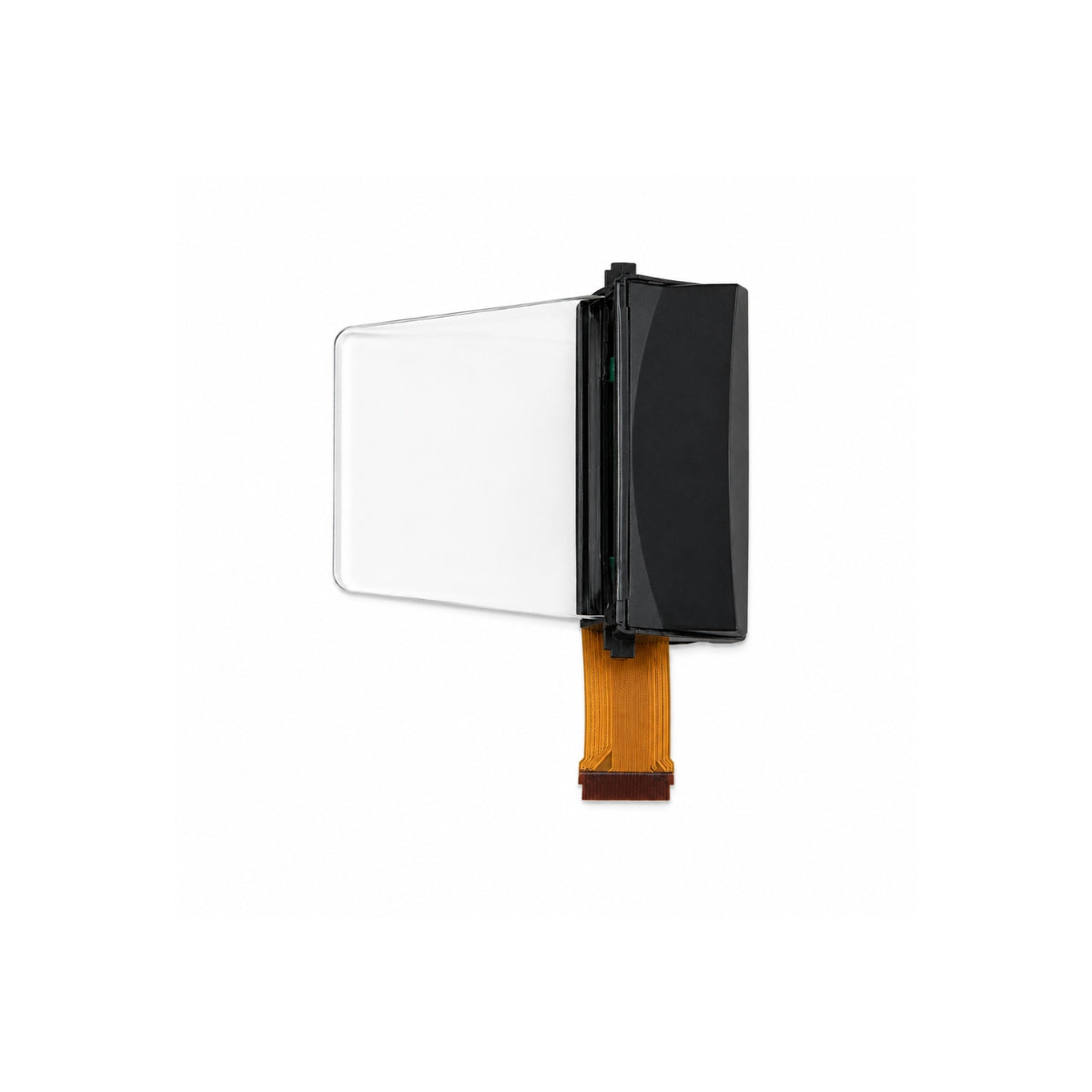
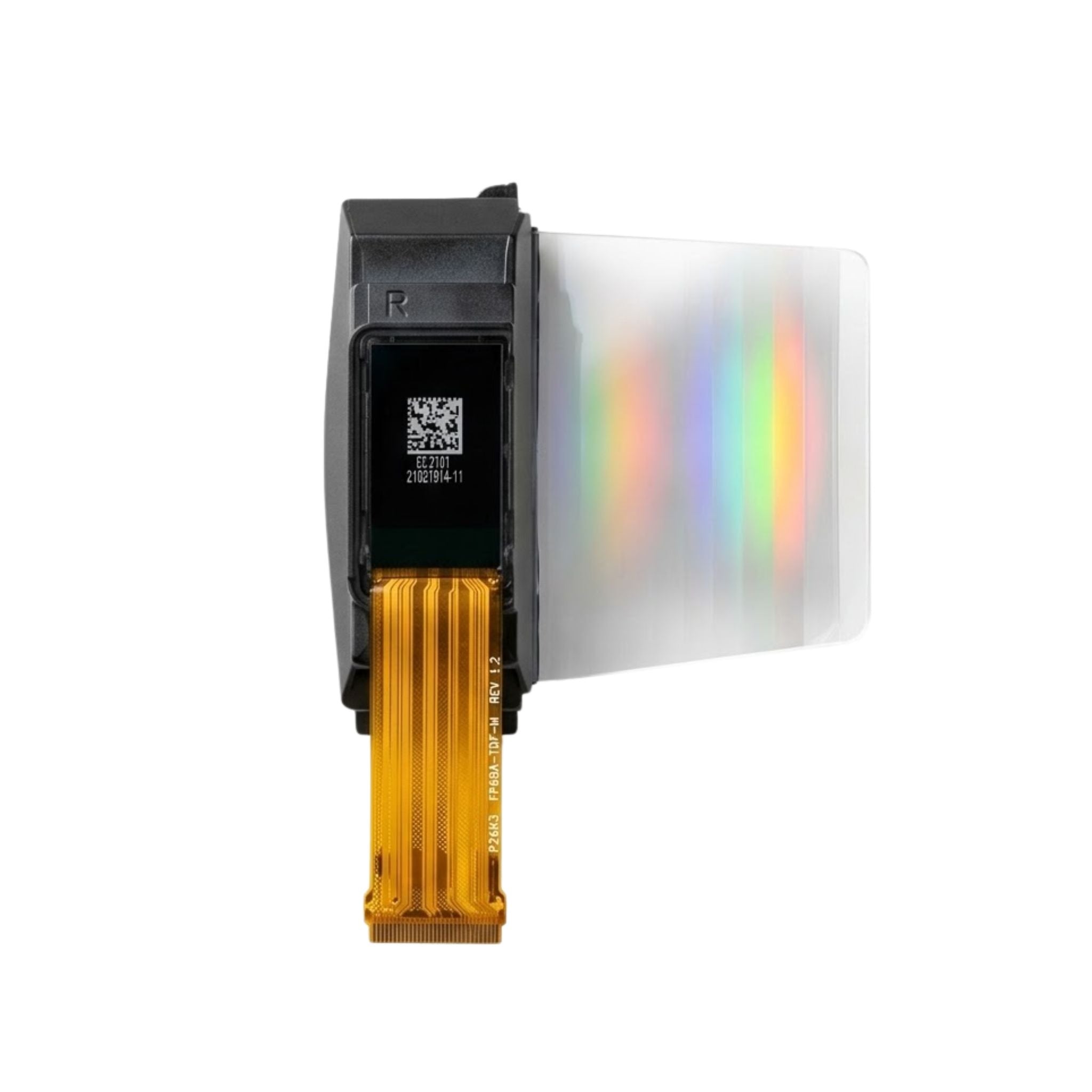


Optical bonding is worth paying for if internal reflections make an outdoor display hard to read and a bonded sample passes your readability test where a cheaper alternative falls short. If an air-gap display already meets the requirement under a canopy or in shade, the premium may not be justified. For an outdoor human-machine interface (HMI), treat glove operation as a separate requirement: clearer optics do not make a touch register.
If you need a sunlight-readable, glove-friendly module, start with DisplayModule’s custom TFT LCD and touch options. The page lists optical bonding and touch options for custom projects; it does not establish that a particular stock module meets both requirements. Ask for a sample and a quote for the exact bonded configuration, with its measured brightness and reflectance, glove test conditions, and operating temperature range.
What Optical Bonding Changes
Optical bonding fills an air gap between display layers with transparent adhesive. Matching the refractive indices reduces reflections at the bonded interfaces, but the outer cover surface can still reflect light. At normal incidence, single-interface reflectance is R = ((n₁ − n₂) / (n₁ + n₂))². Using air at 1.00 and the 1.51 refractive index Corning lists for Gorilla Glass 7i at 590 nm gives about 4.1% for that one interface [1][2].
| Interface | Reflectance | What the number describes |
|---|---|---|
| Uncoated air–glass | About 4.1% | One boundary, not the entire display stack |
| Glass and perfectly index-matched adhesive | 0% in the ideal calculation | Only the matched boundary, not the exposed cover surface |
Do not add those figures to estimate module reflectance. Cover-glass transmittance is also a separate measurement: SCHOTT lists typical transmittance above 91% for its listed unstrengthened Xensation variants at 0.78 mm. That is a glass measurement, not the transmittance or brightness of a finished module [3].
Sunlight Readability
Luminance is expressed in candelas per square meter (cd/m²), also called nits [4]. Compare front-of-glass luminance and reflectance on the assembled sample, not just the base LCD’s brightness rating. Ask for the measurement geometry before comparing reflectance percentages. The outdoor display guide to brightness, contrast, and glare explains why a brighter backlight and a less reflective surface address different problems.
Compare the bonded sample with a viable air-gap option. Keep the displayed interface, ambient lighting, viewing position, and temperature comparable. Try reading the smallest label and the most important alarm from the actual operator position, with polarized sunglasses if operators wear them. A showroom demo is not a substitute for a check in the intended mounting orientation and lighting. ISO 9241-303 provides a general framework for display ergonomics, not a pass threshold for your installation [5].
Glove-Friendly Touch
With projected capacitive (PCAP) touch sensing, specify the cover-glass thickness, sensor, controller, and firmware on the sample. The industrial HMI touch options guide helps frame the choice if wet gloves or water on the cover are part of normal operation.
Before testing, agree on what counts as a first-press pass, the number of trials, and the test temperature. Have operators tap the smallest and most-used controls with their actual gloves. Record glove material, thickness, layering, and dry or wet condition. Log misses and unintended touches separately: an input that registers on the wrong control is not a pass. Keep the sample part number and firmware revision with the results so a later substitute can be retested.
Temperature and Durability
Use the wide-temperature industrial TFT guide to frame your requirements, then verify operating and storage limits on the bonded module’s datasheet. Check whether brightness, display response, and touch still meet your requirements at the relevant operating extremes. Adhesive bonding does not establish an enclosure ingress or impact rating.
For environmental test reports, ask for the specific IEC 60068-2 test part or equivalent method, the tested configuration, severity, duration, sample count, and pass criteria. A series reference alone does not show that the module passed a test [6]. IEC 60068-2-78:2025, for example, assesses steady-state damp heat without condensation; it does not demonstrate resistance to condensation in your installation [7].
Keep adhesive evidence separate from module evidence. For example, 3M reports no appreciable visible deterioration such as bubbles or delamination after specified laboratory exposures on cured glass/film/glass specimens. Those results are typical, not a specification or proof that a finished HMI will pass the same tests [8].
Quote and Sample Checklist
Use the standard TFT range to shortlist sizes and interfaces. Then compare bonded and air-gap options in a configuration-specific quote request. If a mounting or interface requirement is still open, contact DisplayModule about your display requirements before committing to a sample.
- Build: Part number and revision, size, resolution, interface, cover-glass thickness and treatment, adhesive type and thickness, touch controller, and firmware.
- Acceptance: Front-of-glass luminance and reflectance with measurement conditions, supported glove conditions, operating and storage limits, and available test reports for the quoted build.
- Commercial terms: Unit-price difference, sample cost, minimum order, lead time, and what the price includes. Ask who pays for rework or replacement and how the warranty handles bubbles, haze, yellowing, and delamination.
If both samples pass at the intended site, compare cost, power, serviceability, and lead time before paying extra. If only the bonded sample passes the visibility requirement, qualify its touch and temperature performance before approving a production order.
Share your display size, mounting conditions, glove type, and operating temperature range. Ask for a bonded sample and the available test data for the quoted configuration.
Request a Bonded-Module QuoteFrequently Asked Questions
Does optical bonding increase nits?
It does not generate more light at the backlight. It changes the optical stack, so the finished module’s measured luminance can differ from the bare panel’s. A screen can also be easier to read because it reflects less ambient light, even without a higher nit rating.
Can a higher-brightness panel replace bonding?
It can if the assembled air-gap module meets your readability, power, and temperature requirements. Raising luminance and lowering reflectance are different ways to improve contrast in ambient light; compare the actual builds rather than assuming one will win.
Can a clear sample still fail glove testing?
Yes. A screen can be easy to read yet miss a tap with the glove your operator wears. Require separate pass results for visibility and touch before accepting the sample.
Sources
- [1] University of Texas at Austin, reflection at a dielectric boundary.
- [2] Corning, Gorilla Glass 7i product information sheet.
- [3] SCHOTT, Xensation cover-glass technical specifications.
- [4] NIST, SI units for luminous intensity.
- [5] ISO 9241-303:2011, requirements for electronic visual displays.
- [6] IEC 60068-2 series, environmental test methods.
- [7] IEC 60068-2-78:2025, steady-state damp heat.
- [8] 3M, CEF28XX / OCA 802XX Series technical data sheet.
Leave a comment
This site is protected by hCaptcha and the hCaptcha Privacy Policy and Terms of Service apply.