



Why did the IPS panel delaminate in humid storage?
 Short answer
If bubbles started at an edge and spread inward, moisture may have weakened the adhesive holding the polarizer to the LCD glass. Researchers observed edge bubbles spreading inward and adhesive separation when they aged iodine-based polarizer film at 85 °C and 85% relative humidity (RH). That pattern makes moisture worth investigating, but it does not establish what happened to your panel [1].
Leave the lifted layer in place. Photograph the affected edge and check when the bag was opened, where the carton sat, and whether the panel was unpacked while still cold.
Which layer is lifting?
| What you see | What to check |
|---|---|
| Lifted film or bubbles beginning at an edge | Use angled light to see whether the gap follows the film on the LCD glass. Photograph where it starts without pressing on it. |
| Waviness, haze, or a color shift | Record it separately from any visible gap. A change in appearance alone does not show that a bond has separated. |
| Bubbles under a bonded cover lens | Check whether the gap is in the bond between the cover lens and display instead of at the polarizer. Ask for the assembly record if the layer is unclear. |
Before calling it a polarizer defect, check the packing or assembly instructions for a removable shipping film. For example, a bubble that stops at the outline of a documented pull-tab film is a reason to inspect that film first. Remove only the layer the instructions identify as removable. If the drawings do not identify the layer, leave it in place and send the supplier an edge photo that shows where the gap sits.
Cracks, sharp black lines, or missing parts of the image warrant a separate IPS display fault check, even if the film is also lifting.
Why moisture matters at the polarizer edge
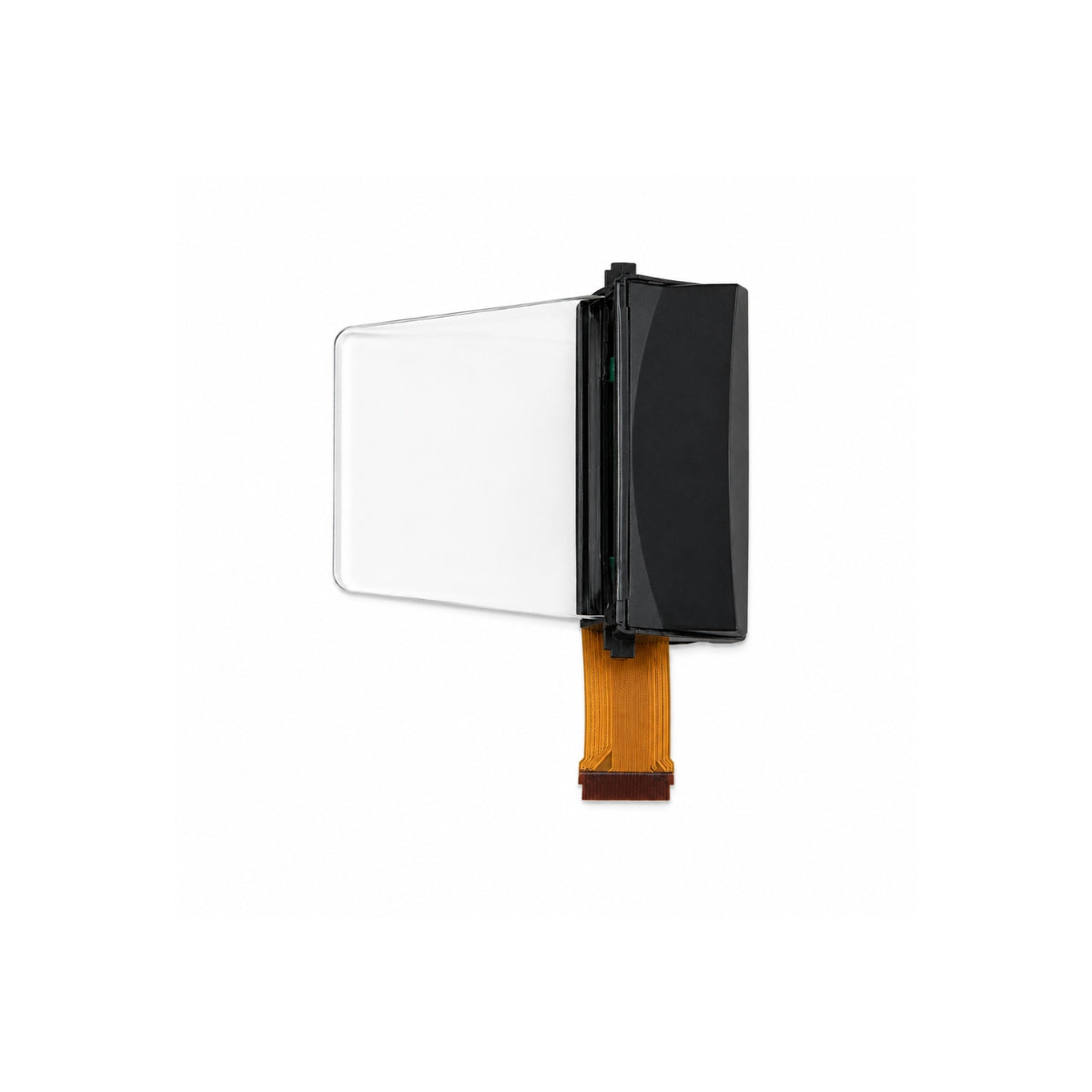
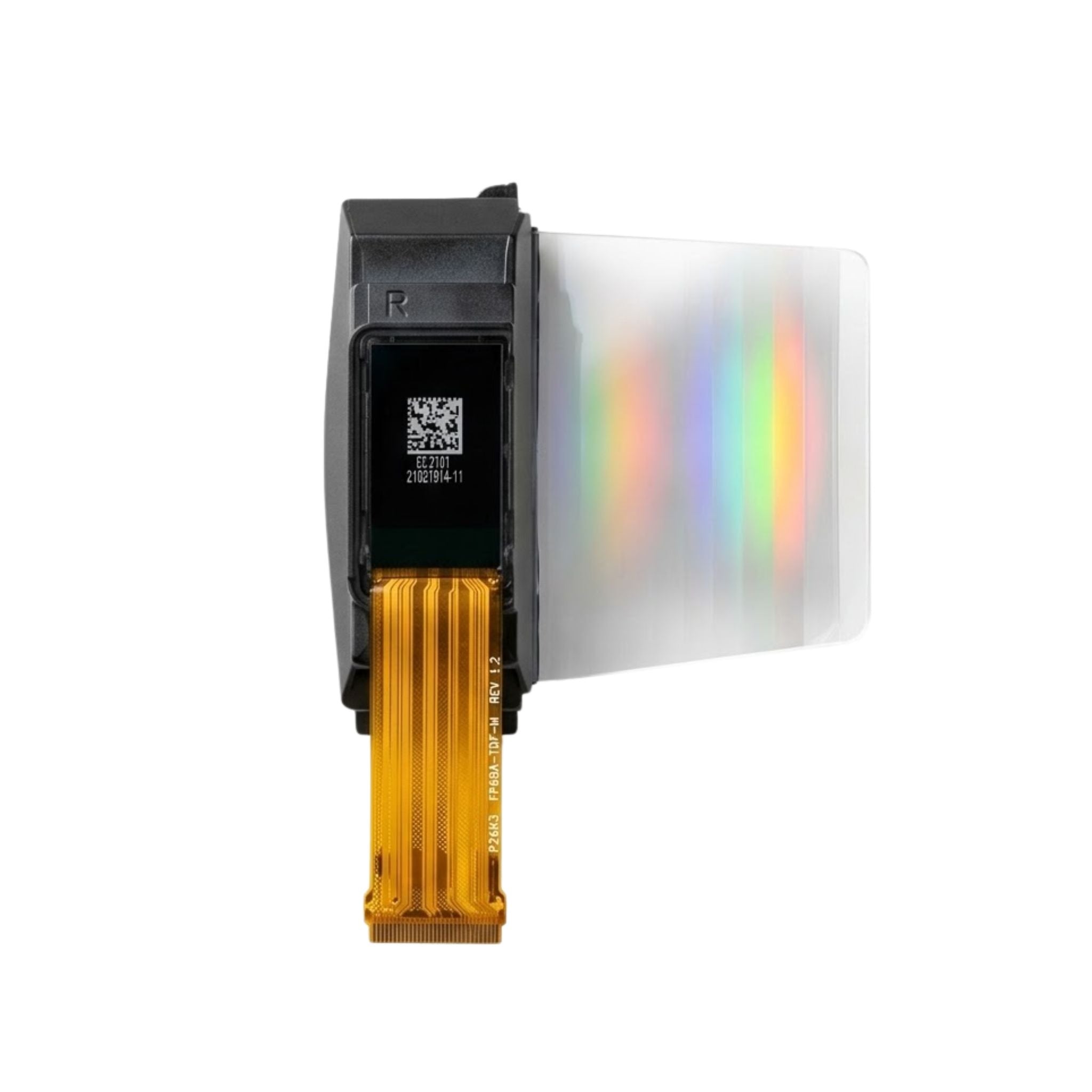
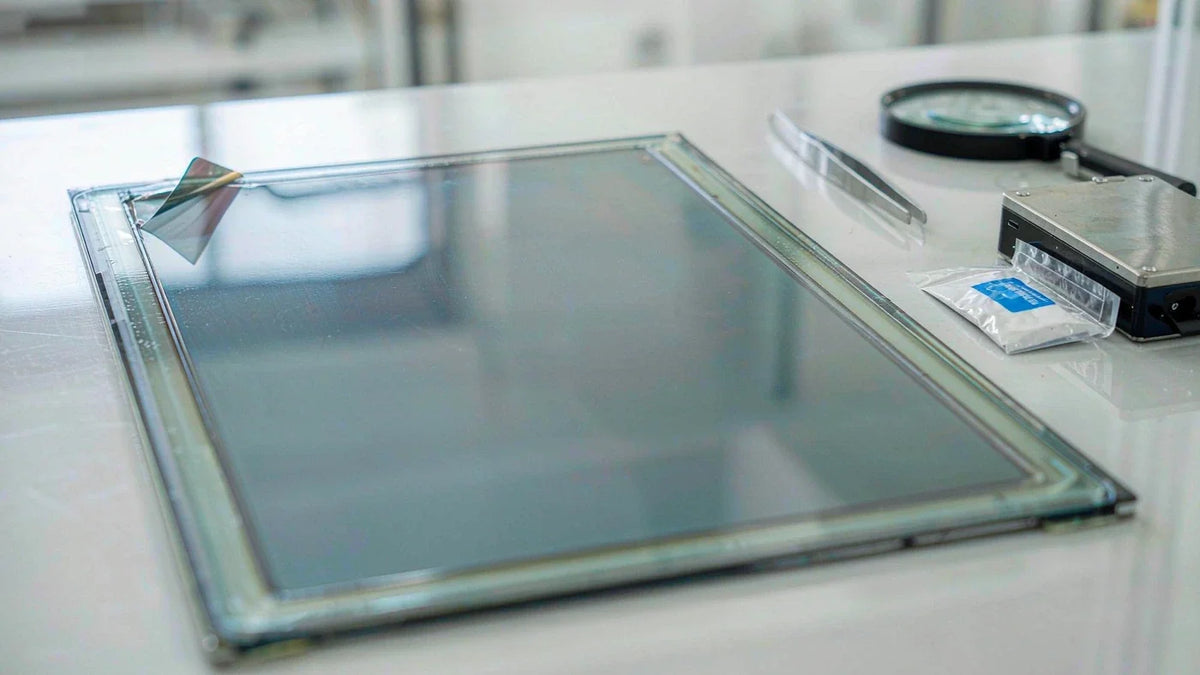
In a common LCD polarizer stack, support films surround a polyvinyl alcohol (PVA) core, and a pressure-sensitive adhesive attaches the stack to the glass. An exposed edge gives moisture a route to the film and adhesive. The accelerated study detected adhesive hydrolysis, a chemical change involving water, alongside the separation. A different LCD study showed that stretched PVA can contract as it loses moisture and stress the panel. That explains one way the film can load the bond; it does not establish that cycling caused a particular warehouse failure [1][2].
Damp heat can also affect the film’s polarizing efficiency and other optical properties. Treat a change in color or contrast as an optical clue, not as proof that the adhesive has let go [1][3].
Check the conditions around the affected lot
- Record the package before opening it. Photograph the seal, carton label, lot code, and any water marks. Record the opening date and the humidity-indicator reading if a card was supplied. A missing card leaves a gap in the record; it does not show that the bag got wet. Use the display-module packing guide to identify packaging features worth documenting.
- Compare units from the same lot. Inspect the same edges under the same light. Where possible, compare packages that differ in one relevant respect: seal status at the same location, or storage location with the same seal status. If both differ, the comparison can narrow the affected stock but cannot separate the effect of location from that of opening. If units from both groups show similar lifting, look for shared shipping or storage exposure and ask the supplier to check the lamination records.
- Rebuild the exposure timeline. Compare receiving photos with the first defect photos. Check temperature and RH logs from the actual storage location, bag-open dates, and moves from cold storage into warm air. The steady-state damp-heat test, IEC 60068-2-78, excludes condensation, so a result from that test does not answer whether panels got wet during a transfer [4].
- Read the storage precautions for the exact part. Use the full part number to identify the right TFT LCD module datasheet. For example, section 8.4 of Displaytech’s DT043CTFT-IPS family specification recommends 25 °C ± 10 °C and 40–60% RH in a dark, clean place. Section 7 separately lists a reliability test at 60 °C and 90% RH for 120 hours. Those are test conditions, not warehouse limits or a prediction of time to failure [5].
Example: A shelf logger shows 65% RH
Suppose the panels are from the DT043CTFT-IPS family and a shelf logger records 65% RH while a bag is open. That is above this family’s recommended range, so record when the reading started and ended and identify the stock exposed during that period. It does not show the humidity inside neighboring sealed bags or prove that the adhesive failed. If lifting is found, sort the inspection results by exposure group instead of reporting just one total for the lot [5].
What to do with a delaminated panel
Hold affected stock and keep a representative unit and its packaging unchanged for the supplier. Send the part and lot numbers, photos, affected quantities, and the exposure timeline. Ask for the inspection criteria and a decision on reuse, rework, or replacement.
Do not peel, press, heat, or glue the film back down. A drier-looking panel does not show that adhesion or optical performance has recovered. Release stock only after it meets the applicable inspection criteria; use a rework procedure only if the supplier approves it for that part.
Keep units that look normal but shared the same exposure on hold pending review. If the storage or packaging records cannot separate exposed stock from the rest, hold the broader group until its scope is clear. For the supplier’s report, list each group’s storage location, seal status, number inspected, and number with visible separation. This gives the supplier a basis for deciding whether to extend the inspection beyond the cartons where the defect was first found.
How to prevent a repeat in storage
- Log temperature and RH where cartons are stored. Keep cartons off the floor and away from leaks and dock doors. Follow the part’s storage and handling instructions rather than copying another model’s humidity range.
- Let sealed packages acclimate before opening when moving stock from cold storage into warm, humid air. Condensation can form when moist air contacts a cold surface. IEC 60068-2-30 covers cyclic damp heat where condensation generally occurs; it does not prescribe an acclimation time for your panel [6].
- Keep supplier-specified packaging sealed until use. Date opened bags and follow the supplier’s resealing instructions for partial lots. IPC/JEDEC J-STD-033C describes dry packing for moisture-sensitive surface-mount devices; it does not set a display module’s shelf life or resealing procedure [7].
Example: The room is in range, but the panel is still cold
Suppose the unpacking room is within the part’s recommended RH range, but the room’s dew point is 14 °C and the panel surface is still at 10 °C. If the panel is exposed to that air, condensation can form because its surface is below the dew point. Check the air where the bag will be opened, not just the warehouse dashboard. Keep the bag closed while the contents acclimate and follow the supplier’s instructions before opening. The two temperatures illustrate the decision; they are not product limits or a fixed waiting time [8].
Facing edge lifting after damp storage? Include the part number and storage conditions with your display inquiry.
Get a QuoteSources
- [1] ACS Applied Polymer Materials, Failure Mechanism of Iodine-Doped Poly(vinyl alcohol) Polarizer under High Temperature and High Humidity Conditions. Accelerated aging of film specimens; not a module storage rating. Publisher abstract accessed 2026-11-23.
- [2] Journal of the Optical Society of Korea, Alleviating Light Leakage in LCDs via Diverse Modifications of Polarizer Film. Panel stress and bending research, not a storage delamination test. Accessed 2026-11-23.
- [3] Chinese Journal of Liquid Crystals and Displays, study of polymerization degree and crosslinking in the hygrothermal stability of iodine-PVA polarizing films. Accessed 2026-11-23.
- [4] IEC 60068-2-78:2025, steady-state damp-heat test method without condensation. Accessed 2026-11-23.
- [5] Displaytech DT043CTFT-IPS family product specification, rev. 1.1, sections 7 and 8.4. Applies to the listed models only. Accessed 2026-11-23.
- [6] IEC 60068-2-30:2025, cyclic damp-heat test method. Accessed 2026-11-23.
- [7] IPC/JEDEC J-STD-033C, handling and dry packing of moisture/reflow-sensitive surface-mount devices. Accessed 2026-11-23.
- [8] U.S. National Weather Service, What is Dewpoint? Explains saturation and surface condensation; not display handling guidance. Accessed 2026-11-23.
Leave a comment
This site is protected by hCaptcha and the hCaptcha Privacy Policy and Terms of Service apply.