



Positive mode is the easier read. Dark characters on a light ground are read faster and with fewer errors than light characters on a dark ground. That advantage tracks display luminance rather than the polarity label[1].
The number that decides it is 3,142 lux. That's where a reflective positive panel reaches 300 nits and matches a backlit negative panel of the same brightness. Below that the negative panel is the brighter display; above it positive pulls ahead.
Both ends have a hard limit. A reflective positive panel needs 400 lux to reach 38.2 nits, and at 300 lux it's down to 28.6 nits. In a dark room it has no light of its own to work with. A negative panel with 4% front-surface reflection passes 42% of its signal to glare at 10,000 lux and has no contrast left at 23,562 lux.
Dark room or dark housing, you'll want a backlit negative. Daylight, go reflective positive. Anywhere from 3,000 to 5,000 lux, either one works.
ISO 9241-303:2011 treats image polarity as a requirement of its own, sitting right next to luminance contrast and character height[2].

Only two parts change
The polarizer and the backlight. Glass, driver IC and interface don't change at all, so a swap between the two modes is rarely a redesign.
Polarity and polarizer type are two separate choices. Positive mode puts dark characters on a light ground, and the panel can be reflective, transflective or transmissive. Reflective contrast lands around 15:1, because an energized pixel blocks 93.3% of the light and the dark state keeps 6.7%.
Negative mode inverts that, and on a monochrome module it's transmissive, with a backlight that stays on, typically 200 to 500 nits. Dark-state leakage is about 0.33%, which is where the 300:1 on the spec sheet comes from. Backlight comes in 3 types (edge-lit, direct-lit, EL), covered in the backlight guide.
| Item | Positive | Negative |
|---|---|---|
| Appearance | Dark characters / light ground | Light characters / dark ground |
| Polarizer | Reflective, transflective or transmissive | Transmissive, backlit |
| Backlight | Optional, daylight does the work | Required and always on |
| Best illuminance | Above 3,000 lux | Below 3,000 lux |
| Typical contrast | TN 30:1–100:1, STN 150:1–300:1 | FSTN 100:1–300:1, DFSTN 500:1–800:1 |
| Typical products | Meters, calculators, shelf labels | Instrument clusters, bedside clocks, night vision |
Ambient light decides the winner
Positive luminance follows L = E × ρ ÷ π, with ρ at 30% for a typical panel. A negative panel with no anti-reflective coating reflects 4% off the front surface, so its glare runs on E × 0.04 ÷ π.
Office lighting is specified at 500 lux[3]. That level gives a negative panel 6.4 nits of glare, 10,000 lux gives 127 nits, and 100,000 lux gives 1,273 nits.
Against a 300-nit backlight, that glare passes 100% at E = 300π ÷ 0.04 = 23,562 lux. No contrast left.
Holding glare under 20% of the signal, you'll need L ≥ E × 0.04 ÷ (π × 0.2). A 300-nit backlight burns through that margin by 4,712 lux. 10,000 lux needs 636 nits. 20,000 lux needs 1,273 nits.
The 800-nit figure you hear quoted lands near 12,600 lux, and direct sunlight starts at 32,000 lux.
Double the ambient light and positive luminance doubles with it. At 100,000 lux the panel carries 9,549 nits on its own, 31.8× what the negative backlight puts out.
| Environment | Illuminance | Reflective positive luminance | Negative glare, 300-nit backlight | Reads better |
|---|---|---|---|---|
| Dim interior at night | 10 lux | 0.95 nits | 0.04% | Negative |
| Indoor at night | 50 lux | 4.8 nits | 0.2% | Negative |
| Office | 500 lux | 47.7 nits | 2.1% | Both read |
| Break-even | 3,142 lux | 300 nits | 13.3% | Positive matches backlight |
| Full daylight | 10,000 lux | 955 nits | 42% | Positive |
| Full daylight, high | 20,000 lux | 1,910 nits | 85% | Positive |
| Direct sun | 100,000 lux | 9,549 nits | 424% | Positive |
Contrast numbers lie a little
What the eye reads is modulation depth, M = (Lhigh − Llow) ÷ (Lhigh + Llow). Run 15:1 through it and you get 87.5%. Run 4:1 and you get 60%. That's 27.5 percentage points apart.
A negative 800:1 lands at 99.8%. A positive 100:1, measured in transmissive mode, lands at 98.0%[4]. The labels differ by 8×, the perception doesn't.
At the same illuminance the two sit at 955 nits against 300 nits, a 3.18× ratio.
| Rated contrast | Modulation depth M | Step from the row above |
|---|---|---|
| 4:1 | 60.0% | — |
| 8:1 | 77.8% | +17.8 points |
| 15:1 | 87.5% | +9.7 points |
| 100:1 | 98.0% | +10.5 points |
| 300:1 | 99.3% | +1.3 points |
| 800:1 | 99.8% | +0.4 points |
Viewing angle and response
In a dim room, 60° to 80° each way is common, and negative contrast still holds at 30° off-axis. Positive panels usually get specified for just 1 viewing direction, most often 12 o'clock.
STN response runs 100 ms to 300 ms, with fast parts down at 80 ms. On a gauge that refreshes once a second, 100 ms is 10% of the cycle and nobody notices. Anything past 10 Hz won't hold. Duty, bias and dot pitch definitions are in the display parameters note.
Backlight current and the battery
A typical backlight is 2 LEDs at 3.2 V and 20 mA: 2 × 3.2 × 0.02 = 0.128 W, or 3.07 Wh over 24 hours. A 1000 mAh, 3.7 V cell holds 3.7 Wh, so the backlight alone eats 83% of it in a day. A reflective positive panel draws 0 A, so it doesn't take anything out of that cell.
Push a negative panel to 800 nits, which is 2.67× the 300-nit step. Power climbs to 0.341 W, or 8.19 Wh a day. That's 2.2× the whole cell. Monochrome and color don't belong in the same power table; see the monochrome vs color LCD comparison.
0.128 W over 43,800 h (5 years) comes to 5,606 Wh, about 5.6 kWh. The 800-nit setting at 8.19 Wh a day runs 2,989 Wh a year, about 2.99 kWh.
Temperature and long-term reliability
Monochrome modules commonly run −20 ℃ to +70 ℃, a 90 ℃ span. Automotive wants −40 ℃ to +85 ℃[5]. That span is 125 ℃, 35 ℃ wider, a ratio of 1.39. Plain STN loses contrast at both ends. Compensation film is what gets you to FSTN or DFSTN.
Damp heat follows IEC 60068-2-78[6], sinusoidal vibration follows IEC 60068-2-6[7], and finished-module appearance follows IEC 61747-20-2[8].
Numbers you can read straight off the spec sheet
Electrical and optical figures on a monochrome datasheet follow IEC 61747-1-1 measurement rules[9]. The 128×64 comes in two common outlines: 75.0 × 52.7 × 8.9 mm (35.5 g, 20 pin through-hole) and 89.7 × 49.8 ±0.5 mm. Do the multiply and you'll get 3,953 mm² against 4,467 mm², so the second one is 13% bigger.
Resolution is 8,192 dots, and a 16×2 character module is 32 characters × 40 dots = 1,280 dots.
Duty ratio sets the bias. 1 + √64 = 9 is the optimum for 1/64 duty. It comes out at 9 for 1/65 duty as well, which is where the 1/9 bias on the spec sheet comes from. Take 8 and contrast drops. Take 10 and you're burning current for nothing. On the glass side, 2 × 0.7 mm substrates plus 2 × 0.2 mm polarizers comes to 1.8 mm. That's 20.2% of the 8.9 mm thickness.
At current catalogue prices the 3.07 in 128×64 runs 25.1% above the 2.61 in ($24.90 against $19.90). The 2.61 and 2.62 in sit at the same money. Jump to a 320×240 at 4.72 in and you're at $129.00, 418% of the 3.07 in.
Where negative mode earns its keep
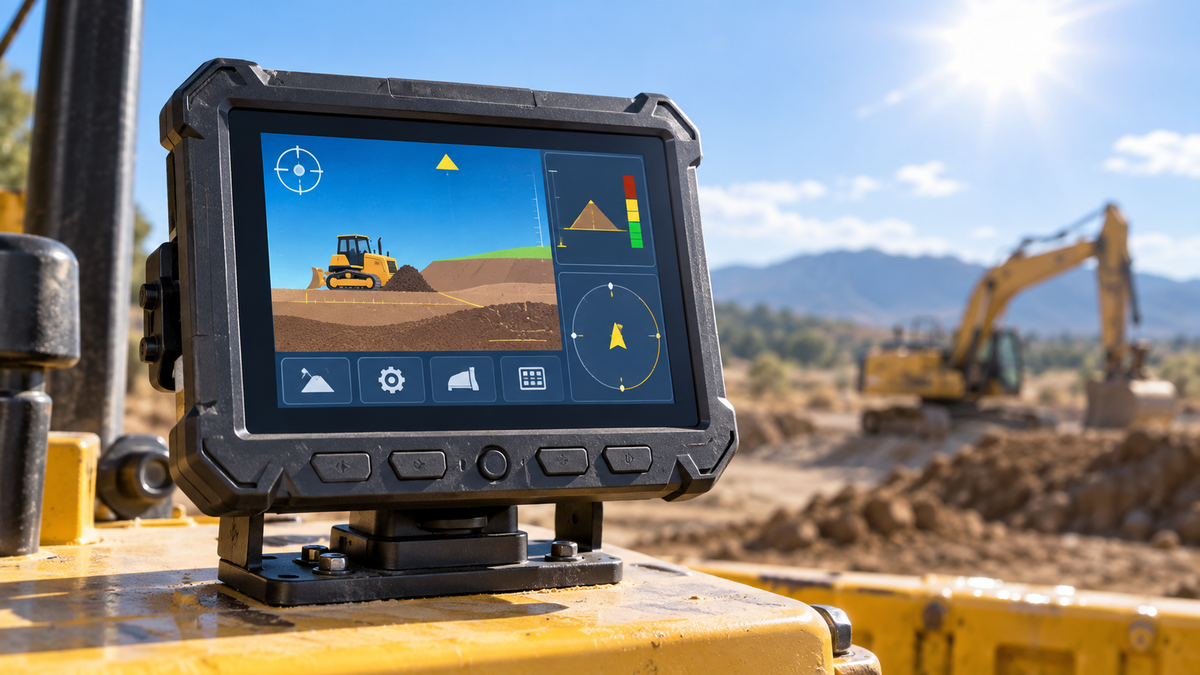
- Instrument clusters and EV charge indicators: dual-duty by design. 800 nits holds up in a 10,000-lux cabin by day, 300 nits is enough in a dark cabin at night. ISO 15008:2017 sets the minimum contrast and font size for this class[10].
- Bedside clocks and night vision gear: night ambient runs under 50 lux, where positive sits at 4.8 nits and you can't read it.
- Patient monitors and handheld meters: dark rooms stay under 100 lux, and a low-power COG module in negative mode keeps current down.
- Consumer gear in dark housings: the panel colour matches the shell, and an anti-reflective layer takes the front surface down from 4% to 1%.
Meters, water meters, electronic shelf labels, calculators and industrial controllers mostly run graphic dot-matrix or character modules. The 128×64 alone ships in 6 outlines, and their ambient light swings from 500 lux to 10,000 lux. Categories and parameters are in the selection guide.
Locking down the choice
- Set the ambient ceiling first: the maximum lux the product will face. The crossover band runs 3,000 lux to 5,000 lux.
- Price the backlight. For negative mode, solve E × 0.04 ÷ (π × 0.2) for the minimum brightness. Multiply by the 0.128 W of 2 LEDs for the daily draw.
- Check the temperature. Past a 90 ℃ span you need compensation film, past 125 ℃ you need a different design.
Details that trip people up
An anti-reflective coating buys four times the ceiling
Drop front-surface reflectance from 4% to 1% and the same 800-nit backlight moves the 20% glare limit from 12,600 lux to 50,265 lux, past the direct-sun ceiling. It costs one more coating step, and the materials still have to pass RoHS 2011/65/EU[11].
Negative only wins in the dark
Under 3,000 lux, 500:1 to 800:1 on a negative panel does beat 300:1 on a positive STN. Move the same panel to 10,000 lux and 127 nits of front-surface reflection wipes out that 0.4-percentage-point edge.
The mistake to avoid
“Negative contrast is higher, so it reads better anywhere.” That doesn't hold above 3,000 lux of ambient light. At 10,000 lux a 300-nit backlight is up against 127 nits of reflected light, and 800:1 over 300:1 buys 0.4 percentage points of modulation depth. Not enough to carry the claim.
Positive mode is the easier read; past 5,000 lux it is also the only one that reads on its own. Under 3,000 lux with a dark housing, negative wins.
Between 3,000 and 5,000 lux both read. Negative glare runs 12.7% to 21.2% of the backlight across that band, and the reflective positive panel sits between 286.5 and 477.5 nits. Set the brightness from the 20% glare margin, then run the runtime budget.
The exception is the dual-duty product. A car dashboard lives in a dark cabin at night and reads in full daylight, so it starts at 636 nits and adds DFSTN compensation film. Negative still works, and a custom outline and backlight spec go through the custom display route.
Three numbers are enough: the maximum ambient light your product will face (lux), the battery capacity (mAh), and the outline size plus annual volume. You get a positive-or-negative call, a backlight brightness and current budget, and an outline drawing with tolerances.
Leave a comment
This site is protected by hCaptcha and the hCaptcha Privacy Policy and Terms of Service apply.