



FSTN earns its premium when contrast is the thing limiting the read.
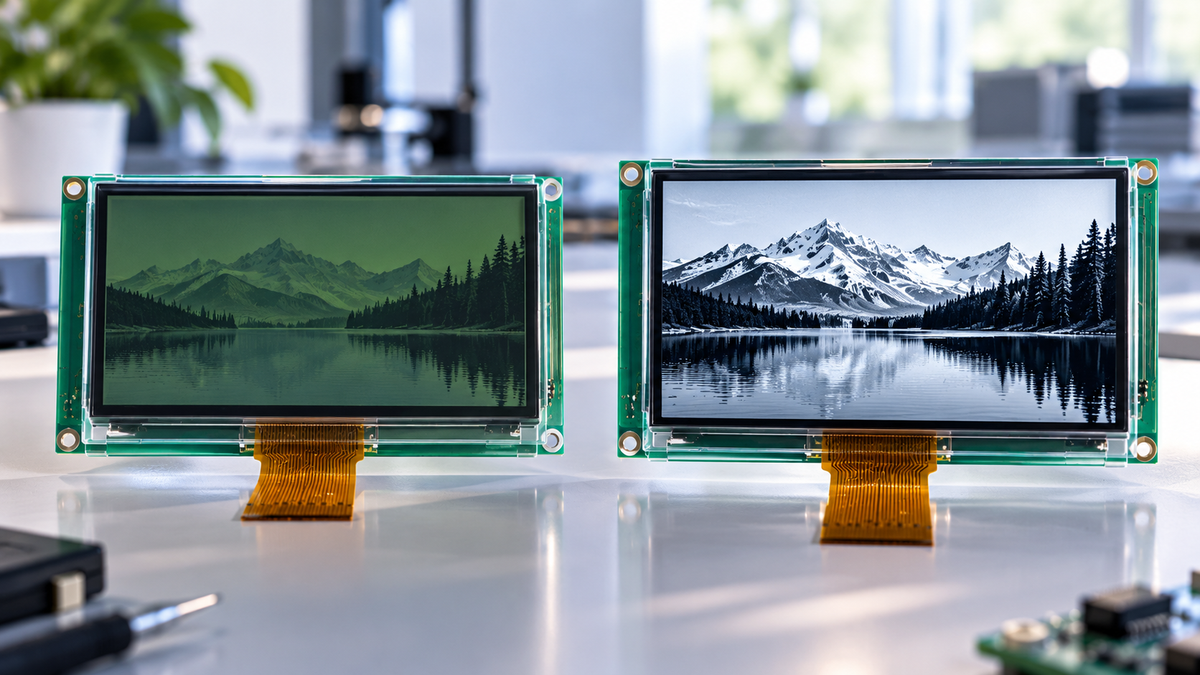
Three cases qualify on their own. You drive 1/16 duty or higher and adjacent segments have to stay separated. The operating floor reaches −20 °C and the panel still has to be legible, slow response accepted. A medical or instrument front cannot show a yellow-green cast.
Bright ambient light is the fourth case, with a condition attached. The cover glass has to be anti-reflective before the film buys anything.
A 128×64 graphic module sells for $5.50 to $7.50 in volume, and FSTN adds 15% to 20%, or $0.83 to $1.50 a piece. Segment displays price per piece rather than per module, so 2 to 5 yuan for STN becomes 5 to 15 yuan for FSTN and the midpoint goes from 3.5 yuan to 10 yuan, a 2.9× jump.
Two problems sit outside the film's reach. Response time at −20 °C stays at 2,700 ms, and a transmissive panel in direct sun still will not read.

The Only Difference Is a Film
The liquid crystal cell is identical on both parts. Twist angle runs 180° to 270°, and 240° is what most factories build.
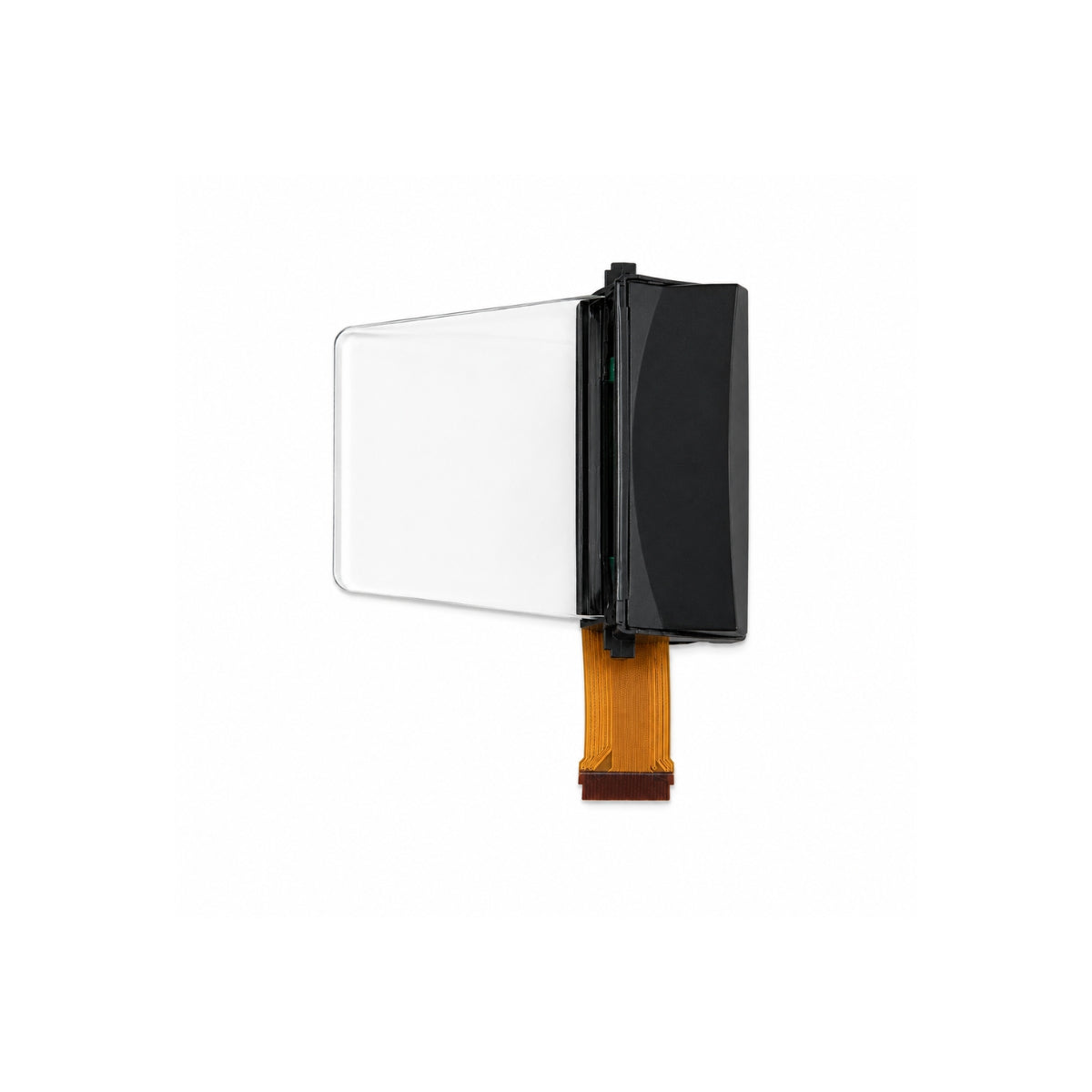
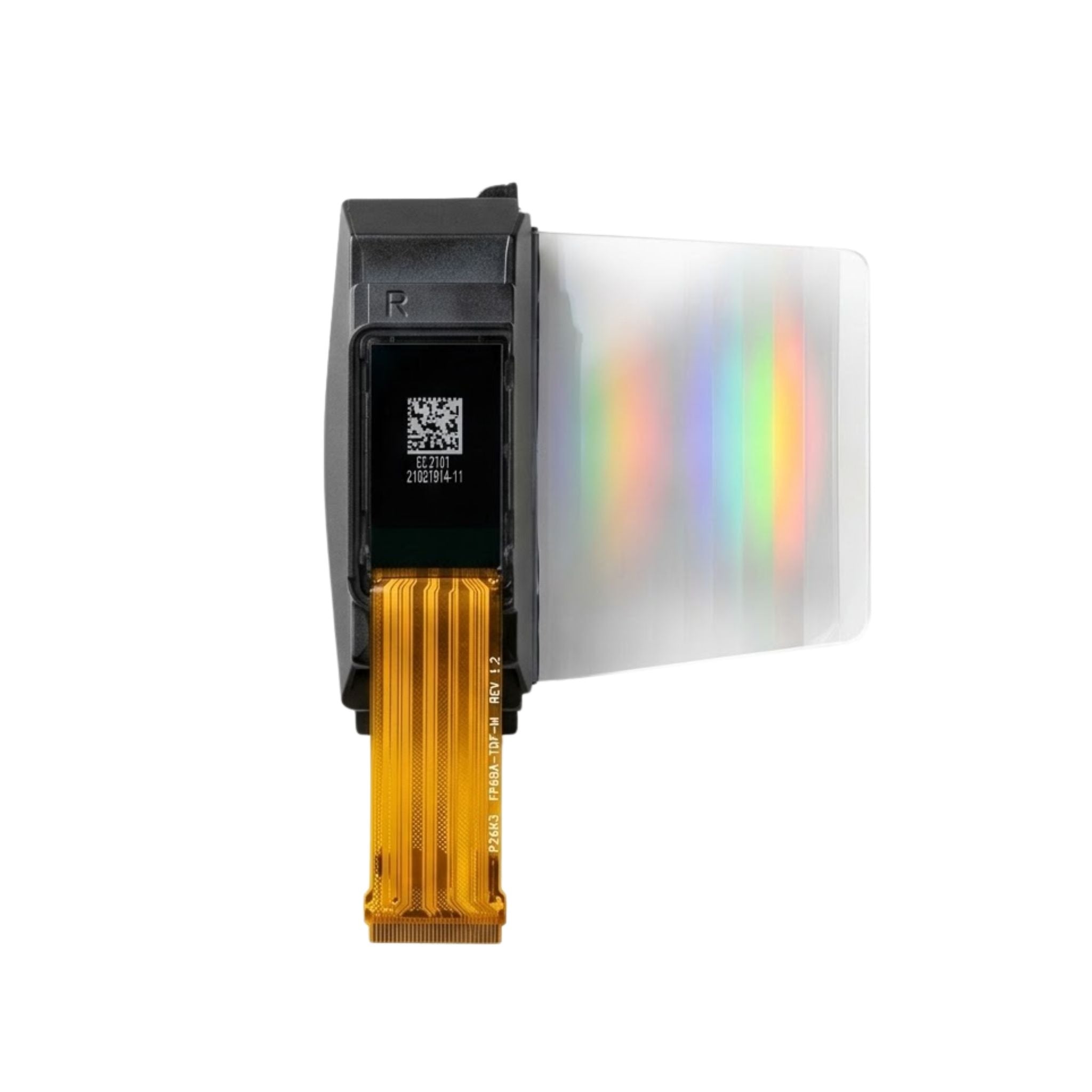
FSTN adds one compensation film between the cell and the rear polarizer. Retardance follows Γ = 2π·Δn·d/λ. With d·Δn at 0.85 μm, light at 550 nm picks up roughly 9.7 radians of phase difference. Nothing cancels that, so the beam leaving the panel carries a yellow-green cast.
The film has to match the cell it sits on. Batch tolerance is held to ±3%. Past that the compensation stops working.
Once the cast is gone the background turns a neutral gray-white. Positive mode becomes black on white, negative mode white on black, and both end up filed under one word on a selection sheet, monochrome.
Inside the cell nothing changed. Thickness, viscosity and the threshold curve are identical to plain STN, so the extra money bought one layer of optical correction.
Everything Else Matches
A single polarizer passes 42% to 46% of light. Two stacked sheets leave 19% in theory. Glass and ITO absorb their share. White-state transmission lands near 15%.
Dot-matrix modules lose another slice to the aperture ratio, usually 60% to 80%. Screen brightness ends up at 9% to 12% of what the backlight delivers.
Static segment panels draw 1 µA to 10 µA. A controller IC pushes a dot-matrix module up to 1 mA to 10 mA, or 5 mW to 50 mW on a 5 V supply.
Why Contrast Numbers Won't Compare
IEC 61747-30-1:2012 replaced the 2004 edition of IEC 61747-6. The method measures the bright state and the dark state in sequence and divides one by the other.[1]
Both readings happen in a dark room. The viewing angle is 0°, and everything except the electrical drive has to hold still between the two measurements.[1]
Reflective panels follow a separate document. IEC 61747-6-2:2011 defines contrast as Yon divided by Yoff and covers reflective modules, plus transflective ones with the backlight off.[2]
Drive conditions move the number as well. The same panel reads differently at 1/16 duty and at 1/240 duty, ambient temperature shifts it again, and none of that appears on the contrast line of a datasheet.
Trade ranges normally run 20:1 to 40:1 for TN, 80:1 to 150:1 for HTN, 40:1 to 60:1 for STN and 100:1 to 300:1 for FSTN, and vendors overlap freely at the edges. Sample those ranges at the ends and FSTN comes in 2.5× to 5× above STN. Polarizers cap the whole family near 300:1, with polarization degree above 99.9%.
Viewing angle figures disagree even more. STN gets quoted anywhere from 40° to 70° by one supplier. The next supplier says 60° to 90°. That gap comes down to the criterion, since some measure at CR above 2 and others at CR above 10. So ask for test conditions. Duty, bias, temperature and ambient light all belong on the datasheet.
How Duty Limits Contrast
A passive matrix lights its rows one at a time in 1/N slices. More rows leave less voltage difference between an on pixel and an off pixel. Alt and Pleshko wrote that ceiling into a single equation back in 1974.
The on-to-off rms voltage ratio tops out at √((√N+1)/(√N−1)), where N is the number of multiplexed lines. That paper calls it the iron law equation and gives two anchor values, 1.0667 at N = 240 and 1.0524 at N = 384.[3]
| Lines (N) | On-to-off voltage ratio | Usable headroom | Optimum bias |
|---|---|---|---|
| 4 | 1.7321 | 73.21% | 1/3 |
| 16 | 1.2910 | 29.10% | 1/5 |
| 64 | 1.1339 | 13.39% | 1/9 |
| 240 | 1.0667 | 6.68% | 1/16 |
| 384 | 1.0524 | 5.24% | 1/21 |
With only 6.68% headroom, the electro-optic curve has to be steep enough to turn that thin slice of voltage into black and white. TN curves fall short. That caps plain TN at 1/4 duty. Off pixels never see zero volts either, so a yellow-green background smears that leftover glow across the panel while a neutral one flattens it into even light gray.
Driver ICs list duty from 1/1 to 1/240 and bias from 1/2 to 1/16. Budget parts stop at 1/16 duty with 1/5 bias, short of anything past 1/64.
Temperature Sends a Second Bill
Measured industry data for a standard STN dot-matrix module gives 80 ms rise and 120 ms fall at 25 °C. That is 200 ms total.
| Ambient | Rise | Fall | Total | Against 25 °C |
|---|---|---|---|---|
| 25 °C | 80 ms | 120 ms | 200 ms | 1× |
| 0 °C | 200 ms | 350 ms | 550 ms | 2.75× |
| −10 °C | 450 ms | 800 ms | 1,250 ms | 6.25× |
| −20 °C | 900 ms | 1,800 ms | 2,700 ms | 13.5× |
| −30 °C | 2,500 ms | 4,500 ms | 7,000 ms | 35× |
The controller pushes a frame every 16.6 ms. At −20 °C a molecule needs 2,700 ms to flip once. That mismatch is what makes scrolling text smear.
Threshold voltage drifts with temperature, usually −0.05% to −0.15% per °C. Going from 25 °C down to −20 °C covers 45 °C and pushes the drive voltage up 2.25% to 6.75%. Compare that with the 6.68% headroom at 1/240 duty. A single temperature point eats the whole margin.
Lower temperature shifts the birefringence along with the threshold, so a fixed drive voltage lands further down the electro-optic curve and the on/off contrast drops. A compensated film holds the off-state nearer neutral gray across that shift. Response speed still follows the mixture.
Clearing points land between 70 °C and 110 °C, Δn sits at 0.08 to 0.24, and rotational viscosity runs 10 mPa·s to 100 mPa·s. Improved formulations hold dV/dT under 7 mV/°C.
Reaching −40 °C takes a low-temperature mixture that won't crystallize. Response time at that temperature needs its own acceptance test. Data taken at 25 °C will not extrapolate.
Full contrast at −20 °C on power-up needs a heater. A 3.5-inch graphic module draws 1.5 W to 2.5 W to hold 0 °C surface temperature in a −30 °C ambient. The module itself draws about 0.05 W at 10 mA. That is 30× to 50× more power, enough to pull a 100-hour battery down to 2 to 3 hours.
Light Matters More Than Mode
Optical type matters first in bright light. Reflective panels build their picture from ambient light, transmissive ones from the backlight. Transflective splits the difference, acting as a reflector in bright light and as a backlit panel in the dark. Both paths give up some transmission.
Indoor lighting runs 300 lx to 500 lx, and an overcast sky outside gives 1,000 lx to 10,000 lx. Midday sun reaches 100,000 lx. The 5 klx and 45 klx thresholds in ISO 15008 land on overcast outdoor light and on sunlight through a side window.
A monochrome module runs 2 to 4 side-lit LEDs at 20 mA each. Anything from 100 cd/m² to 400 cd/m² on screen is enough.
A color panel that has to hold contrast at 45 klx needs 800 cd/m² to 1,000 cd/m² on screen. Color filters cut transmission to roughly 5%, so the backlight has to deliver 16,000 cd/m² to 20,000 cd/m².
Both LEDs run at 20 mA. A yellow-green one drops 1.9 V to 2.2 V, a white one drops 2.9 V to 3.3 V, and the gap between them comes to about 20 mW.
ISO 15008:2017 sets minimum contrast at 2:1 in 45 klx direct sunlight, 3:1 in 5 klx diffuse daylight, 3:1 at 250 lx twilight, and 5:1 below 10 lx at night.[4]
The test procedure comes from SAE J1757/1[5], and the artificial light source follows Table 4 of CIE 85:1989[6] while avoiding fluorescent lamps with sharp spectral spikes.[4]
A 2:1 floor is low because surface reflection decides readability long before the cell's contrast ratio does. Untreated cover glass reflects about 4% specularly. Multilayer AR coating pulls that under 1.5%. At the same illuminance that 4% reflection is brighter than the dark state on screen. A compensated FSTN behind ordinary cover glass therefore loses to a plain STN behind AR glass.
When STN Is Enough
- Content never changes and the panel faces one direction.
- Ambient light under 5 klx, covering dim interiors and shade.
- Duty stays at 1/16 or below, static drive or 1/4 duty, with no need to tell adjacent segments apart.
- The display costs single-digit yuan and the product competes on price.
Thermostat readouts, bench scales, calculators and simple timers live here. Adding FSTN changes none of their readings.
When FSTN Is the Only Answer
- A duty above 1/16 with clean separation between adjacent segments.
- An operating floor at −20 °C or lower, and the content has to stay readable.
- A reflective or transflective panel read above 30 klx, after the cover glass has been given an AR coating.
- Medical and precision instruments want a neutral look with no color cast.
The liquid crystal layer has no organic emitter. Industry figures put continuous life past 100,000 hours. At 24 hours a day that works out to 11 years. A monochrome OLED emitter manages 10,000 to 50,000 hours.
The Options in Between
HTN gets skipped more often than it should. Twist runs 110° to 130°, drive voltage is low, temperature performance holds up, and with no compensation film there is no adhesive layer to fail in the cold.
If your duty stays low but your temperature floor has to drop, HTN is the tier to take. Double-compensated FSTN is the next step up, with cleaner black and white and a higher price.
VA tops the segment range with black backgrounds, white characters and a much wider viewing cone than STN. Black-mask and touch processes live at this tier too. Anything above 4,096 colors, or animated graphics, moves the choice to CSTN or TFT.
What to Put in the RFQ
| Item | Why it has to be nailed down |
|---|---|
| Liquid crystal mode and variant | TN, HTN, STN, FSTN and double-compensated FSTN step up in both price and appearance |
| Optical type | Reflective, transflective or transmissive decides whether it reads in bright light |
| Display polarity | Positive or negative drives the background, the backlight structure and the look of the product |
| Duty and bias | Have to match what the driver IC supports, and they set the contrast ceiling |
| Viewing direction | 6 o'clock or 12 o'clock, aligned with how the panel gets mounted |
| Operating and storage temperature | Decides whether wide-temperature materials add 30% |
| Contrast test conditions | Duty, bias, temperature, viewing angle and darkroom or not |
| Viewing angle criterion | CR above 2 against CR above 10, and the numbers differ a lot |
| Film retardance tolerance | Held to ±3% in normal practice, and past that compensation fails |
| Backlight color and brightness | Yellow-green costs $0.15 to $0.25 less per LED than white |
| Connection type | Metal pins, zebra strip, heat seal or COG changes structure and cost |
| Glass thickness and ITO sheet resistance | Segment panels usually run 1.1 mm glass at 30 Ω/□ to 100 Ω/□ |
| Polarizer type and transmission | Sets the white-state brightness ceiling at 42% to 46% per sheet |
| Driver IC model and duty options | The duty and bias table has to cover the line count on your panel |
| Pin pitch and outline tolerance | Usually 2.54 mm or 2.0 mm, with outline tolerance at ±0.3 mm |
| Reliability test conditions | 240 hours of damp heat at 40 °C / 90% RH, and 5 cycles between −20 °C and +70 °C |
| Sampling plan and defect rate | Common AQL is 0.65 and 1.5, with production defect rates at 0.3% to 1% |
Export or medical use adds two documents. A RoHS report lists lead, mercury, cadmium and hexavalent chromium, four of the 10 substances the RoHS directive restricts,[7] and a REACH report declares any substance of very high concern above 0.1% by weight.[8]
Price, Tooling, and Lead Time
Segment displays split into three price tiers. TN runs 0.15 to 1 yuan a piece, STN runs 2 to 5 yuan, and base FSTN and VA run 5 to 15 yuan. A VA part with a black mask or a touch layer reaches 25 yuan.
Medical-grade wide-temperature parts, −30 °C to 70 °C with IP67 and capacitive touch, quote at 18 yuan on a COG build.
Graphic modules price in dollars. A 16×2 character module runs $1.80 to $2.20 in volume, and a 128×64 graphic module runs $5.50 to $7.50.
Widening operating temperature from −20 °C to +70 °C out to −40 °C to +85 °C usually adds 30% in materials and packaging. Backlight color counts too, since yellow-green runs $0.15 to $0.25 cheaper per LED than white.
Tooling is a separate bill. Standard TN and HTN segment panels run 2,000 to 8,000 yuan, and STN, FSTN and VA go higher, from a few thousand yuan to 20,000.
An 8,000 yuan mask fee spread over 50,000 pieces adds 0.16 yuan a piece. Over 1,000 pieces the same fee adds 8 yuan, level with the panel price at that volume.
Reusing an existing mask and changing only the print or the backlight brings sampling down to 3 to 7 working days. Full tooling takes 15 to 25 working days. Production runs 15 to 30 days.
Minimum order quantities usually land between 1,000 and 5,000 pieces. Volume moves the unit price almost as much as the mode does. A 500 to 1,000 piece trial can quote at 8 yuan a piece, while 50,000 pieces press down to 4 yuan, half the price.
Incoming inspection follows the usual GB/T 2828.1 table, AQL 0.65 for major defects and 1.5 for minor ones. Mature production holds defect rates at 0.3% to 1%. The first few lots off new tooling run 2% to 5%.
What to Check on Samples
- Test on your own driver board. Demo boards usually run 1/4 duty. That setting hides the contrast loss and crosstalk that show up at high duty.
- Measure at 25 °C and −20 °C. Let the cold sample soak before power-up. The first 30 to 60 seconds is the slowest window.
- Set light levels to the real scene, 5 klx for diffuse daylight and 30 klx or more for direct sun. Every character has to read at both.
- Get 3 to 5 samples across batches. Batch variation in the compensation film shows up as a background shift, so one batch looks fine and the next reads a different color.
- Match the driver IC duty and bias table to the panel, 1/16 duty with 1/5 bias and 1/240 duty with 1/16 bias.
- Run 72 hours of continuous aging and watch for missing segments, extra segments, ghosting and background shadowing.
- Supplier reliability reports should cover two conditions, 240 hours of damp heat at 40 °C / 90% RH[9] and 5 temperature cycles between −20 °C and +70 °C.[10]
Common Questions
Why Do Two Suppliers Quote Different Contrast?
Test conditions differ. Duty, bias, temperature, viewing angle and darkroom conditions all feed into the figure, and changing any one of them moves the number.
Does a Negative-Mode Display Need FSTN?
Above 1/16 duty, residual light in unselected segments shows up more easily against a dark background. A neutral off-state holds up better.
Will FSTN Help in Sunlight?
Not for a transmissive panel. It has to become transflective or reflective first. Then accept it at 45 klx with every character readable, and keep cover glass reflectance under 1.5%.
Does FSTN Draw More Power?
The compensation film draws nothing, and passive panel current stays at 1 µA to 10 µA either way. Backlight is where the real difference sits. A white LED drops 2.9 V to 3.3 V at 20 mA.
Miss all of those cases and STN keeps its 6.5 yuan a piece, or 65,000 yuan across a 10,000-piece run.
If you do pay up, put three items in the spec, the d·Δn tolerance at ±3%, the duty and bias used for the contrast measurement, and the definition of viewing angle at CR above 2 or CR above 10.
When your duty, operating floor or appearance requirement lands in one of those cases, the module gets built to spec instead of picked off a shelf. Send over the duty, the operating floor, the light level and your planned volume, and the reply comes back with an STN or FSTN recommendation, a sample plan and the tooling cost.
Send your display spec
Sources and Data Tiers
The cited tier covers four ISO 15008:2017 illuminance levels and minimum contrast values, the SAE J1757/1 test procedure, the CIE 85:1989 solar spectra, and the scope and contrast definitions in two IEC 61747 standards. All of it can go straight into a technical agreement.
Rounding out that tier are the Alt and Pleshko selection ratio, the two IEC 60068 test methods behind the reliability conditions, and the EU RoHS and REACH texts behind the material declarations.
Uncited figures are industry ranges, marked in place with "usually" or "typical". They support selection and price comparison, not acceptance.
That tier covers contrast and viewing angle ranges, glass and ITO, polarizers, liquid crystal materials, ambient illuminance, backlights and LEDs, price and tooling, MOQ and lead time, response time, the 30% wide-temperature premium, reflectance, heater power, sampling and defect rates, reliability conditions, and the film tolerance.
A third tier holds numbers calculated in this article. The headroom and bias table, 9.7 radians of retardance, and the 2.25% to 6.75% voltage drift across 45 °C.
Also in that tier, the 2.9× and 50× ratios, the 9% to 12% white-state transmission, the 16,000 cd/m² to 20,000 cd/m² backlight derived from screen brightness, and the 11 years behind 100,000 hours.
- IEC 61747-30-1:2012 Liquid crystal display devices, Part 30-1, Measuring methods for liquid crystal display modules, Transmissive type. webstore.iec.ch
- IEC 61747-6-2:2011 Liquid crystal display devices, Part 6-2, Measuring methods for liquid crystal display modules, Reflective type. webstore.iec.ch
- P. M. Alt, P. Pleshko, Scanning limitations of liquid-crystal displays, IEEE Transactions on Electron Devices, vol. 21, no. 2, pp. 146-155, 1974. doi.org
- ISO 15008:2017 Road vehicles, Ergonomic aspects of transport information and control systems, Specifications and test procedures for in-vehicle visual presentation. iso.org
- SAE J1757/1, Standard Metrology for Vehicular Displays, 2015 edition, revised as J1757/1_202108 in 2021. sae.org
- CIE 085-1989 Solar spectral irradiance. cie.co.at
- Directive 2011/65/EU on the restriction of the use of certain hazardous substances in electrical and electronic equipment (RoHS). eur-lex.europa.eu
- Regulation (EC) No 1907/2006 concerning the Registration, Evaluation, Authorisation and Restriction of Chemicals (REACH). eur-lex.europa.eu
- IEC 60068-2-78:2025 Environmental testing, Part 2-78, Test Cab: Damp heat, steady state. webstore.iec.ch
- IEC 60068-2-14:2023 Environmental testing, Part 2-14, Test N: Change of temperature. webstore.iec.ch
Laisser un commentaire
Ce site est protégé par hCaptcha, et la Politique de confidentialité et les Conditions de service de hCaptcha s’appliquent.