

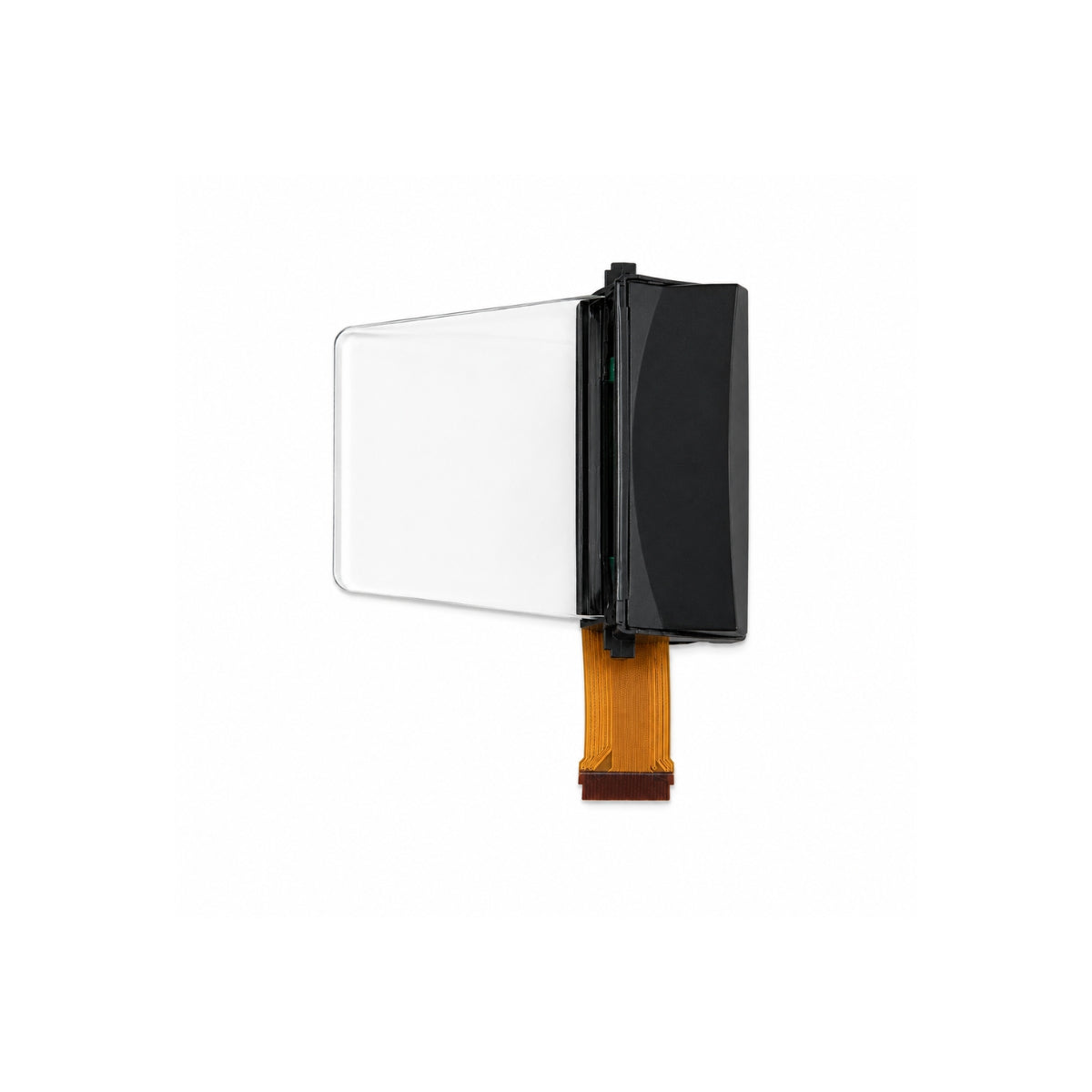
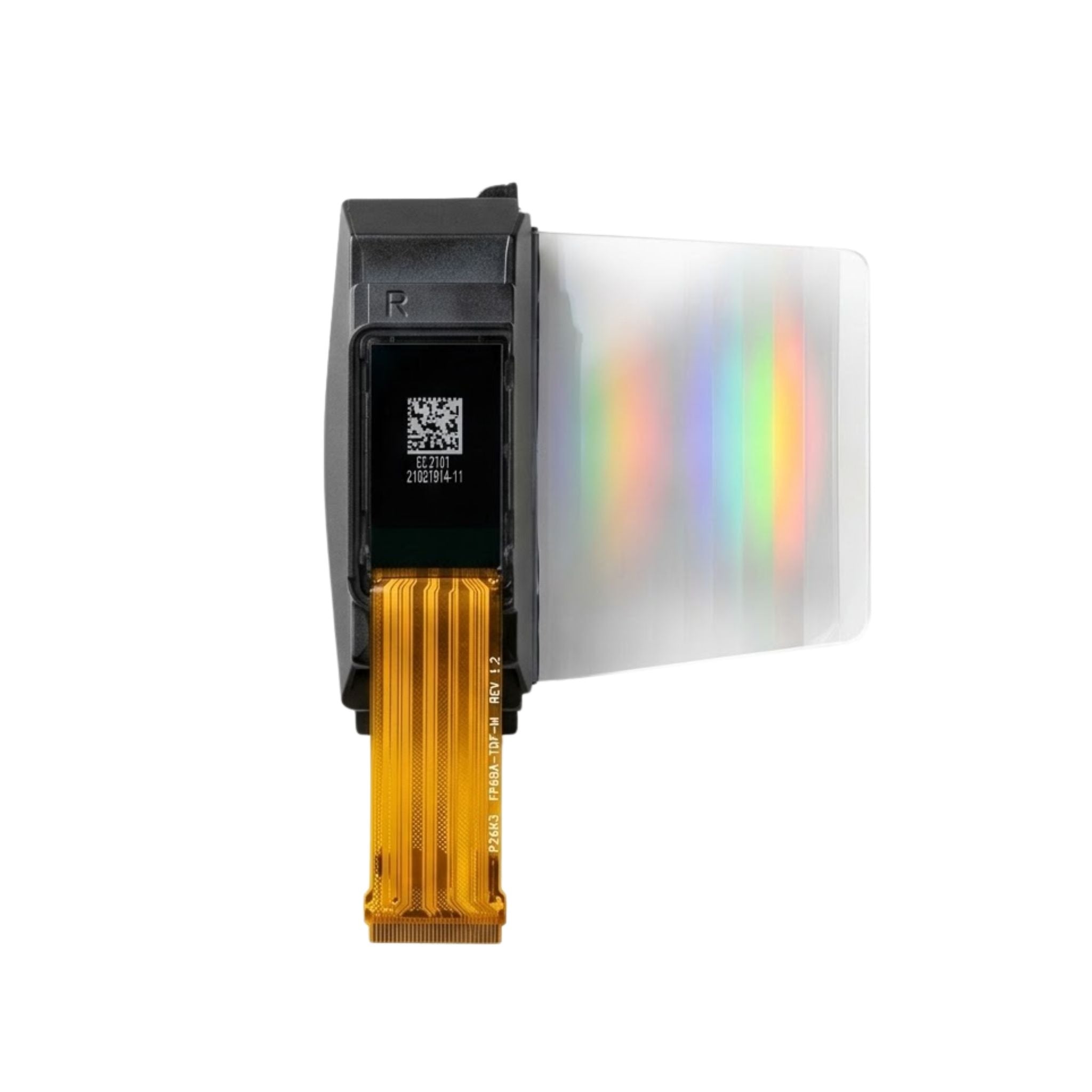


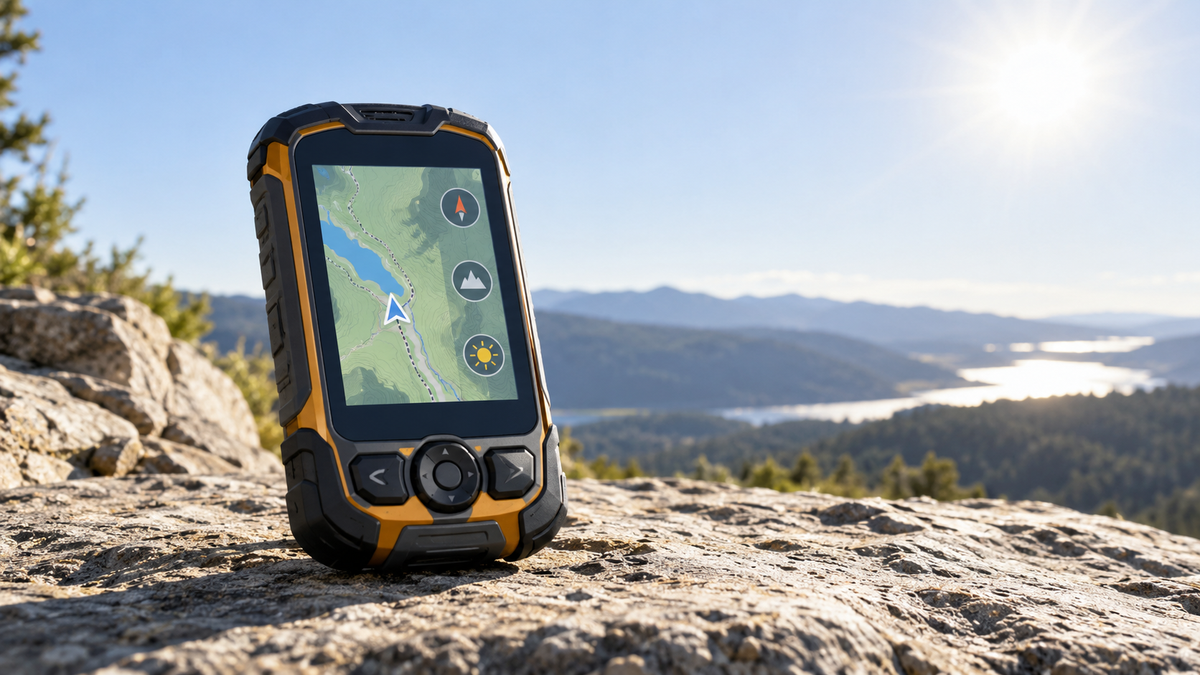
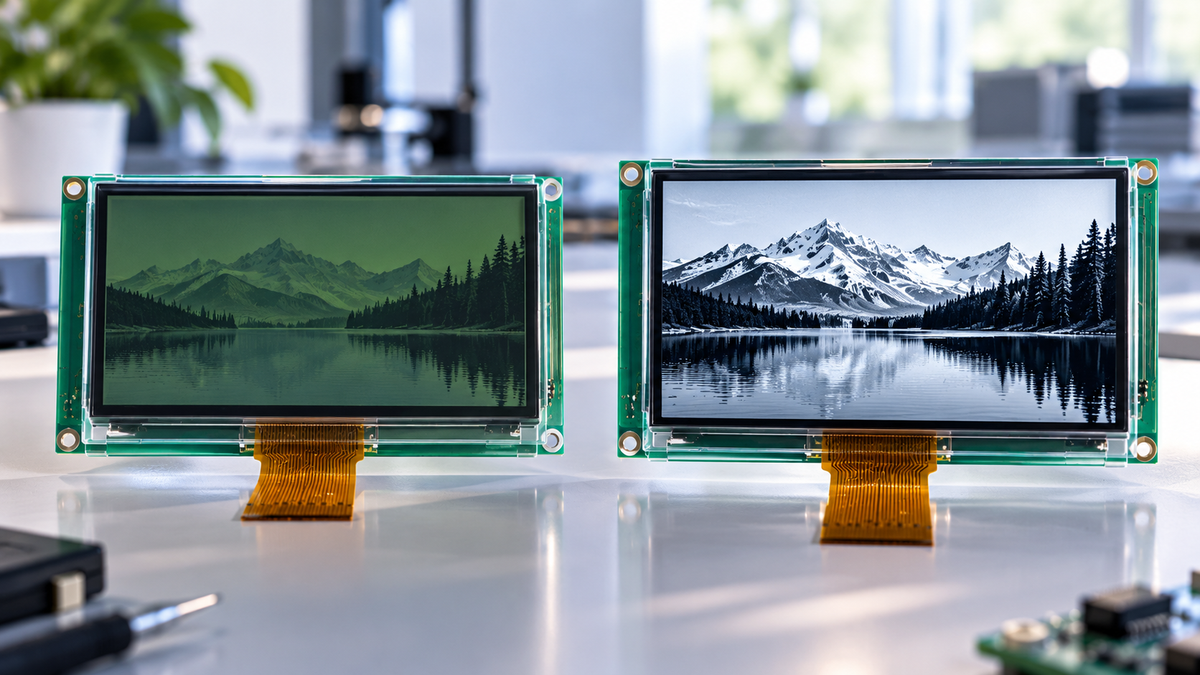
For outdoor equipment the transflective LCD reads better by day, and the high-brightness TFT reads better at night or in full color under direct sun. Dark text on a light background reads faster than the reverse, and that advantage tracks display luminance rather than polarity.[1] A reflective panel harvests ambient light. A transmissive one manufactures its own.
The deciding number is 3,142 lux. Reflective luminance follows L = E × ρ ÷ π with ρ the panel reflectance at 0.30, so 300 × π ÷ 0.30 = 3,142 lux.
The floor sits at 400 lux, where the reflective side returns 38.2 nits and the backlight has to come on.[2] The ceiling sits at 23,562 lux, where front-surface glare on a 300-nit panel equals the backlight outright.
Between those two ends the choice follows the content. Monochrome on a cell goes transflective; color on mains power goes high-brightness TFT.

How each panel makes light
Transflective borrows the ambient light
A transflective polarizer splits each pixel into a reflective region and a transmissive one. The usual cut is close to 50/50 of pixel area. The reflective side bounces ambient light back through the liquid crystal to your eye. The transmissive side lets the backlight through.
At noon under 100,000 lux the reflective section delivers 100,000 × 0.30 ÷ π = 9,549 nits, which is 31.8× a 300-nit backlight.
Mainstream transflective modules sit between 2.0 and 3.5 inches, a 3.06× area spread. Most of them carry monochrome content.
High-brightness TFT piles on backlight current
A high-brightness TFT is fully transmissive. Ambient light doesn't play a part in the image, so 100% of every pixel's brightness comes from the backlight. Outdoors you're buying legibility with current.[3]
Semi-outdoor runs 800 to 1,200 nits. Full outdoor under direct sun needs 1,500 to 2,500 nits. Industrial high-brightness modules reach 4,000 nits.
At 3,000 nits a large outdoor advertising panel burns 850 to 1,200 W. Module-level gear scales down from there.
The crossover sits at 3,142 lux
With ρ held at 0.30, reflective luminance tracks illuminance linearly.
| Ambient illuminance | Typical scene | Reflective luminance | Backlight needed |
|---|---|---|---|
| 300 lux | Indoor night lighting | 28.6 nits | Yes |
| 400 lux | Dim corridor | 38.2 nits | Yes |
| 500 lux | Office lighting | 47.7 nits | Yes |
| 1,000 lux | Overcast day | 95.5 nits | Yes |
| 3,000 lux | Bright dusk | 286.5 nits | Borderline |
| 5,000 lux | Overcast outdoors | 477.5 nits | No |
| 10,000 lux | Full daylight | 955 nits | No |
| 20,000 lux | Hazy bright sky | 1,910 nits | No |
| 100,000 lux | Direct sun | 9,549 nits | No |
The 500-lux office figure comes from ISO/CIE 8995-1. That step yields 47.7 nits, 6.3× short of 300 nits.[4] Drop to 400 lux and the yield falls to 38.2 nits, where the backlight takes over.
At 3,000 lux the reflective side reaches 286.5 nits. Another 4.7% of light gets you to 3,142 lux, and the backlight can then go dark.
Glare is the real opponent
Front-surface reflection is what trips a high-brightness TFT outdoors. At 300 nits of backlight, bare glass reflecting 4% at the Fresnel boundary sets glare at L_g = E × R ÷ π.[5]
At 500 lux glare lands at 6.4 nits, 2.1% of the backlight. Ignore it. At 10,000 lux glare climbs to 127 nits, 42.4% of the signal, and your blacks turn grey.
At 100,000 lux glare hits 1,273 nits, 424% of the signal. Contrast drops below 1:1 and the screen's finished.
Hold glare under 20% of the signal and the backlight you need solves from L ≥ E × R ÷ (π × 0.2). 10,000 lux takes 636 nits. 20,000 lux takes 1,273 nits.
A 300-nit panel's glare headroom runs out at 4,712 lux, and at 23,562 lux the glare equals the backlight itself. An 800-nit panel holds out to 12,600 lux.
An anti-reflective coating drops reflectance from 4% to 1%, a 4× cut, or to 0.5%, an 8× cut.[6] At 10,000 lux the reflected luminance falls from 127 nits to 31.8 nits.
Contrast numbers lie a little
What your eye reads outdoors is modulation depth, M = (CR − 1) ÷ (CR + 1). A 4:1 ratio lands at 60.0%, 8:1 at 77.8%, 15:1 at 87.5%.
Higher up, 100:1 lands at 98.0%, 300:1 at 99.3%, 800:1 at 99.8%. The label climbs 2.67× between 300:1 and 800:1 while modulation depth moves 0.5 of a percentage point.
Outdoor legibility is judged by ambient contrast ratio, and the floor's 5:1. Above 50,000 lux, killing surface reflectance does far more than driving backlight current.
Power hinges on whether the backlight can switch off
A transflective panel can switch its backlight off in daylight and leave only the driver drawing current. At 3.3 V and 2 mA that's 3.3 V × 0.002 A = 6.6 mW, or 0.16 Wh across 24 hours.
A high-brightness TFT can't do that. Take a 3.2 V twin-string, 20 mA backlight branch: 2 × 3.2 V × 0.02 A = 0.128 W.
Run it 24 hours and you're at 0.128 W × 24 h = 3.07 Wh. A 1,000 mAh, 3.7 V cell holds 3.7 Wh, so the backlight alone eats 83% of it.
Push brightness from 300 to 800 nits and current climbs 2.67×. Power becomes 0.341 W, or 8.19 Wh a day, more than twice the whole cell's capacity.
Same 3.7 Wh cell: 0.16 Wh a day on transflective by daylight, 8.19 Wh a day on high-brightness TFT. That's a 51× spread in runtime.
Temperature range decides survival
A sealed enclosure runs 15 to 20 ℃ hotter than ambient in sun. A desert excavator panel sees 70 ℃ at the surface.
Standard liquid crystal clears at around 75 ℃, and past that point the material turns isotropic and the screen goes black.[7] Wide-temperature formulations push the clearing point to about 105 ℃. That's what holds up the 85 ℃ ceiling in the table.
| Tier | Operating | Storage | Typical fit |
|---|---|---|---|
| Consumer | 0 to 50 ℃ | -20 to 60 ℃ | Indoor handhelds |
| Semi-wide | -10 to 60 ℃ | -20 to 70 ℃ | Sheltered outdoor |
| Standard wide | -20 to 70 ℃ | -30 to 80 ℃ | General outdoor |
| Ultra-wide | -40 to 85 ℃ | -40 to 90 ℃ | Vehicle and polar |
ISO 16750-4 sets the climatic load for road-vehicle electronics at -40 to 85 ℃.[8]
Sealed outdoor units also face damp heat at 85 ℃ and 85% RH,[9] plus sinusoidal vibration[10] and mechanical shock.[11]
At -20 ℃ viscosity climbs from 20 to 30 cP at room temperature to over 300 cP. Response time stretches from 8 ms to 500 to 800 ms. That's a 100× worst case.
Color and resolution
The reflective region takes about half the pixel area on a transflective panel. That nearly halves the transmitted light.
A high-brightness TFT is fully transmissive, with an aperture ratio near the ceiling. At the same 3.5 inches, 262K colors or better isn't a structural problem. Map overlays and color-graded instruments leave you with TFT.
Digits, status icons and QR codes are monochrome work. There a transflective panel trades aperture for a backlight that can go dark, cutting the cell share from 83% to 4.3%.
Cost and minimum order
| Dimension | Transflective LCD | High-brightness TFT |
|---|---|---|
| Image source | Ambient reflection plus backlight | Backlight |
| Daylight legibility | Good, backlight can go dark | Needs a 1,500 to 2,500 nit backlight |
| Night legibility | Backlight on, dimmer output | Good |
| Color and resolution | Mostly monochrome or low color count | Full color, high resolution |
| Power | Can drop to zero by day | 0.128 W or more, continuous |
| Common sizes | 2.0 to 3.5 inches | 3.5 inches and up |
| Cost center | Polarizer and structure | Backlight and heat |
Rated brightness is measured on a new unit at 25 ℃. LED backlights fade 3% to 5% a year under continuous high-temperature running. Design in a 20% margin and the 1,500-nit outdoor tier's rated at 1,875 nits.
Selection rules
- Daylight-only outdoor gear, monochrome content, battery power: go transflective LCD and let the backlight sit off by day.
- Full color, maps or a graphical UI under direct sun: go high-brightness TFT at 1,500 nits or more, with an anti-reflective coating.
- Any unit spanning -20 to 70 ℃ needs wide-temperature liquid crystal either way, and vehicle work budgets for -40 to 85 ℃.
- Fixed outdoor equipment lit all day: solve the ambient contrast floor first, then work back to the backlight current and heat you'll need.
- Surface reflectance of the module: 4% on bare glass or 1% coated.
- Confirm whether rated brightness came off a new 25 ℃ unit or already carries a 20% derating margin.
- Pin down the wide-temperature tier, whether semi-wide, standard or ultra. The three span 70 ℃, 90 ℃ and 125 ℃.
The 47.7-nit office step sits below that line. The 9,549-nit noon step sits above it.
Three numbers are enough: your ambient illuminance band, whether the content is monochrome or full color, and whether the unit runs on a cell. Send those and you get back an outline drawing with the reflectance spec, the backlight current and the temperature tier priced in.
댓글 남기기
이 사이트는 hCaptcha에 의해 보호되며, hCaptcha의 개인 정보 보호 정책 과 서비스 약관 이 적용됩니다.